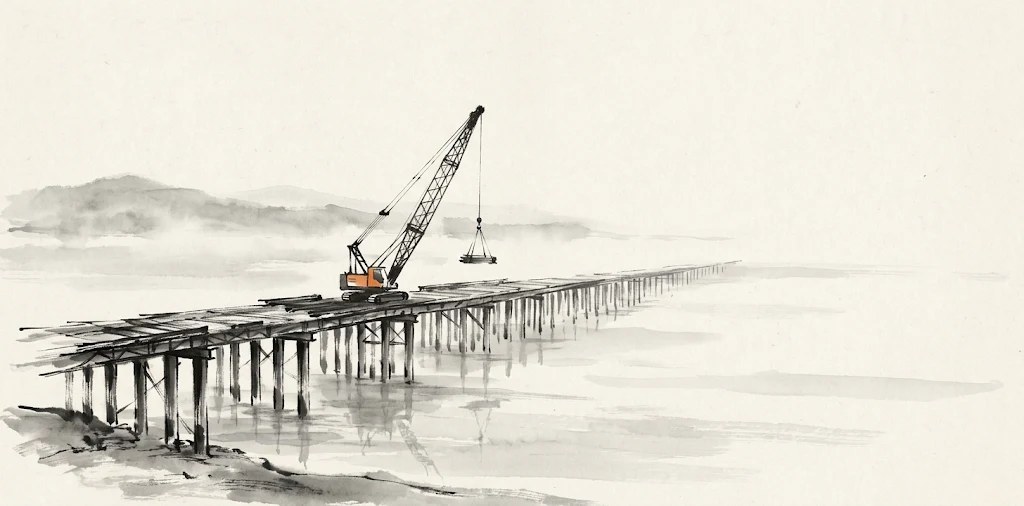
Field notes: what to watch for
The crane over the side governs: one track carries most of the crane and its load, so keep heavy lifts to the shorter spans or lay crane mats across several girders. Check the soil before the steel: in soft clay the piles grow long, and a borehole changes the answer more than any girder size. Plan the removal from the start, because extracted piles are worth money and cut ones are not.
Inputs are saved on this device · reset to defaults
How the trestle tool works
The girders are simply supported between bents and the deck spans between girder lines, so each crane track or wheel line is shared between the two girders beside it (lever rule). Moving loads are run along each span for the largest moment, shear and reaction. Girders and twin cap beams are rolled H-beams checked to AISC 360-16 (flexure with lateral-torsional buckling between cross bracing, shear, the web over the support with bearing stiffeners where needed, deflection under live load). The cap beam is analysed as a continuous beam on the piles for every transverse position of the crane or trucks.
Piles are driven open-ended steel pipes with a corrosion allowance. They are fixed below the scoured bed at the depth to fixity of Davisson and Robinson, braced in each bent above the water, and checked for axial load with bending, buckling and a thin wall where the diameter-to-thickness ratio is high. The embedment comes from the same pile engine as the Pile capacity tool (driven pile method), with half the plugged end bearing for an open pipe and a factor of safety of 2.5 against dead plus live load. Wind follows ASCE 37 for a short service period, and current acts on every pile; waves, ship impact and earthquake are not included.
The cost has four parts: building it (piles, girders, caps, bracing, deck, piling and erection), keeping it over the service period, removing it, and the steel recovered at the end. The same engine runs inside Bridge Design, where the trestle of a marine bridge is designed for the crane that lifts the heaviest girder. Related: temporary trestle construction, pile capacity, wind load, HL-93.
Questions
What is a temporary trestle?
A temporary steel bridge built beside or along the line of a new bridge so that piling rigs, cranes and trucks can reach the work over water or soft ground. It stands on driven steel pipe piles, carries rolled steel girders and a deck of steel panels or precast planks, and is taken down and the steel recovered when the bridge is finished.
How far apart are the piles of a trestle?
Spans of 6 to 15 m between bents are usual. Heavy crawler cranes need shorter spans (6 to 9 m for 200 to 400 t cranes), light traffic trestles run to 12 to 15 m. The tool designs every span in its list and keeps the cheapest that passes.
What crane can a trestle carry?
Any crane the girders, caps and piles are sized for. The tool turns the crane weight, the lifted load and the share of the load chart used into track loads; lifting over the side puts most of the weight on the near track, which usually governs the girders.
How much does a temporary trestle cost?
It depends mostly on the crane, the water depth and the soil. The tool prices the steel, the deck, piling and erection, upkeep over the service period and removal, and subtracts the value of the steel recovered at the end; the rates are generic placeholders you should replace with local prices.
How is a trestle removed?
The deck and girders are lifted off bay by bay working back to the shore, then the piles are extracted with a vibratory hammer or cut below the bed. Extracted piles and the girders can be reused or sold; the tool counts that as recovery.