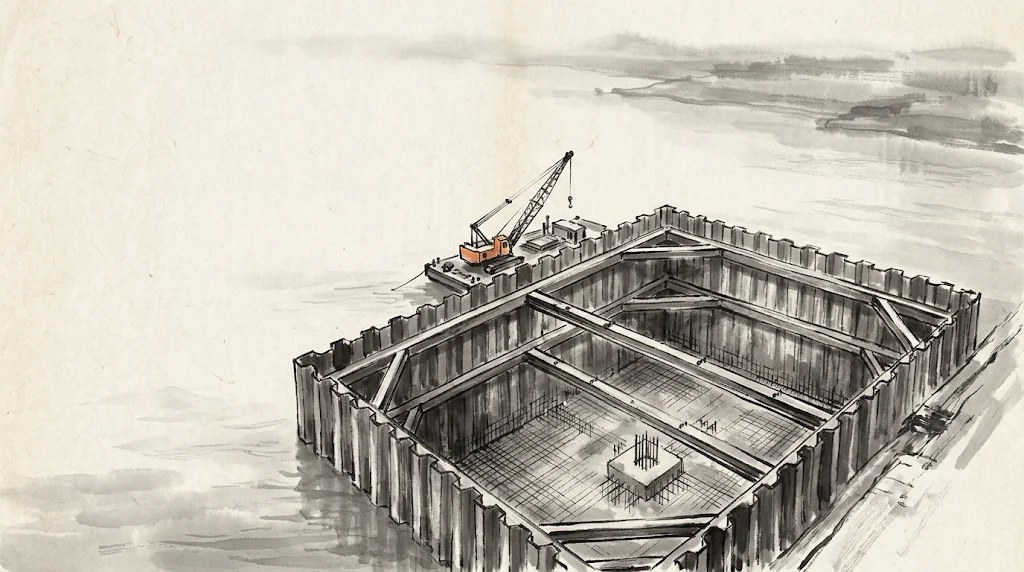
Field notes: what to watch for
Cofferdams fail at the bottom and at the joints: a frame fitted late, a dig taken below the next frame, boiling sand at the toe, a seal pumped out before it has gained strength. Watch the water level outside against the freeboard, keep standby pumps, survey the frames for movement, and flood the cofferdam on purpose before a flood overtops it.
Inputs are saved on this device · reset to defaults
How the cofferdam tool works
Water presses on the outside of the wall at its full depth. In sand the ground adds active earth pressure and, once the inside is pumped down, water seeps round the toe: that lowers the passive resistance inside and can lift the bottom of the dig (piping). In clay the tool works in total stress with the undrained strength and assumes water gets into the gap behind the wall.
The wall is analysed stage by stage. The top frame goes in first, above the water; each lower frame is fitted before the water or the dig goes below it. Between frames the wall is taken as simple spans; below the lowest frame it is held by the ground in front of the toe, with the passive side reduced by 1.5. Sheet piles are chosen from JIS U sections (at 80 % of their modulus) and steel pipe sheet piles; walings and struts are checked to AISC 360-16 with a factor of 1.5 on the pressure, using the same member functions as the Trestle tool.
Two schemes are designed and priced: pumped dry, and dug in the wet with a tremie seal. The seal is the default in sand under open water with more than 4 m of head. The same engine prices the cofferdams of piers in water in Bridge Design. Related: pile capacity, scour, footing, falsework.
Questions
What is a cofferdam?
A temporary watertight enclosure that lets a pier foundation be built in the dry below the water level. For bridge piers it is usually a box of interlocking steel sheet piles driven into the bed and braced inside by frames of walings and struts.
How deep must the sheet piles go below the dig?
Deep enough for three things: the ground in front of the toe has to hold the wall below the lowest frame, the seepage path round the toe has to be long enough to stop piping in sand, and in clay the base must not heave. The tool finds the embedment that meets all three with a factor of 1.5.
When is a tremie seal needed?
When the dig cannot be pumped dry safely: free-draining sand or gravel under open water, or soft clay that cannot hold a pumped dig. The ground is dug out under water, a concrete plug is placed by tremie, and the water is pumped out after it has hardened.
How thick is a tremie seal?
Thick enough that its weight, with its bond to the foundation piles and the sheet piles, holds down the water pressure underneath. Without piles that is roughly 0.4 to 0.45 times the head to the underside of the seal; bond to the piles makes it much thinner.
How are the bracing frames sized?
The wall is checked at every stage: each frame is fitted before pumping or digging goes below it. Each frame takes the largest reaction it sees at any stage; the walings span between the struts in bending and the struts work as columns.