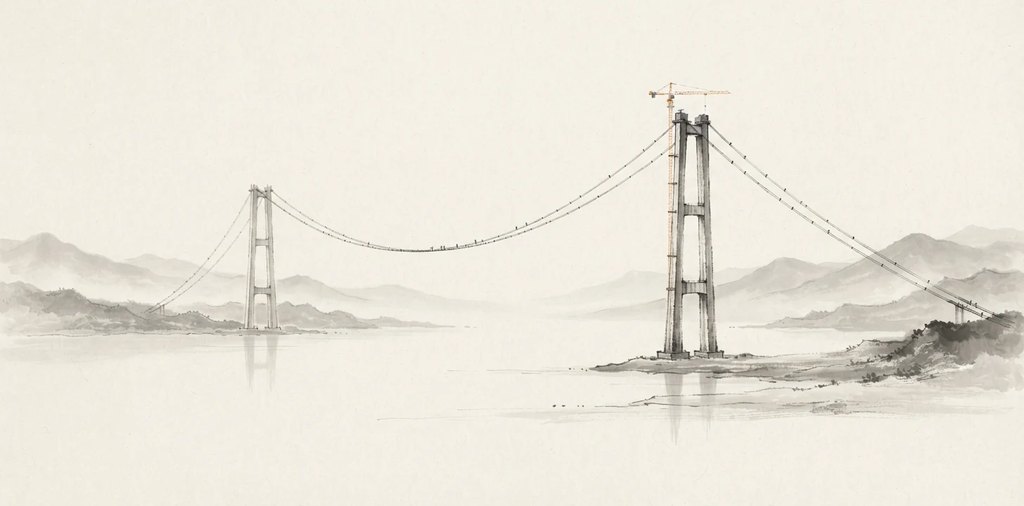
Field notes: what to watch for
Adjust the sag at night or at dawn, when the ropes and the towers are at one temperature, and adjust the ropes of a catwalk relative to each other before chasing the absolute level. Mark the ropes at the saddles before loading the floor, so that any slip shows. A catwalk without storm ropes or cross bridges swings a long way in strong wind: clear it well before the limit.
Inputs are saved on this device · reset to defaults
How the catwalk rope tool works
The main cable is taken as a free cable: a catenary with the sag you give in the main span, and the same cable hanging between the tower top and the anchor in each side span. The catwalk ropes follow it a fixed distance below. For each span the tool finds the unstressed length of rope that hangs to that curve under the weight of the finished catwalk, treating the rope as an elastic catenary.
With the lengths fixed, the load cases are run on the three spans together. The tower tops are not rigid: each moves along the bridge in proportion to the difference of the pulls on its two sides, which lengthens one span and shortens the next. Working is the catwalk with people, equipment and, for PPWS, a strand in transit, at the cold end of the temperature range for the tension and the hot end for the sag. Storm is the empty catwalk under the peak wind pressure of EN 1991-1-4. The number of ropes is the fewest that keeps the factors of safety you ask for.
The adjustment table and the survey angle come from the same model, by changing one thing a little and solving again. Related: suspension bridge records, how a suspension bridge is erected, bridge cables, wind load, Bridge Design.
Questions
What is a catwalk on a suspension bridge?
A temporary footbridge hung under each main cable, from anchor to anchor over both tower tops, so that people and machines can reach every metre of the cable while it is built. It is a mesh floor a few metres wide carried by a group of ropes, with handrails, cross bridges to the other catwalk and, later, the frames and rollers of the hauling system.
How much do the catwalk ropes carry?
Their own weight, the floor and its fittings, the people and equipment on it, and the wind. With prefabricated strands (PPWS) there is one more load: the strand being hauled rides on rollers on the catwalk until it is lifted into place. With air spinning the wires hang clear of the catwalk. In both cases the finished part of the cable hangs free and the catwalk does not carry it.
Why does the catwalk follow the cable?
The work is done by hand at the cable, so the floor has to stay about a metre and a half below it along the whole length. The ropes are therefore cut so that, under the weight of the finished catwalk, they hang in the same curve as the free cable. This tool sets the rope lengths from that condition.
How is the sag of a catwalk rope adjusted?
By length. A rope that is 10 mm longer between the tower tops hangs lower by roughly 3 L / (16 f) times as much, about 15 to 20 mm in a main span and more in a side span. Temperature does the same thing through thermal expansion, and so does any movement of the tower tops. The adjustment table gives these figures for each span.
How is the sag checked on site?
One common way is the tangent method: from a point of known position and level, find the vertical angle at which the line of sight just touches the rope from below. The angle is sensitive to the sag, it needs no target on the rope, and it can be read on all ropes one after another. The tool gives the angle for the rope at its design sag.