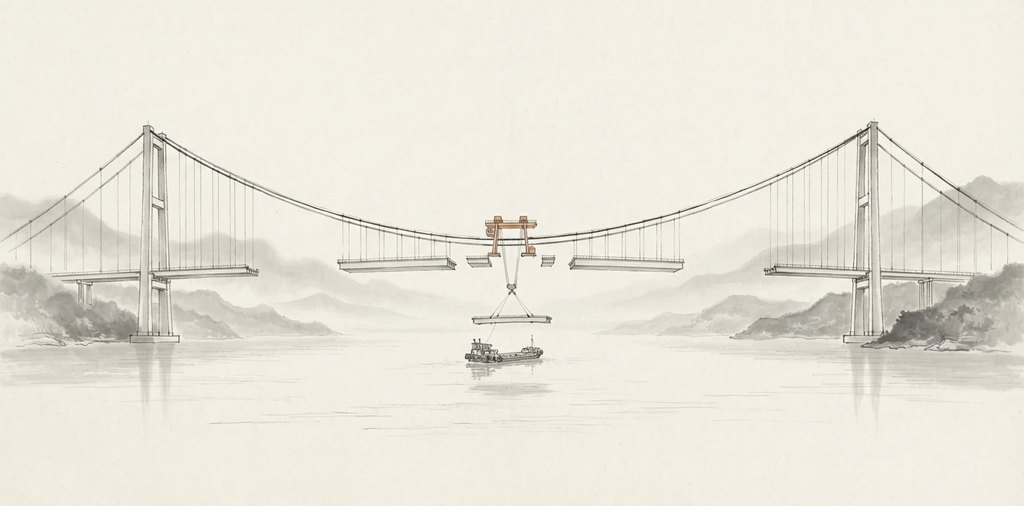
Field notes: what to watch for
Geometry is controlled by length and level, not by force: strands are set by sag, hangers are made to length, and the deck is welded only when its curve is close to final. Survey at night, when cable, deck and towers are at one temperature. Move the saddles in the planned steps and check the tower tops each time.
Inputs are saved on this device · reset to defaults
How the erection simulator works
It starts from the finished bridge. Under the full dead load the cable has its design sag, and each cable band sits above its hanger. That fixes the unstressed length of the cable and the place of every band on it. Every earlier day is the same cable with less load on it.
For each day the cable is solved as a chain of elastic catenary pieces between the bands, with the weight of the segments already lifted hanging at their bands. The saddles are placed where the horizontal pulls of the main span and the side spans balance, which gives the set-back. The deck is drawn hanging from its hangers with hinged joints until it is welded.
The programme puts the works in site order and gives each a duration: the cable from the steel placed per working day, slower at the start; the deck from the segments lifted per day; welding from the time two thirds of the deck is up. Details: catwalk ropes. Related: how a suspension bridge is erected, suspension bridge records, bridge cables.
Questions
In what order is a suspension bridge built?
Towers and anchorages first. Then the saddles go on the tower tops, a pilot rope crosses the water, and a footbridge called the catwalk is hung where the cable will be. The main cable is built on it, strand by strand or wire by wire, then squeezed round. Bands and hangers follow, the deck is lifted in segments and welded, the cable is wrapped, the road is surfaced and the catwalk comes down.
Why do the saddles start set back?
The bare cable pulls much less than the finished one, and the side-span cables are shorter and stiffer than the main span. If the saddles sat in their final place, the two sides would pull unequally and bend the towers. So the saddles start offset towards the side spans, where the pulls balance, and are moved forward in steps as the deck load arrives.
Why does the cable change shape while the deck is lifted?
A cable has no stiffness of its own: it takes the shape of its load. The first segments are a few heavy points on a light cable, so the cable drops under them and rises elsewhere. Only when the whole deck hangs on it does it settle to a smooth curve, and the surfacing brings it down to the finished line.
Why lift from mid-span, or from the towers?
From mid-span outward, the middle of the cable comes down first and the deck hangs near its final shape early, which suits hinged temporary joints. From the towers inward, the middle of the cable first rises well above its free shape before it comes down. The choice also depends on water depth, access for barges and the lifting equipment.
How long does the cable and deck work take?
Often between one and two years for a long span. The example here takes about seventeen months, with one day in five lost to weather. The cable time follows the tonnes of steel placed per day, the deck time the segments lifted per day. The durations on this page are indicative and you should replace them with your own.