How bridges get built · Ground improvement · Vibro-compaction
Also called: vibroflotation, deep vibratory compaction
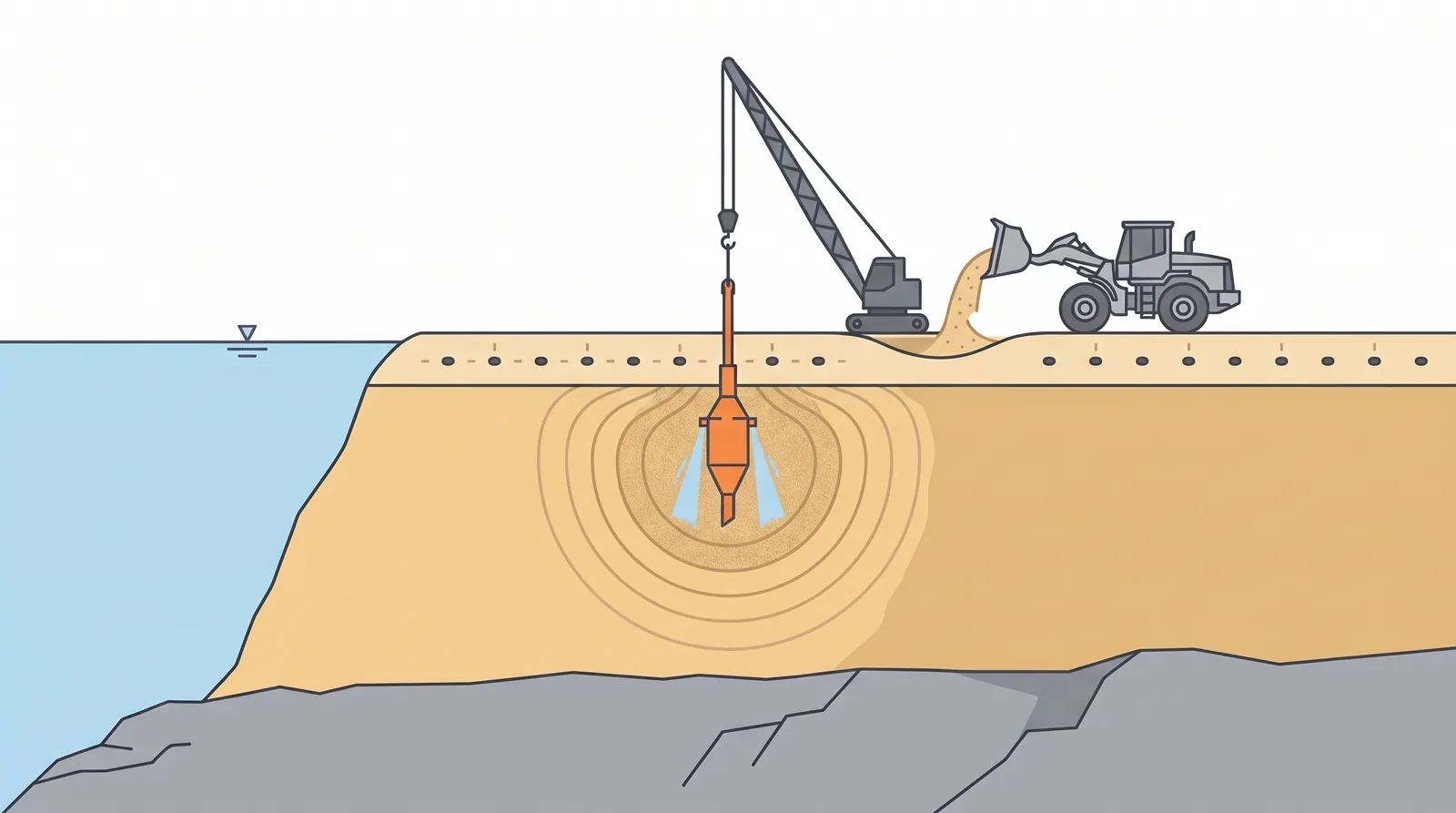
How it is done
- Set a grid of 2.5-4 m; penetrate with the vibroflot and water jets to the treatment depth.
- Withdraw in steps, holding at each until the amperage shows compaction; feed sand at the surface to fill the crater.
- Verify with CPT between the points against the target cone resistance.
Where it fits
- Clean sands with less than 10-15 % fines, reclaimed fill, hydraulic fill under approaches and abutments.
- Depths to 30 m.
Where it does not
- Silty or clayey sands; fines stop the densification. Use stone columns or dynamic compaction instead.
Plant, pace and money
PlantVibroflot on a crane, water supply, loader for sand feed.
ProductivitySeveral thousand square metres per rig per week.
CostUSD 10-25 per square metre for 10-15 m treatment.
Risks and controls
What goes wrong
- Settlement of the surface during treatment affecting nearby structures.
- Fines content higher than the investigation showed.
Quality assurance
Pre- and post-treatment CPT on a fixed grid; amperage records per point.
Examples
Reclaimed islands and coastal approaches in the Gulf, Singapore and Korea.
Related methods
Further reading
Mitchell and Jardine, A Guide to Ground Treatment (CIRIA C573)