How bridges get built · Steel erection · Temporary towers and bents for steel erection
Also called: temporary support towers, falsework bents, shoring towers
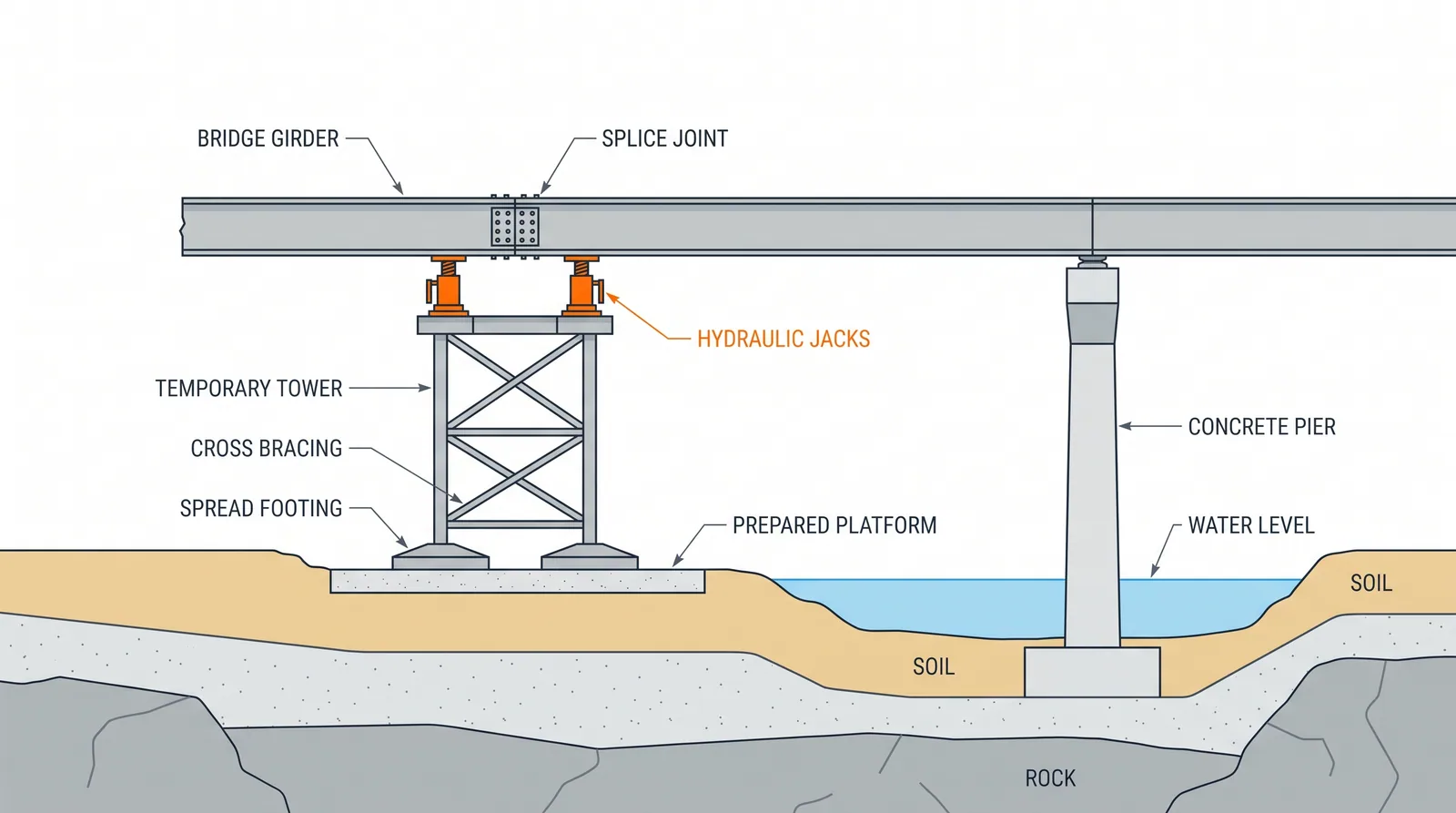
How it is done
- Found the towers on spread footings, mats or driven piles; brace them longitudinally and laterally.
- Set girder sections on the towers with adjustable heads; complete splices; release the towers by jacking down after the span is continuous and the deck is placed if the design requires.
- Remove and reuse.
Where it fits
- Steel spans over 40-50 m erected by crane, spliced girders, arch rib assembly.
Where it does not
- Deep water, navigation routes, soft ground without piles, positions in the traffic below.
Plant, pace and money
PlantModular tower systems (e.g., heavy-duty shoring), jacks, foundations.
ProductivityDays per tower.
CostUSD 50,000-300,000 per tower depending on height and foundation.
Risks and controls
What goes wrong
- Settlement changing the girder geometry, buckling under wind, vehicle impact.
Quality assurance
Temporary works design and check, foundation verification, jack-down sequence.
Examples
The game's spliced girder and steel crane erection assume towers where spans exceed the crane reach.
In the bridge game
What Bridge Master applies when you pick it
Deck types: Steel plate girder, Steel box girder, Orthotropic steel box, Steel truss, Steel arch, Network tied arch, Spliced PSC girder. Spans 50-120 m, up to 160 m.
- +35: The standard way to erect steel spans too long for one lift.
- +25: Tied arches and ribs are assembled on bents, then the bents come out.
- +15: Spliced precast girders on towers: the concrete cousin of the same method.
- -25: A single crane lift does it; bents add nothing.
- +10: Bents on spread footings, cranes on the ground.
- -10: Bents on temporary piles from a trestle: fine, slower.
- -35: Bents in deep water are a marine job; launch, float or cantilever instead.
- -30: No bents in the navigation channel: the channel span must be lifted or closed in one piece.
- -25: Bents in the rail corridor only in possessions; usually launch or slide instead.
- -25: Bents over 40 m tall are towers in their own right.
- -40: Bents in the water where in-water works are banned.
- -15: Bents standing through the flood season: debris and scour.
- -10: Long unbraced girders on bents in high wind: tie-downs and bracing sequence matter.
- not allowed: Temporary bents in the water where in-water works are banned.
Related methods
Crane erection of steel girdersSpliced precast girders on temporary towersFalsework and temporary works engineering
Further reading
AASHTO/NSBA Erection Guide · BS 5975