How bridges get built · Site investigation and testing · Scour investigation and hydraulic study
Also called: hydraulic analysis, bed material sampling, flood modelling
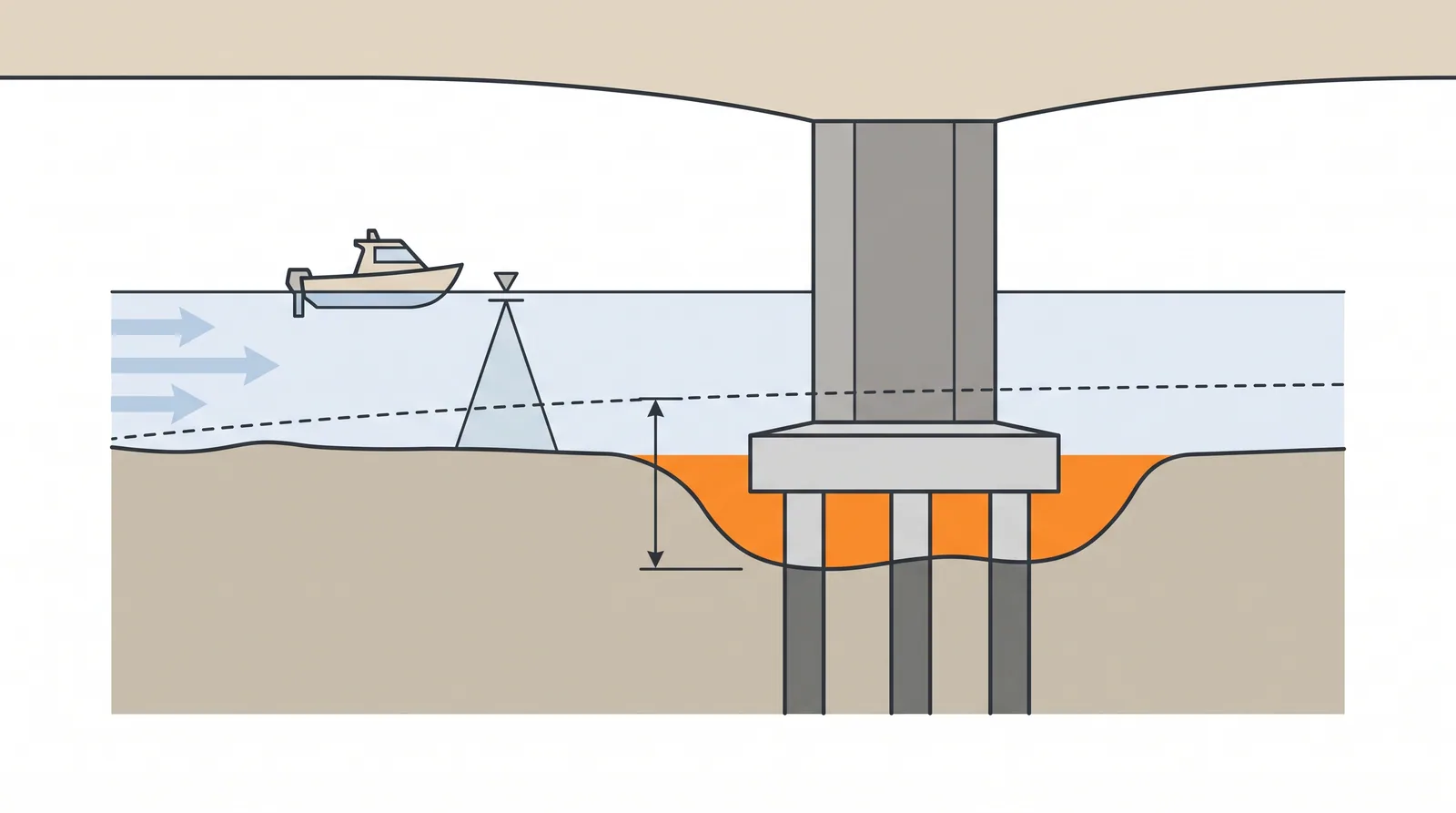
How it is done
- Gather discharge records and derive the design flood (typically 100-year for design, 500-year for check).
- Survey the channel and sample the bed material; look for armouring and for the depth of erodible sediment above rock.
- Model the flood profile and velocities; compute local pier scour, contraction scour and long-term degradation (HEC-18 or the local method).
- Set pile embedment below the total scour depth with a margin, or design scour protection.
Where it fits
- Every river, estuary and tidal crossing; also canals with fast flows.
Where it does not
- Using a single average velocity for a braided or meandering river; the thalweg can move to any pier.
Plant, pace and money
PlantSurvey boat with echo sounder, ADCP for velocities, bed samplers.
ProductivityA few days of fieldwork and a few weeks of modelling.
CostA small fraction of the project; the game's scour check is HEC-18 and it is the most common reason a design is marked poor.
Risks and controls
What goes wrong
- Bed changes during construction (cofferdams narrow the channel).
- Debris rafts on piers increasing effective pier width.
Quality assurance
Post-construction bed survey and a monitoring plan with a trigger level.
Examples
Schoharie Creek 1987 (US) and many monsoon-region collapses are scour failures.
Related methods
Further reading
FHWA HEC-18 and HEC-20 · AASHTO LRFD Section 2.6