How bridges get built · Ground improvement · Piled embankment with load-transfer platform
Also called: basal reinforced piled embankment, geosynthetic-reinforced pile-supported embankment, GRPS
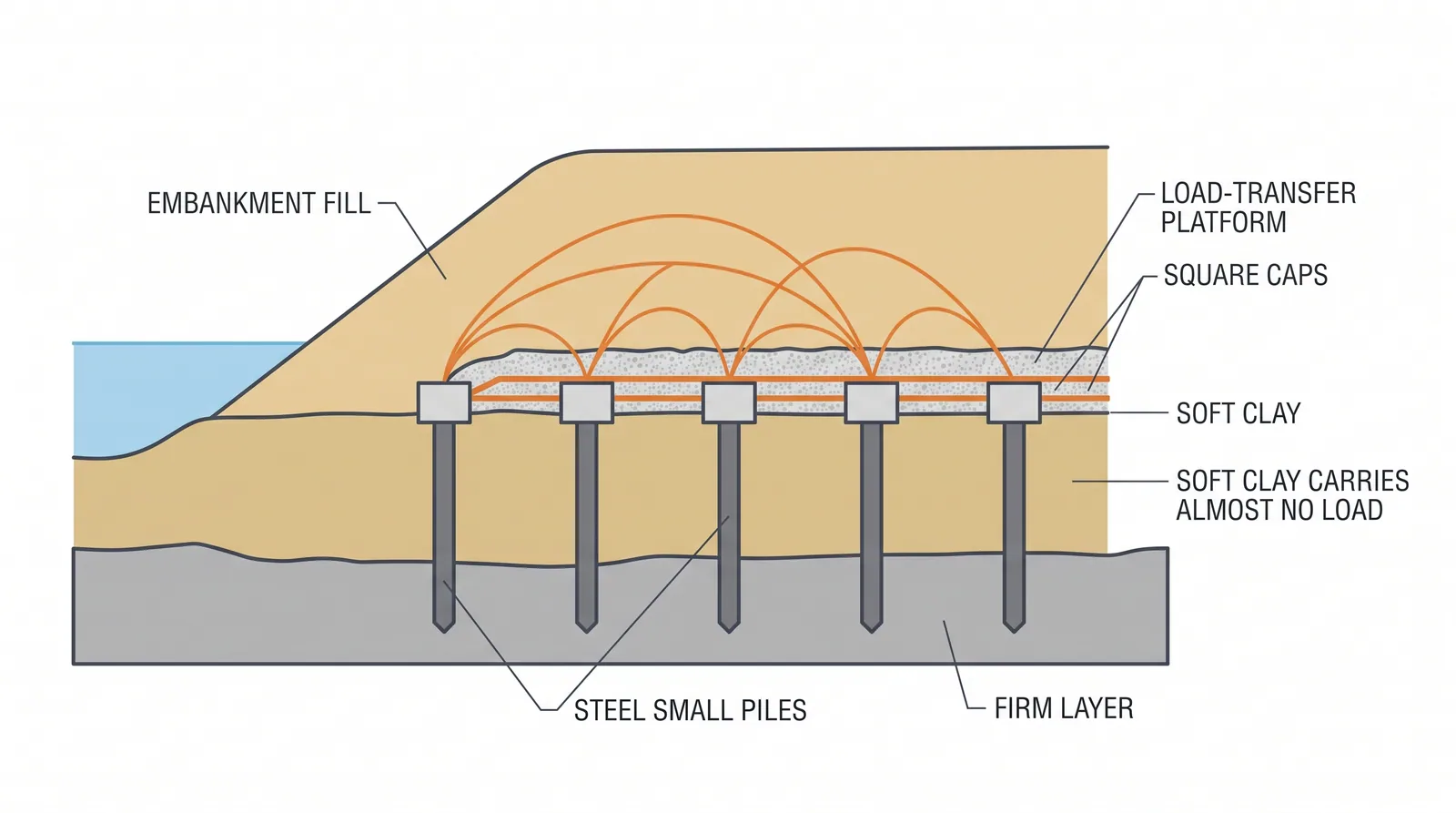
How it is done
- Install piles (driven concrete, timber, CFA, DCM or stone columns) on a 1.5-3 m grid with caps 0.6-1.2 m square.
- Place one to three layers of high-strength geogrid in a 0.5-1 m granular platform.
- Build the embankment; the platform arches the load onto the caps within about 1 m of fill height.
Where it fits
- Approaches on very soft or organic soil, where the programme is short, or where the approach must not settle against a fixed abutment.
Where it does not
- Thin soft layers where PVDs are far cheaper.
Plant, pace and money
PlantPiling rig, earthmoving, geogrid laying crew.
ProductivityPiling dominates: 40-80 piles per rig per day.
CostUSD 150-400 per m2 of embankment footprint, two to four times a PVD scheme, but no waiting.
Risks and controls
What goes wrong
- Punching of caps through the platform if the geogrid is under-designed; lateral spreading at the embankment toe.
Quality assurance
Pile records, geogrid overlap and tension checks, settlement plates on caps and between them.
Examples
Dutch and Scandinavian railways, Korean high-speed rail approaches, Bangkok expressway ramps.
Related methods
Prefabricated vertical drains with surchargeLightweight fill (EPS geofoam, foamed concrete, LWA)PHC spun concrete piles
Further reading
BS 8006-1 · CUR 226 (Dutch design guideline)