How bridges get built · Heavy lift, moving and accelerated construction · Strand jack lifting
Also called: heavy lifting by strand jacks, deck section lifting, lifting gantry
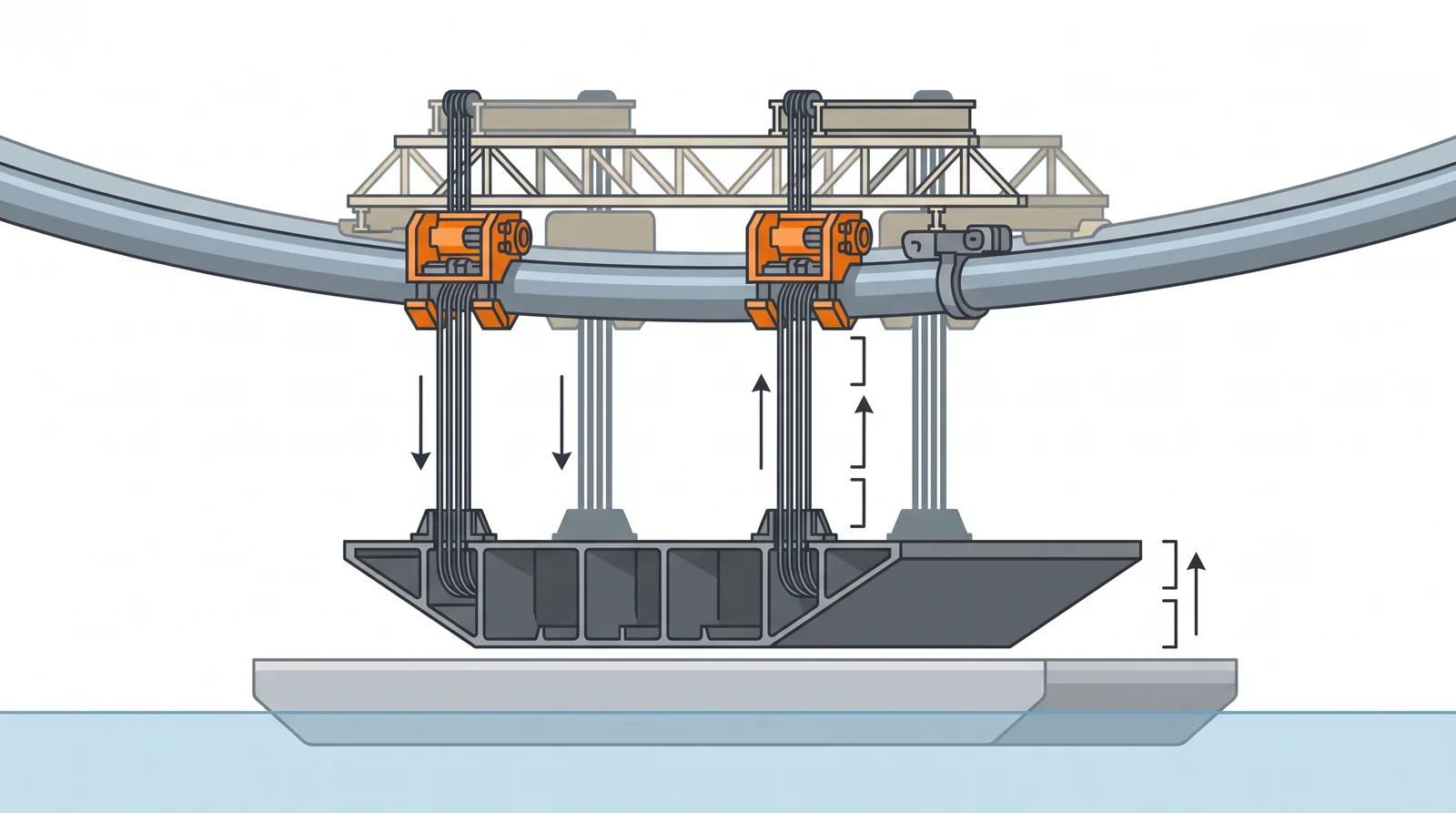
How it is done
- Mount lifting gantries with strand jacks on the completed structure (main cable, deck edge, temporary towers).
- Position the load on a barge below; connect the strands; lift at 5-20 m per hour with synchronised jacks; land and connect.
- Repeat; strand jacks also lower, slide and launch.
Where it fits
- Suspension bridge deck erection, box girder sections for cable-stayed bridges, arch halves, spans up to 5,000 t or more.
Where it does not
- Sites where a crane can do the lift faster; loads without a stable landing structure.
Plant, pace and money
PlantStrand jacks (50-800 t each), gantries, power packs, control system.
ProductivityOne section per day in a lifting campaign.
CostUSD 50,000-150,000 per section; system hire per campaign.
Risks and controls
What goes wrong
- Strand jack synchronisation failure, gantry overload, barge drift under a partially lifted load.
Quality assurance
Lift procedure with load monitoring, strand inspection, synchronisation tests.
Examples
Every modern suspension bridge deck (Akashi, Great Belt, Xihoumen, Yi Sun-sin); Millau steel deck placement.
In the bridge game
What Bridge Master applies when you pick it
Deck types: Orthotropic steel box, Steel arch, Steel truss, Steel box girder, Cable-stayed, Suspension, Extradosed, Steel plate girder, Precast segmental box, Concrete arch, Network tied arch. Spans 100-300 m, up to 500 m.
- +30: Central span over a shipping channel: float in and jack up.
- -40: Needs barge draft.
Related methods
Suspension bridge erection: cables, hangers and deckFloating crane erectionLateral slide (slide-in bridge construction)
Further reading
Enerpac and VSL heavy lifting guides · DNV-ST-N001