How bridges get built · Steel erection · Truss assembly and erection
Also called: truss erection, panel-point erection, truss bridge construction
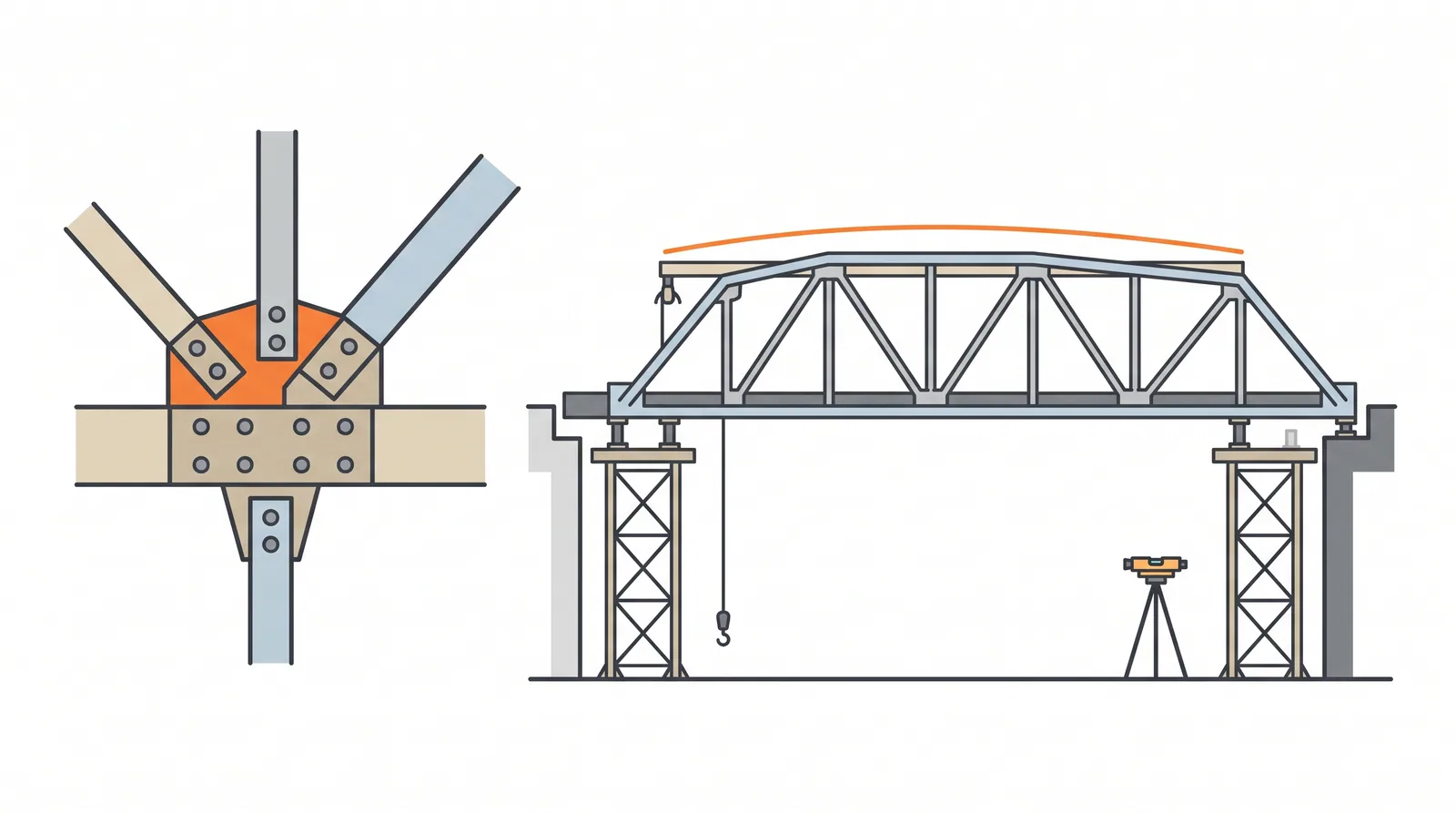
How it is done
- Shop-fabricate members with drilled connections from a matched assembly; trial-assemble in the shop for long spans.
- Erect on temporary towers (short spans), by cantilever with a derrick (long spans), or fully assembled on shore.
- Bolt panel points progressively; install the deck system and bracing to stabilise the trusses.
- Survey camber and alignment continuously; adjust with temperature in mind.
Where it fits
- Rail bridges, long-span river crossings, sites where the deck must be shallow for clearance, floating or sliding in complete trusses.
Where it does not
- Sites without room for assembly or without lifting capacity; highly repetitive short spans where girders are cheaper.
Plant, pace and money
PlantCranes, derricks, temporary towers, bolting crews.
ProductivityOne panel per day on towers; slower by cantilever.
CostSteel USD 4,000-8,000 per tonne fabricated and erected.
Risks and controls
What goes wrong
- Gusset plate deficiencies (I-35W), member buckling during erection, misfit at closure.
Quality assurance
Shop trial assembly, gusset design check, bolting inspection, survey.
Examples
Ikitsuki (400 m continuous truss), Japanese and Chinese rail-road trusses, US Mississippi trusses.
Related methods
Cantilever erection of steel (derrick and lifting frames)Float-in of complete arches and spansLateral slide (slide-in bridge construction)
Further reading
AASHTO LRFD 6 · NCHRP gusset plate guidance