How bridges get built · Site investigation and testing · Rock coring and rock mass logging
Also called: diamond coring, RQD logging, rock socket investigation
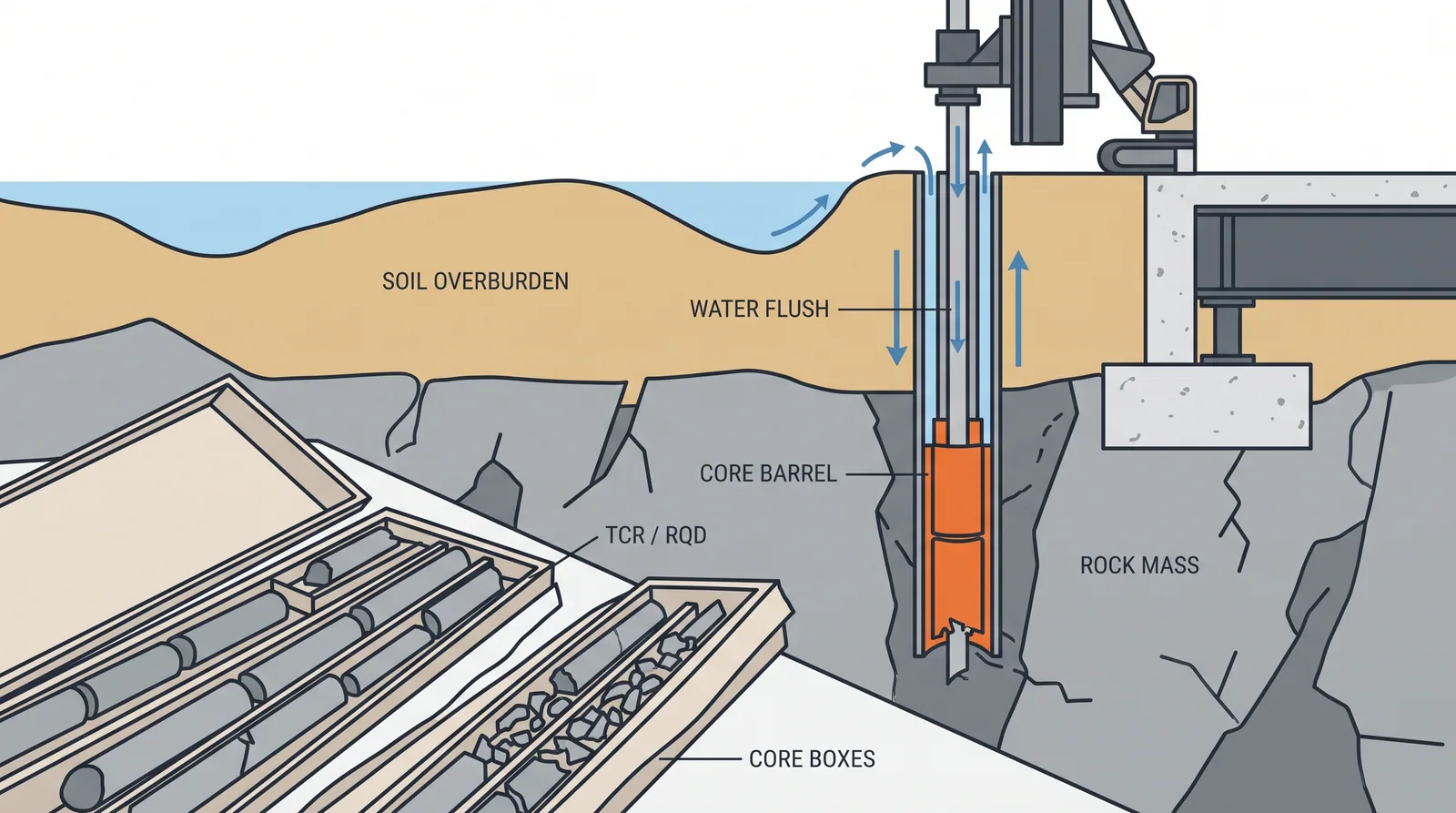
How it is done
- Switch from soil drilling to double- or triple-tube wireline coring once weathered rock is met; core 5-10 m below the expected socket base.
- Log total core recovery, RQD, fracture spacing, weathering grade and joint condition; photograph boxes wet and dry.
- Test unconfined compressive strength and point load on selected pieces; pressuremeter or dilatometer tests in the hole for modulus.
- Note water loss during drilling, which flags open fissures and karst.
Where it fits
- All rock-socketed piles, spread footings on rock, pylon foundations.
- Karst regions, where voids must be proven absent below the socket.
Where it does not
- Accepting a single short core in weathered rock as proof of bedrock: weathering profiles are irregular, core more holes rather than deeper ones.
Plant, pace and money
PlantRotary rig with wireline coring, HQ or PQ size bits, core barrels, core boxes.
Productivity3-10 m per shift depending on rock; slower in fractured or abrasive rock.
CostUSD 250-500 per metre on land; more offshore.
Risks and controls
What goes wrong
- Core loss in weak zones being logged as intact rock.
- Karst cavities between holes.
Quality assurance
Geologist on the rig, recovery and RQD per run, UCS tests at socket level, cavity probing where karst is suspected.
Examples
Sandstone and calcarenite in the Gulf, granite and gneiss in Korea; sockets of 1-3 diameters are typical.
Related methods
Boreholes with SPT and samplingDrilled shafts (bored piles) with casing or slurryPercussion rotary drilled (PRD) steel pipe pilesKarst and cavity probing
Further reading
ISRM suggested methods · Eurocode 7-2 Annex · FHWA GEC 10 (drilled shafts)