How bridges get built · Piers, pylons and abutments · Pylon construction: concrete, anchorage zones and geometry
Also called: tower construction, cable-stayed pylon, pylon anchor box
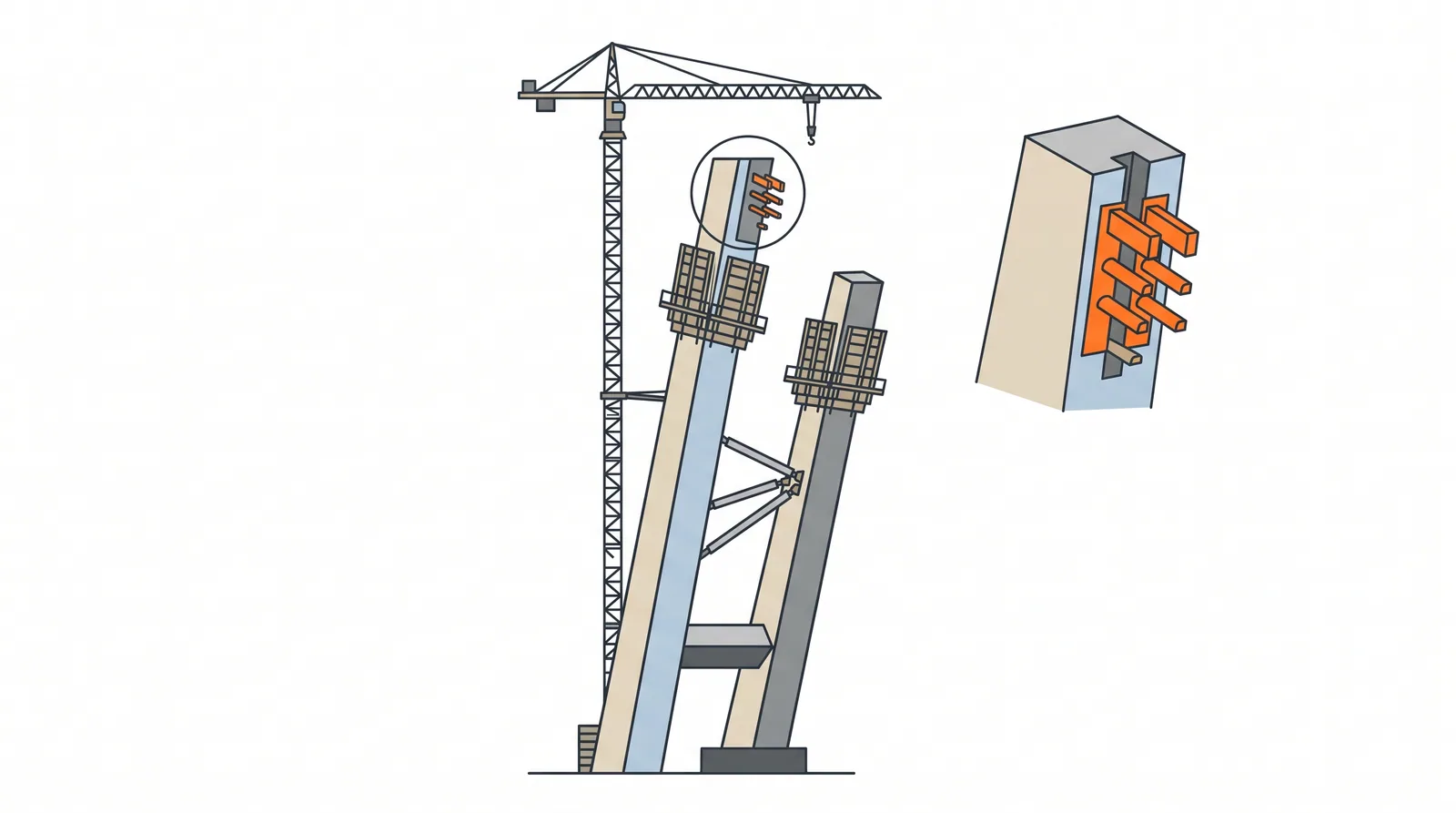
How it is done
- Climb the legs in 4-5 m lifts; for inclined legs, install temporary ties between the legs or to the ground until the cross beam is cast.
- Cast cross beams on bracket-supported formwork or lift prefabricated steel beams.
- In the anchorage zone, install the steel anchor boxes or pipes lift by lift with the deviator plates surveyed to millimetres; add the transverse post-tensioning that holds the anchorage zone together.
- Finish with the saddle or the top anchorage, the maintenance lift and access.
Where it fits
- Concrete pylons of 60-300 m; H, A, inverted-Y and diamond shapes.
Where it does not
- Skipping the temporary ties on inclined legs; skipping the lift-by-lift survey.
Plant, pace and money
PlantClimbing forms, tower crane of 100-300 m hook height, concrete pump with placing boom, survey with prisms and GNSS.
Productivity8-14 months for a 150-200 m pylon per leg pair.
CostUSD 30-120 million per pylon depending on height.
Risks and controls
What goes wrong
- Geometry error accumulating (cables then need adjustment), cracking in the anchorage zone, wind on the free-standing legs before the cross beam, crane capacity for the anchor boxes.
Quality assurance
Daily survey with temperature correction, anchor box position within 5-10 mm, post-tensioning records.
Examples
Sutong (306 m), Russky (320 m), Incheon (238 m), Stonecutters (298 m, composite top).
Related methods
Climbing and jump formworkSteel and composite pylonsCable-stayed cantilever erectionStay cable installation and tensioning
Further reading
Gimsing and Georgakis, Cable Supported Bridges · PTI DC45.1 Recommendations for Stay Cable Design