How bridges get built · Piers, pylons and abutments · Pier protection: fenders, dolphins and collision walls
Also called: ship impact protection, fender system, dolphin, crash wall
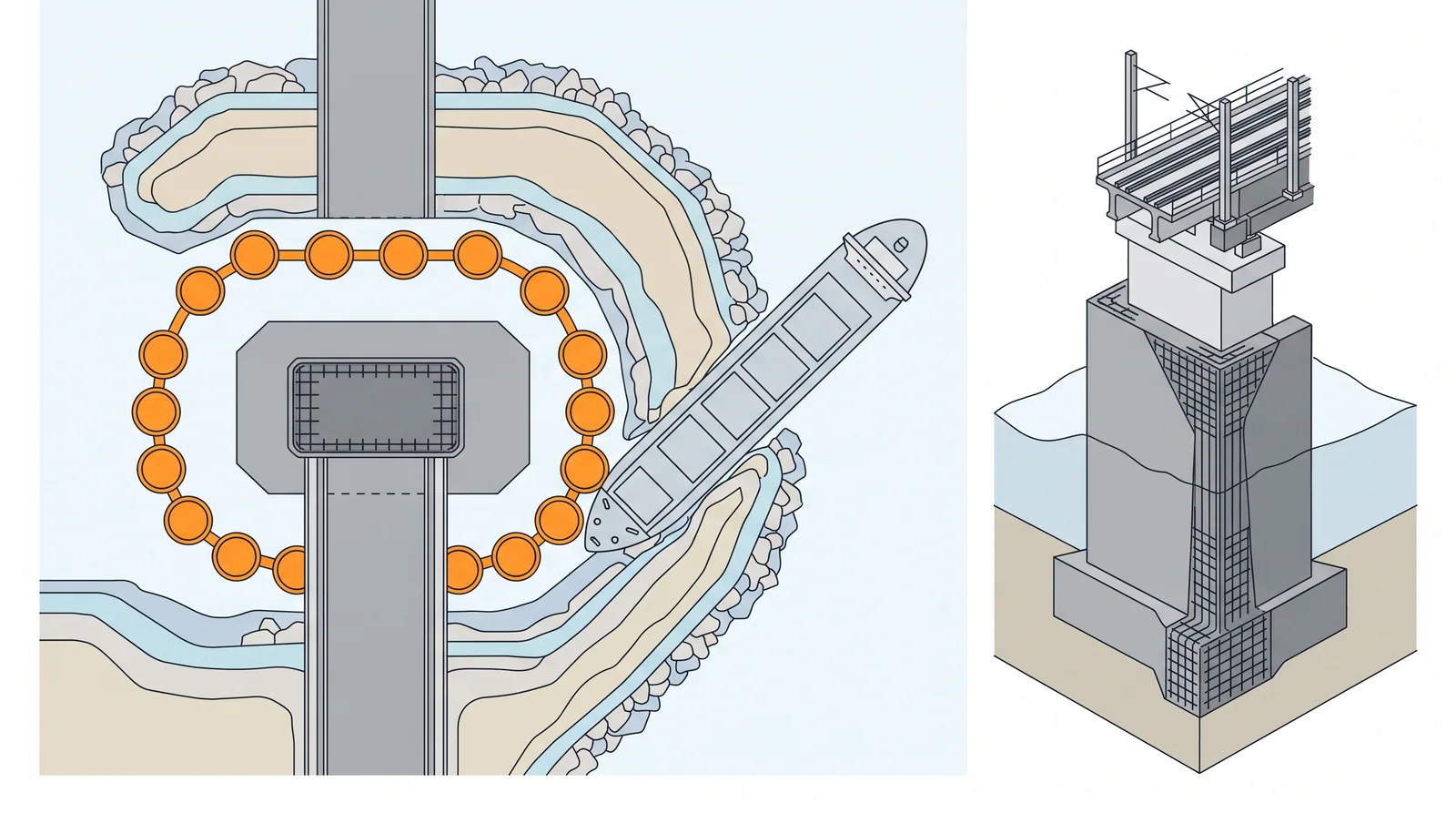
How it is done
- Estimate the design vessel and its energy (AASHTO or Eurocode 1-7); decide whether the pier resists the impact or a protection system absorbs it.
- Install dolphins (pile clusters or caisson cells) upstream and downstream, or floating fenders on piles around the pier, or an island of rock fill.
- For railways, cast a collision wall at least 2 m high and 0.75 m thick, or set piers back the required distance.
Where it fits
- Navigable rivers and channels, sea bridges near shipping lanes, piers within 4.5 m of a rail track.
Where it does not
- Relying on pier strength alone against large vessels; the energy is enormous.
Plant, pace and money
PlantPiling barges, rock placement, fender installation crews.
ProductivityWeeks per pier.
CostUSD 1-20 million per protected pier depending on the vessel.
Risks and controls
What goes wrong
- Under-estimating vessel size growth over the bridge life; scour around islands.
Quality assurance
Energy calculation reviewed, fender performance certificates, inspection after any contact.
Examples
Sunshine Skyway (rebuilt with dolphins after 1980), Francis Scott Key collapse in 2024 renewed attention; the game marks piers in the navigation route as unacceptable.
Related methods
Open caisson (well foundation)Steel pipe sheet pile (SPSP) well foundationScour investigation and hydraulic study
Further reading
AASHTO Guide Specifications for Vessel Collision Design · Eurocode 1-7