How bridges get built · Cable-supported and arch bridges · Network tied arch construction
Also called: network arch erection, crossing hanger arch
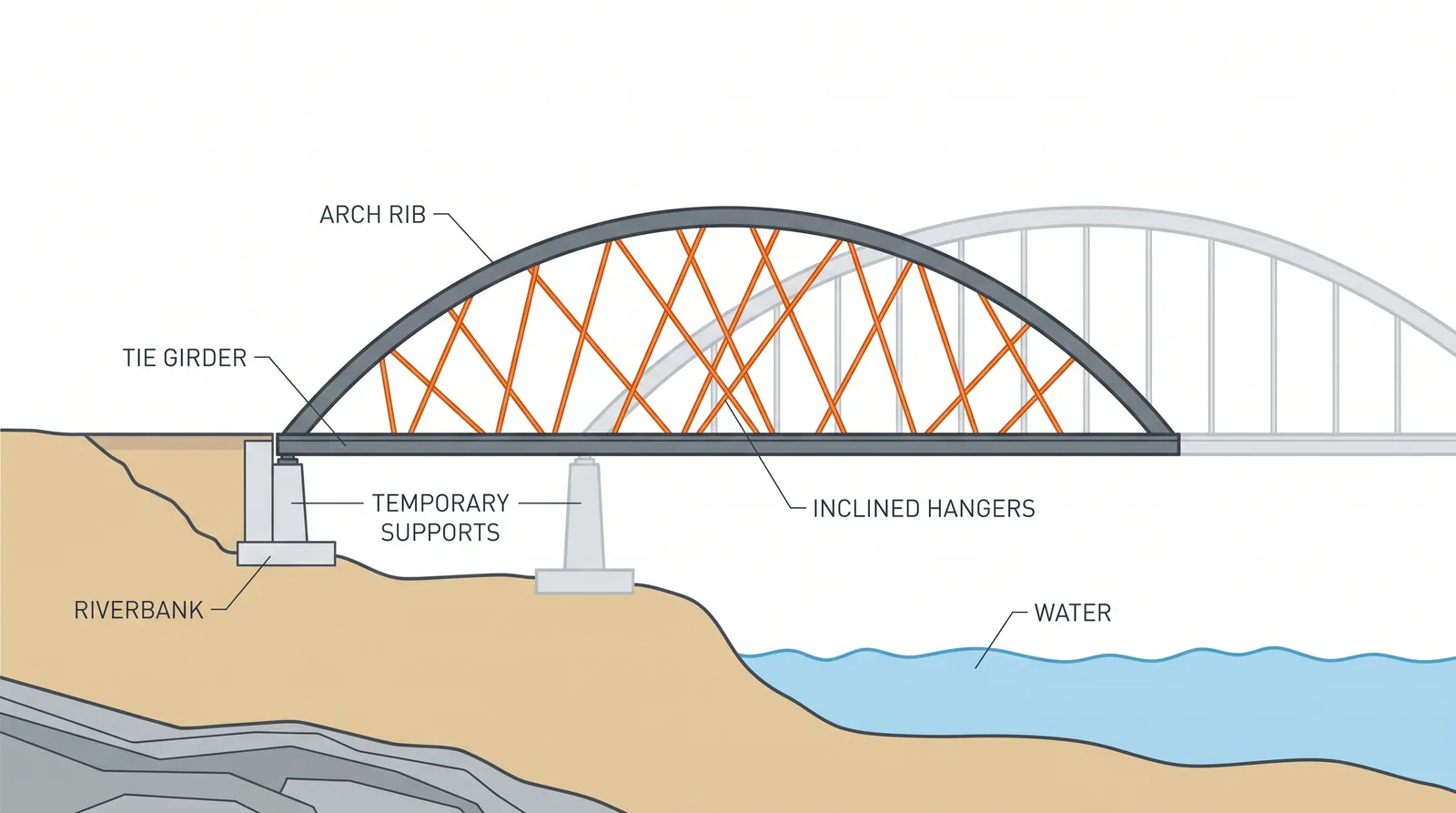
How it is done
- Assemble the arch ribs and the steel tie on temporary supports or on shore; install the hangers in the design sequence.
- Cast the concrete tie or deck slab in stages that keep every hanger in tension, or erect the whole steel structure then cast the deck with temporary hanger adjustment.
- Move the span by float-in, slide or SPMT, or strike the falsework.
Where it fits
- Single spans of 80-260 m over rivers, canals and railways; replacement spans that must go in during a short closure.
Where it does not
- Sites where the assembly area does not exist; designs without a hanger sequence analysis.
Plant, pace and money
PlantFalsework or assembly yard, cranes, hanger stressing equipment, movers.
ProductivityAssembly in months; installation in a day.
CostSteel USD 5,000-8,000 per tonne erected.
Risks and controls
What goes wrong
- Slack hangers during deck casting, arch buckling before the deck stiffens the system.
Quality assurance
Hanger force records at each stage, arch geometry survey.
Examples
Brandanger (Norway), Providence River, Blennerhassett, many Norwegian and German road bridges; the game's network tied arch type.
Related methods
Float-in of complete arches and spansLateral slide (slide-in bridge construction)Arch erection by cantilever with temporary stays
Further reading
Tveit, network arch publications · NCHRP guidance on tied arches