How bridges get built · Ground improvement · Dynamic compaction
Also called: heavy tamping, dynamic consolidation
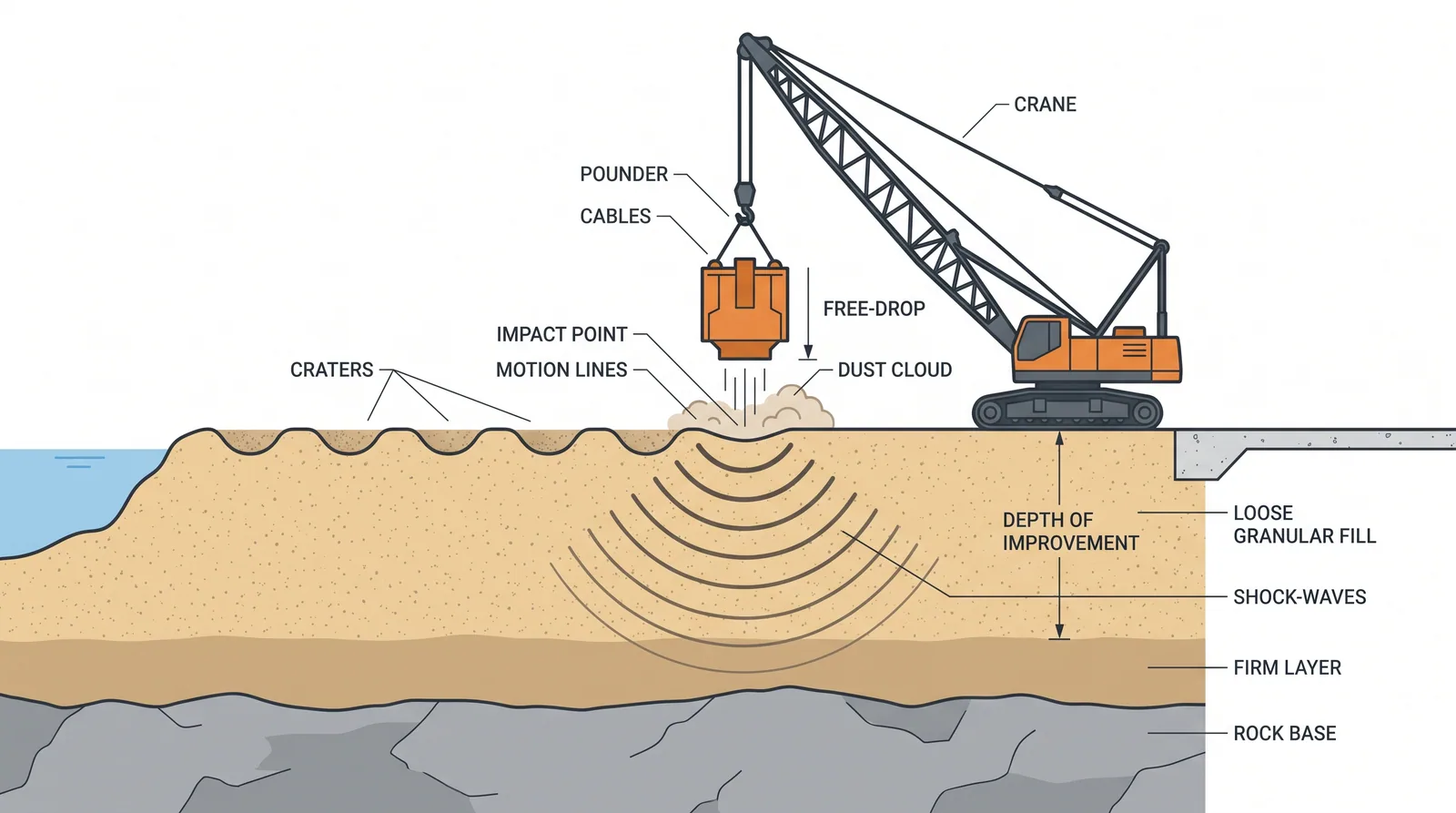
How it is done
- Drop the weight several times at each grid point in two or three passes with decreasing spacing; a final ironing pass with low drops levels the surface.
- Monitor crater depth and surface settlement; test with CPT or SPT between passes.
Where it fits
- Loose sand and gravel fill, rubble, reclaimed land, old industrial sites under approaches.
- Depths to about 10 m.
Where it does not
- Saturated clays and silts (no densification, only pore pressure).
- Within 30-50 m of structures or services sensitive to vibration.
Plant, pace and money
PlantLarge crawler crane (100-200 t) with a free-fall drum and a tamper.
Productivity2,000-5,000 m2 per crane per week.
CostUSD 8-20 per m2.
Risks and controls
What goes wrong
- Vibration damage, flying debris, crane fatigue.
Quality assurance
Pre- and post-CPT, plate load tests, vibration monitoring at the site boundary.
Examples
Airport and port fills; occasionally bridge approaches on rubble fill.
Related methods
Further reading
FHWA Dynamic Compaction guideline (GEC 1)