How bridges get built · Finishing, articulation and maintenance · Surfacing: asphalt, SMA, concrete and thin overlays
Also called: bridge pavement, asphalt on bridges, epoxy asphalt, Gussasphalt, polymer overlay
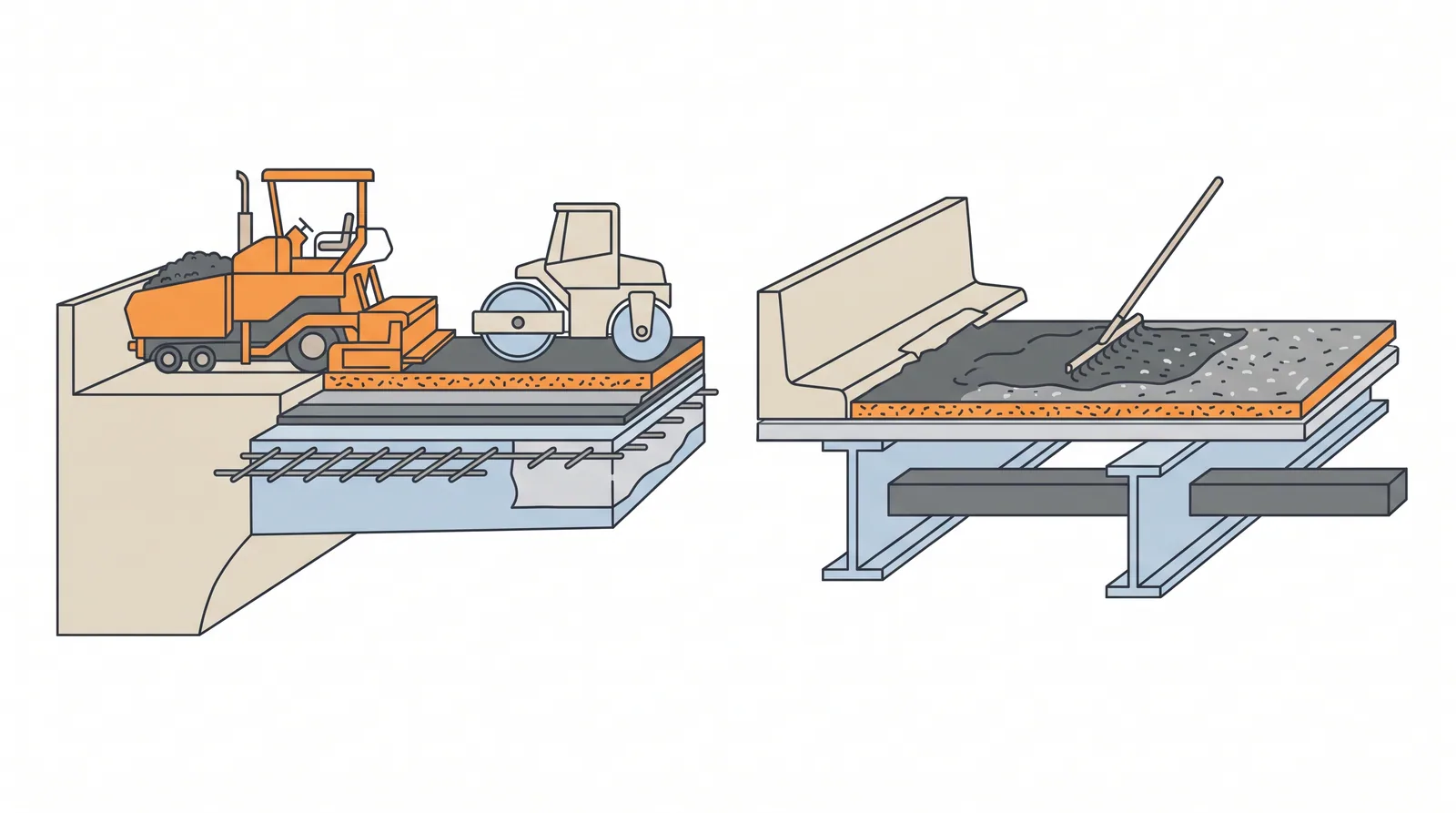
How it is done
- Concrete decks: tack coat on the membrane protection, base course and wearing course in two lifts of 40-70 mm compacted; keep rollers off joints and drains.
- Steel decks: blast and prime the plate, bond coat, Gussasphalt poured hot or epoxy asphalt compacted; thickness 50-80 mm; control the plate temperature.
- Thin overlays: broadcast aggregate into a polymer binder in two layers, 6-10 mm, cured in hours.
Where it fits
- All bridges; SMA for heavy traffic, epoxy asphalt for steel decks in hot climates, thin overlays for weight-critical and movable bridges.
Where it does not
- Thick asphalt on long-span steel decks (weight), plain asphalt on orthotropic plates in the Gulf (rutting and debonding).
Plant, pace and money
PlantPavers, rollers, Gussasphalt cookers, overlay rigs.
ProductivityA deck in days.
CostAsphalt USD 25-45 per m2; epoxy asphalt USD 80-150 per m2; the game's pavement options carry these differences.
Risks and controls
What goes wrong
- Debonding on steel, rutting, reflective cracking at joints.
Quality assurance
Bond tests, thickness cores, ride quality survey.
Examples
Epoxy asphalt on Chinese and Gulf steel decks; Gussasphalt on German and Japanese decks.
Related methods
Further reading
FHWA orthotropic deck manual (surfacing chapter) · Asphalt Institute guidance