Suspension Bridge Records · South Korea
Yi Sun-sin Bridge: How It Was Built
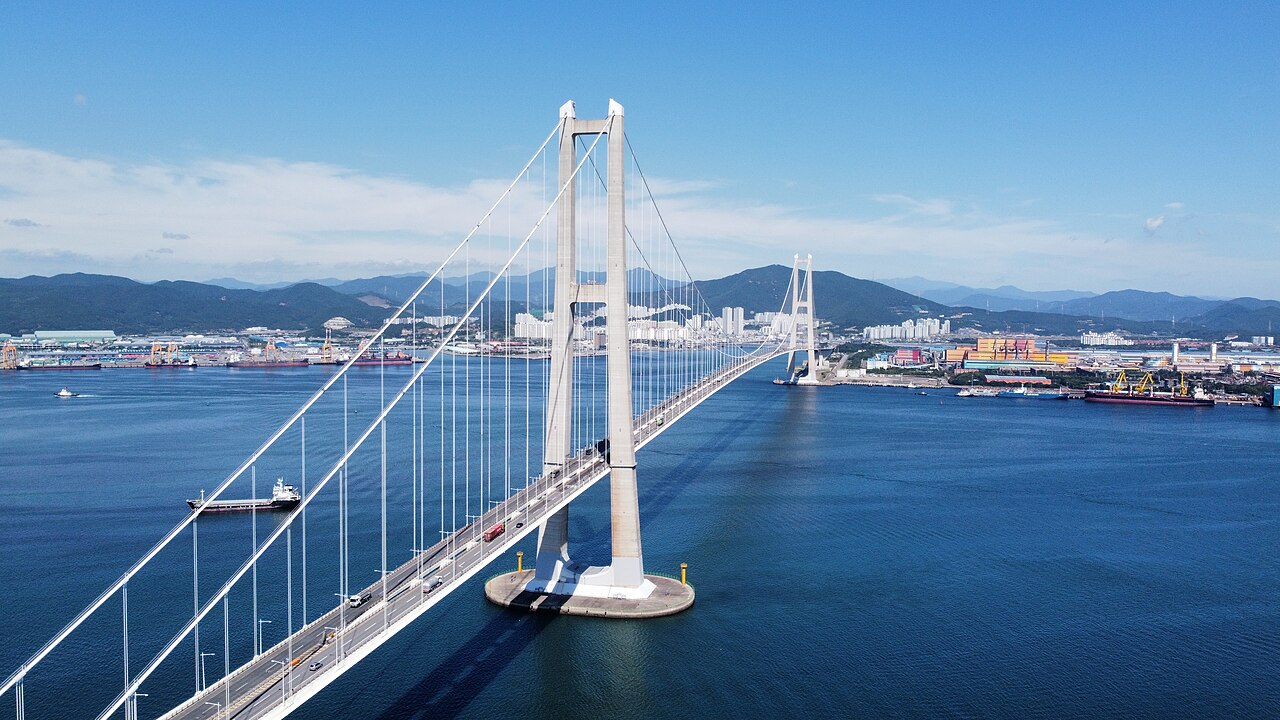
A 1,545 m main span across Gwangyang Bay between Yeosu and Gwangyang, opened in 2013: the longest suspension span in Korea, on 270 m concrete towers.
Yi Sun-sin Bridge carries the access road of the Yeosu National Industrial Complex across Gwangyang Bay, from Myodo-dong in Yeosu to Geumho-dong in Gwangyang. Its 1,545 m main span marks 1545, the birth year of Admiral Yi Sun-sin, and is about three times the 500 m of Gwangan Bridge, the previous longest suspension span in Korea. The bridge cut the road distance between the Yeosu and Gwangyang industrial complexes from about 60 km to 10 km.
The bridge was designed by Yooshin Engineering and built by Daelim Industrial, which developed its own cable spinning equipment for it. It was promoted as the first long-span suspension bridge designed and built entirely with Korean technology, and its builder described its 270 m towers as the tallest concrete suspension bridge towers in the world.
Key facts
| Location | Across Gwangyang Bay, linking Myodo-dong (Yeosu) and Geumho-dong (Gwangyang), South Jeolla Province, on the Yeosu National Industrial Complex access road |
|---|---|
| Type | Three-span suspension bridge with a streamlined twin steel box girder and no cross beam under the deck (floating system); earth-anchored |
| Spans | 357.5 + 1,545 + 357.5 m (2,260 m) |
| Main span | 1,545 m |
| Sag ratio | 1/9 |
| Towers | Reinforced concrete portal towers with curved legs, 270 m |
| Deck | Twin steel box girder, 3.05 m deep, about 25.7 m wide, four lanes; 50 mm epoxy asphalt |
| Main cable | Wire 5.35 mm, 1,860 MPa; main span 32 strands × 400 wires (12,800 wires), 677 mm before wrapping; side spans 34 strands (13,600 wires), 698 mm |
| Cable erection | Air spinning, with spinning equipment developed by Daelim |
| Navigation clearance | About 85 m at its highest |
| Built | November 2007 to February 2013; temporary opening 10 May 2012 |
| Owner | Jeollanam-do (South Jeolla Province) |
| Design | Yooshin Engineering |
| Construction | Daelim Industrial |
| Cost | KRW 493.3 billion for the suspension bridge contract |
Design
The main span was sized for container ships of up to 18,000 TEU and set at exactly 1,545 m to mark Admiral Yi's birth year. The cable sag ratio is 1/9.
The deck is a streamlined twin box girder. It is about 21 percent lighter than a single streamlined box would have been, 10.6 tf/m against 13.5 tf/m, which reduced the size and cost of the main cables. A 1/165 scale elastic model showed no flutter or other instability in the wind tunnel at wind speeds up to 100 m/s.
The towers have curved legs to match the twin box deck and no cross beam beneath the deck, so the girder floats between the towers. The top cross beam doubles as an observation deck and a crane support; the middle cross beam is 110 m above the road.
The cable wire, to KS D 3059, has a tensile strength of 1,860 MPa and an allowable stress of 744 MPa (a safety factor of 2.5); at the time the 1,860 MPa grade was claimed as a world first for a suspension bridge main cable. The two anchorages answer different ground. On the Myodo (Yeosu) side the anchorage was designed to keep rock excavation and concrete to a minimum. On the Gwangyang side, where thick soft clay lies over the rock, the anchorage is a gravity type built inside a circular continuous wall and filled with roller-compacted concrete.
How it was built
Foundations
The towers and side piers stand on cast-in-place piles 3.0 m in diameter.
Towers
The 270 m legs were slipformed around the clock at about 2 m a day, with verticality and shape controlled by GPS and total station. Switching from the planned auto-climbing formwork to slipforms, which allowed 24-hour working, cut the tower schedule from 25 months to about 12. The precast cross beams were fabricated on land and raised by heavy lifting at 4.5 to 5.5 m an hour.
Main cables
The cables were air spun with spinning equipment developed by Daelim, replacing equipment that had previously been rented from Japan. Each cable has 12,800 wires of 5.35 mm in the main span, in 32 strands of 400 wires, and 13,600 wires in 34 strands in the side spans; together the two cables hold about 72,000 km of wire. The strands were arranged in a square pattern, which reduced the number of sag adjustments and sped up erection. Three techniques were developed for the cable work: an improved spinning wheel, a wire supply method for spinning the extra side-span strands, and a method for installing the cable bands and hangers. The cable bands were placed at night by the tower crane and bolted, and the hangers were brought out with a carrier and connected to the girder.
Deck
The twin box deck, about 23,000 tf in all, was lifted in small blocks by lifting devices on the cables. The blocks were first pinned together with temporary hinges and made rigid once 75 percent or more of the deck was in place. The main span was erected from midspan towards the towers and the side spans from the side piers towards the towers. About seven months were planned for deck erection, including welding and painting, and the deck was surfaced with 50 mm of epoxy asphalt.
Key dates
| November 2007 | Construction begins |
| 10 May 2012 | Temporary opening for Expo 2012 Yeosu |
| 13 August 2012 | Closed again after the Expo |
| 7 February 2013 | Official opening |
| June to October 2014 | Deck surfacing replaced |
| 26 October 2014 | Deck motion in light wind, blamed on curing screens on the barriers; bridge closed and screens removed |
What engineers remember it for
- The cable work was done with Korean-built spinning equipment and 1,860 MPa wire.
- Changing the tower formwork from auto-climbing to slipforming saved about 13 months.
- In October 2014, shortly after the deck surfacing was replaced, cloth screens fixed to the barriers to cure the new surfacing were blamed for vertical deck motion of about 1 m in light wind. The bridge was closed to traffic and the screens removed, a reminder that temporary attachments change the aerodynamics of a deck.
Construction records
The construction records below can be read in the browser or downloaded. Large scanned volumes may take a moment to open.
← All suspension bridge records
Related on TheBridgeEng
Questions engineers ask
- Why is the main span of Yi Sun-sin Bridge 1,545 m?
- The span was sized for container ships of up to 18,000 TEU and set at 1,545 m to mark the birth year of Admiral Yi Sun-sin.
- How were the Yi Sun-sin Bridge cables built?
- By air spinning with equipment developed by the contractor, Daelim, using 5.35 mm wire of 1,860 MPa. Each cable has 12,800 wires in the main span and 13,600 in the side spans.
- How were the 270 m towers built so quickly?
- By slipforming around the clock at about 2 m a day instead of auto-climbing formwork, which cut the tower schedule from 25 months to about 12.
Sources
- Kim, J.H. (Daelim) 2010: 여수국가산단 진입도로(3공구) 이순신대교 (koreascience PDF)
- Baek et al. (2012) Yi Sun-sin Bridge: Technologies for Accelerated Construction of 270m-High Pylons, IABSE Congress Seoul
- Yi Sun-sin Bridge: Several Unique Features on the Cable Erection Procedure, IABSE Congress Seoul 2012
- Lee, Kwon, Shin (2012) Yi Sun-sin Bridge: Design of the long span suspension bridge with streamlined twin box girder, IABSE Congress Seoul
- Structurae: Yi Sun-sin Bridge
- LUSAS case study: Yi Sun-sin Bridge
- Money Today (10 Oct 2010): 대림산업, 이순신대교로 현수교기술 자립 선언
- NewDaily (10 Oct 2010): 대림산업 100% 국산화 성공
- Money Today (29 Apr 2012): 세계 4위 이순신대교
- Seoul Shinmun (30 Apr 2012): 우리 기술 첫 현수교 이순신대교
Updated 2026-11-13 · written by a practising bridge engineer