Suspension Bridge Records · South Korea
Yeongjong Bridge, Incheon: How It Was Built
A self-anchored suspension bridge of 125 + 300 + 125 m with three-dimensional cables, carrying road and airport railway to Incheon International Airport, opened in 2000.
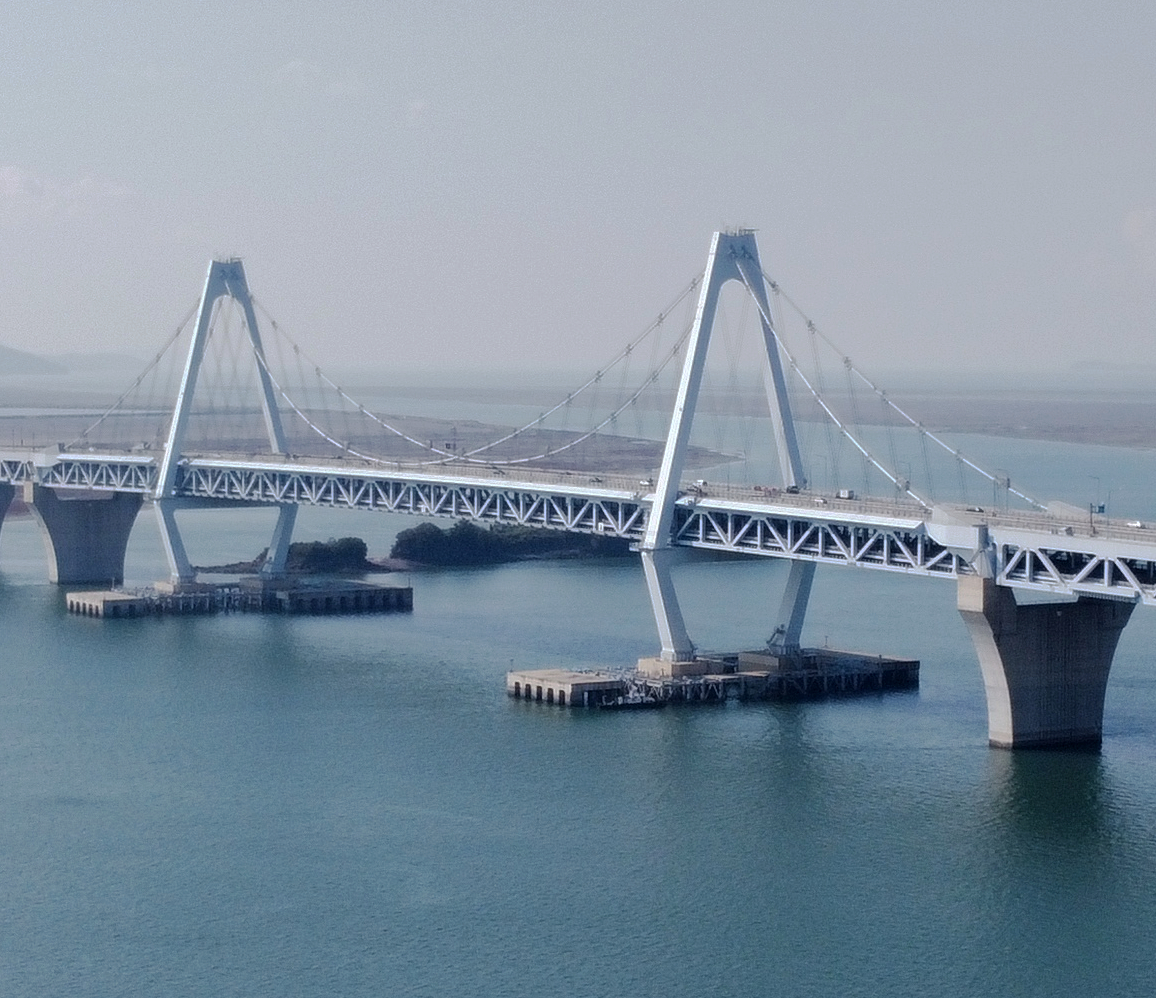
Yeongjong Bridge links Incheon with Yeongjong Island and Incheon International Airport. Its 550 m suspension section is the centre of a 4.42 km crossing that also has 2,250 m of double-deck steel truss and 1,620 m of steel box girder approaches, on 49 piers in all. The upper deck carries the six-lane airport expressway; the lower deck carries four more road lanes and the double-track airport railway.
Two features make it unusual. It is self-anchored: the main cables are fixed to the stiffening truss, not to anchor blocks in the ground. And its cables are spatial: they leave the deck edges parallel, lean inwards until they nearly touch at the tower tops, then spread apart again. On completion it was described as the first self-anchored suspension bridge in the world with three-dimensional cables, and its 550 m suspension section was longer than the 540 m of the previous record self-anchored bridge, in Osaka.
The bridge was part of the Incheon International Airport Expressway, the first facility built under Korea's private investment law, and it had to be finished before the airport opened.
Key facts
| Location | Incheon, linking the mainland to Yeongjong Island (Incheon International Airport) on the Incheon International Airport Expressway |
|---|---|
| Type | Self-anchored suspension bridge with three-dimensional (spatial) cables and a double-deck steel stiffening truss |
| Spans | 125 + 300 + 125 m (550 m suspension section of a 4.42 km crossing) |
| Main span | 300 m |
| Towers | Steel open-diamond towers, about 107 m high |
| Deck | Double-deck steel stiffening truss, 35 m wide; six road lanes above, four road lanes and a double-track railway below |
| Main cable | Hot-dip galvanised parallel wires of 5.1 mm, 6,720 wires per cable; about 1,300 t of cable wire |
| Cable erection | Three-dimensional air spinning |
| Hangers | Inclined, following the spatial cable planes |
| Built | November 1995 to November 2000; expressway opened 20 November 2000 |
| Owner | New Airport Hiway Co. (concessionaire of the Incheon International Airport Expressway) |
| Design | Yooshin Engineering and Chodai, from a government design competition (design completed December 1993) |
| Construction | Samsung (main contractor); Hanjin Heavy Industries erected 1,375 m of the approach truss |
| Cost | KRW 813 billion for the crossing |
Design
The scheme came from a government design competition, with the design completed in December 1993 by Yooshin Engineering and Chodai. The brief asked for an airport expressway and a combined road and rail bridge that would also act as a gateway to Seoul and suit its setting. The three-dimensional cables and the self-anchored form were chosen to echo the curved line of a traditional Korean tiled roof.
In a self-anchored bridge the stiffening girder carries the horizontal pull of the main cables as compression, so no anchor blocks are needed. The price is the erection sequence: the deck must be built first, on temporary supports, and only then can the cables be made and the deck load transferred to them. The towers were changed from the closed diamond of the original design to an open diamond, for appearance and economy.
No one had built a spatial-cable self-anchored bridge before. Experts reportedly put its chance of being buildable at about 50 percent, and within Samsung there were proposals to switch to a proven two-dimensional cable layout. The company kept the three-dimensional design, reasoning that any delay in changing it could push completion beyond the opening of the airport.
How it was built
Foundations
The site has water up to 17 m deep and a tidal range of about plus or minus 4.5 m. The pier foundations were sunk by the pneumatic caisson method. Each tower caisson, a steel box 18 m wide, 47 m long and 26 m high, was built on land, carried to site by a 3,000 t class floating crane and set on the seabed. Compressed air then pushed the sea water out of the working chamber and robots excavated the seabed beneath it. This was the first unmanned robotic caisson excavation in Korea and the second in the world after Japan; the earlier Dolsan Bridge had used workers inside the caisson.
Towers and truss
About 27,000 t of steel for the towers and the stiffening truss was fabricated in large blocks on Geoje Island, shipped to site and erected in single lifts by the 3,000 t class floating crane, working with temporary bents. On the approaches, Hanjin Heavy Industries replaced the planned 75 m floating-crane blocks, which would have needed more than ten temporary bents in the sea, with 120 m blocks placed without bents, and erected 1,375 m of double-deck truss, about 60,000 t, this way.
Spatial air spinning
With the truss in place, the main cables were air spun from hot-dip galvanised 5.1 mm wire: 6,720 wires per cable, more than 4,000 km of wire and about 1,300 t in all. The spinning wheel ran back and forth along the cable path much like a ski lift, and because no one had spun three-dimensional cables before, the contractor recruited technicians with experience of repairing ski lifts and trained them for the work.
The inclined cables change direction in plan as well as in elevation at the tower tops, so full-scale mock-up tests of cable erection at the tower saddle were carried out first. They showed the wires moving sideways and bending inside the saddle, and the countermeasures developed in the tests were used on the bridge.
Completion and monitoring
Sensors tracked the structure against the design during construction, and a real-time monitoring system with many sensors was installed for maintenance, together with automatic ultrasonic testing for fatigue-critical members. The airport expressway opened on 20 November 2000.
Key dates
| December 1993 | Design completed, based on the government competition scheme |
| November 1995 | Construction begins |
| 20 November 2000 | Incheon International Airport Expressway opens across the bridge |
What engineers remember it for
- Described on completion as the first self-anchored suspension bridge in the world with three-dimensional cables, and the longest self-anchored suspension section (550 m).
- Its robot-excavated pneumatic caissons were a first in Korea.
- Its cable band bolts lost about 45 percent of their axial force in the first three years and about 30 percent over the next three, and were re-tightened twice, a case later cited when the same problem was found on other Korean suspension bridges.
- The experience gained on Yeongjong and Gwangan fed into the design of later Korean suspension bridges such as Sorok.
Construction records
The construction records below can be read in the browser or downloaded. Large scanned volumes may take a moment to open.
← All suspension bridge records
Related on TheBridgeEng
Questions engineers ask
- Why does Yeongjong Bridge have no anchor blocks?
- It is a self-anchored suspension bridge: the main cables are fixed to the ends of the stiffening truss, which carries their horizontal pull as compression. For that reason the truss had to be built before the cables.
- What are the three-dimensional cables of Yeongjong Bridge?
- The two main cables are not in vertical planes. They start parallel at the deck edges, lean inwards until they nearly touch at the tower tops and then spread apart again, so the hangers are inclined.
- How were the Yeongjong Bridge foundations built?
- By pneumatic caissons. The 18 × 47 × 26 m steel tower caissons were set on the seabed by a 3,000 t class floating crane and excavated under compressed air by robots, the first unmanned caisson excavation in Korea.
Sources
- CERIK: 영종대교 세계 최초의 3차원 케이블 자정식 현수교 (1)
- CERIK: 영종대교 세계 최초의 3차원 케이블 자정식 현수교 (2)
- Gil, H. (2001) Design and Erection of the Yongjong Bridge, World Steel Bridge Symposium (TRID)
- Gil, H. and Cho, C. (1998) Yong Jong Grand Suspension Bridge, Korea, SEI 8(2) (TRID)
- Gil, H. and Choi, Y. (2001) Cable Erection Test at Pylon Saddle for Spatial Suspension Bridge, J. Bridge Eng. 6(3)
- Structurae: Yongjong Self-anchored Suspension Bridge, SEI 11(1) 2001
- Structurae: Yeongjong Grand Bridge
- mageba reference sheet: Yeongjong Grand Bridge
- Hanjin Heavy Industries conference paper on approach truss erection (koreascience)
- Samsung C&T Newsroom: Like a bridge over salty water (2020)
Updated 2026-11-13 · written by a practising bridge engineer