Suspension Bridge Records · China
Xihoumen Bridge: How It Was Built
A 1,650 m main span across the Xihoumen Strait in the Zhoushan archipelago, opened in 2009: the longest suspension span in China and second in the world when its main span was closed in 2007.
The Xihoumen Bridge crosses the Xihoumen Strait between Cezi Island and Jintang Island. It is the fourth of the five bridges of the Zhoushan Mainland and Islands Link and opened together with the cable-stayed Jintang Bridge. It should not be confused with the separate Xihoumen road and rail bridge now being built nearby.
It was the first suspension bridge with a split steel box girder: two boxes with an open gap between them, a form chosen to keep the deck stable in a strait exposed to typhoons. The bridge received a FIDIC Outstanding Engineering Project Award in 2015.
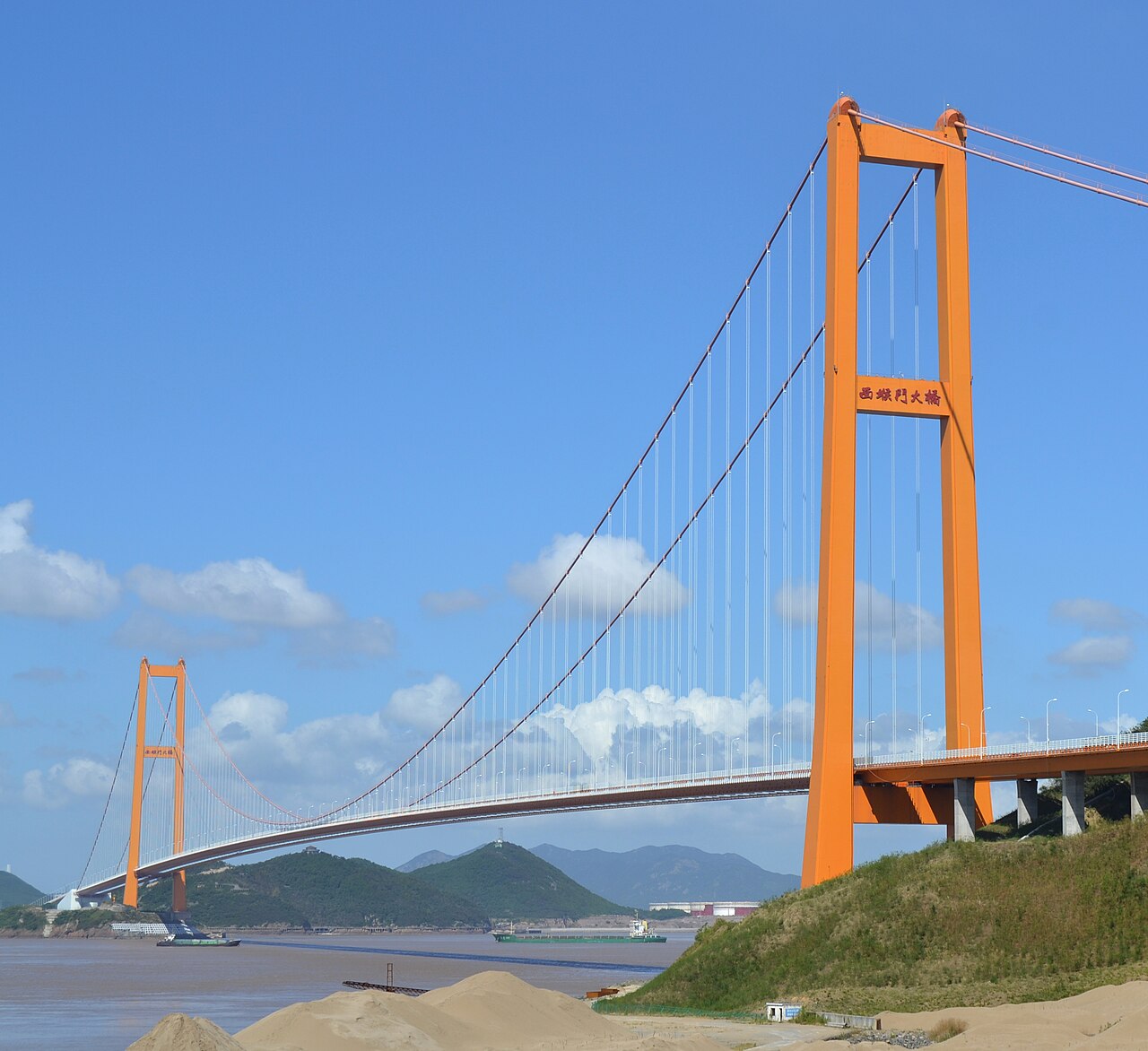
Key facts
| Location | Xihoumen Strait, between Cezi Island (north) and Jintang Island (south), Zhoushan Archipelago, Zhejiang |
|---|---|
| Type | Suspension bridge with the north side span and main span suspended and a split twin steel box girder continuous over two spans; earth-anchored |
| Spans | 578 + 1,650 + 485 m (the 485 m south side span carries no deck) |
| Main span | 1,650 m |
| Towers | Reinforced concrete portal towers, 211.3 m |
| Deck | Two steel boxes, each 15 m wide and 3.5 m deep, with a 6 m gap; 36 m overall; continuous over 2,428 m |
| Main cable | 169 prefabricated strands × 127 wires of 5.25 mm, 1,770 MPa, per cable; cable about 850 mm in diameter and about 2,820 m long |
| Cable erection | Prefabricated parallel wire strands (PPWS) |
| Hangers | 476 steel wire rope suspenders at a standard spacing of 18 m (1,394 t) |
| Navigation clearance | 49.5 m |
| Built | Built from 2005; main span closed 16 December 2007; opened 25 December 2009 |
| Owner | Zhejiang Provincial Construction Headquarters of the Zhoushan Islands Link Project |
| Design | China Communications Construction Company, with HPDI Consultants; COWI for aerodynamic analysis |
| Construction | Sichuan Road and Bridge Group; Shanghai Pujiang Cable (strands); Dorman Long Technology (deck erection gantries); Baosteel (steel) |
| Cost | CNY 2.48 billion |
Design
The 1,650 m span was chosen so that the towers could stand clear of deep water. The deck is suspended over the 578 m north side span and the main span, and is continuous over both, 2,428 m in all, a Chinese record for a box girder; the 485 m south side span carries only the cables.
In a strait exposed to typhoons, the stiffening girder was split into two steel boxes, each 15 m wide and 3.5 m deep, with a 6 m open gap between them. The gap raised the critical flutter wind speed to about 88 m/s, above the 78.7 m/s requirement, and the bridge is designed to resist a super typhoon of force 17. COWI carried out aerodynamic analysis for the project.
The main cable strands were made with domestically produced 1,770 MPa wire, a step that later Chinese bridges built on for 1,860 MPa strands.
How it was built
Towers
The two reinforced concrete portal towers, 211.3 m high, were built with tower cranes of 12 to 15 t capacity.
Cables
Each main cable was erected from 169 prefabricated parallel wire strands of 127 wires, made by Shanghai Pujiang Cable. Each strand runs about 2,820 m from anchorage to anchorage. Strands were hauled across at about 22 m/min with a 36 t winch, typically four strands a day and at most five. The main cables and eight back cables weigh 10,758 t, and the 476 suspenders a further 1,394 t.
Deck
The segments, about 360 t each, were trial assembled horizontally in the fabrication shop with the vertical profile simulated, so that the alignment of every segment was checked before it left the shop. They were then lifted by three sets of cable-mounted gantries designed and supplied by Dorman Long Technology, which also supervised the lifting on site. At the anchor end of the north side span, Sichuan Road and Bridge Group used special erection and alignment adjustment techniques to cope with the harsh marine site.
Weather and opening
The bridge came through two typhoons during construction. The main span was closed on 16 December 2007. The opening was delayed after a ship struck the neighbouring Jintang Bridge on 16 November 2009, and the bridge opened to traffic on 25 December 2009.
Key dates
| 2005 | Construction begins |
| 16 December 2007 | Main span closed |
| 16 November 2009 | A ship strikes the neighbouring Jintang Bridge, delaying the opening |
| 25 December 2009 | Opened to traffic |
| 2015 | FIDIC Outstanding Engineering Project Award |
What engineers remember it for
- The first suspension bridge with a split (twin) steel box girder.
- Longest suspension span in China and second in the world when built.
- Its 2,428 m continuous steel deck set a Chinese record for a box girder.
Construction records
The construction records below can be read in the browser or downloaded. Large scanned volumes may take a moment to open.
← All suspension bridge records
Related on TheBridgeEng
Questions engineers ask
- Why does the Xihoumen Bridge have a split box girder?
- The strait is exposed to typhoons. Two 15 m boxes with a 6 m open gap raised the critical flutter wind speed to about 88 m/s, above the 78.7 m/s requirement.
- How were the Xihoumen Bridge cables erected?
- From 169 prefabricated parallel wire strands per cable, each of 127 wires of 1,770 MPa and about 2,820 m long, hauled at about 22 m/min, typically four strands a day.
- Why is the south side span of the Xihoumen Bridge empty?
- Only the 578 m north side span and the main span are suspended. The deck is continuous over those two spans, and the 485 m south side span carries only the cables down to the anchorage.
Sources
- Zhoushan Xihoumen Bridge with the World Record Span Length of Steel Box Girder, China (SEI 20(3), 312-316, DOI 10.2749/101686610792016871), Structurae abstract
- Structurae: Pont de Xihoumen
- Strategic Study of CAE 2010: manufacturing technology of main cable strands (Xihoumen 1,770 MPa)
- Strategic Study of CAE 2010: transport of coiled main cable strands (Xihoumen)
- Strategic Study of CAE 2010: influence of central buckles (Xihoumen model spans)
- Strategic Study of CAE 2010: pre-assembly alignment control of split steel box girders
- Strategic Study of CAE 2010: erection of steel box girder at anchor side of north side span
- Design and construction of super-long span bridges in China: review and future perspectives (Frontiers of Structural and Civil Engineering, 2020)
- Dabrowiecki, Two-hundred-year history of modern suspension bridges, part 3 (Nowoczesne Budownictwo Inzynieryjne, 2020)
- Road Traffic Technology: Xihoumen Bridge
Updated 2026-11-13 · written by a practising bridge engineer