Suspension Bridge Records · China (Hong Kong SAR)
Tsing Ma Bridge: How It Was Built
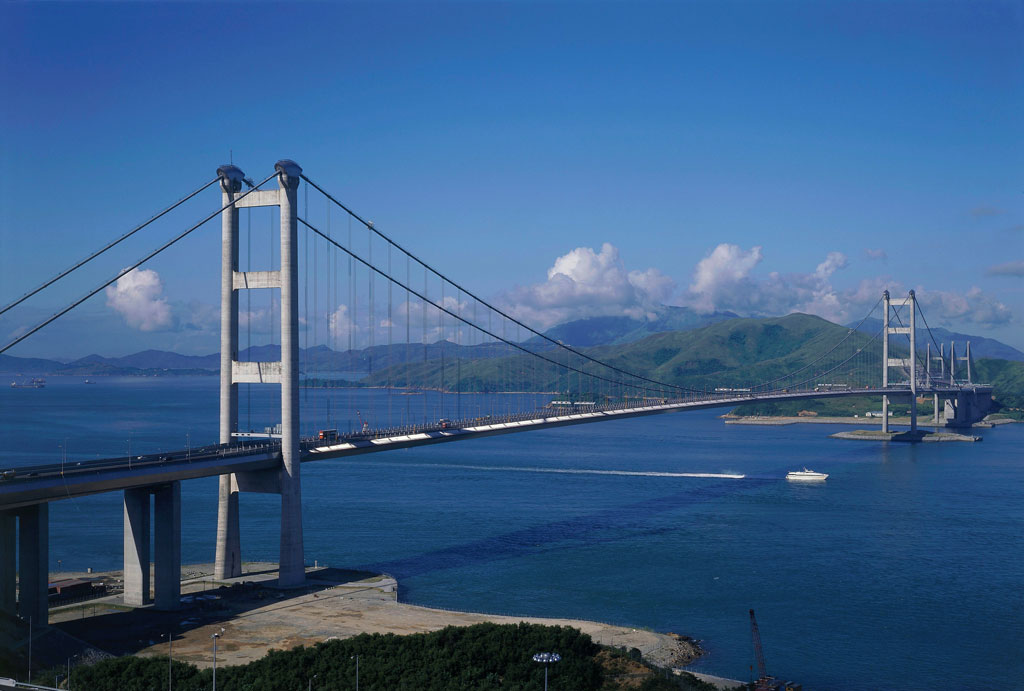
A 1,377 m road and rail suspension span between Tsing Yi and Ma Wan, opened in 1997 as the key link to the new Hong Kong airport: at its opening the longest span in the world carrying both road and rail.
The Tsing Ma Bridge is the largest structure of the Lantau Link, which with the Ma Wan Viaduct and the cable-stayed Kap Shui Mun Bridge carries road and railway to the airport at Chek Lap Kok. The upper deck carries six traffic lanes; inside the deck are two railway tracks and two sheltered lanes for use in high winds. When the Lantau Link was opened on 27 April 1997, both its main spans were the longest of their type in the world carrying road and rail.
The programme was very tight. The bridge had to be structurally complete in just under four years and three months from the day the contractor was given the site, so that the airport railway could start fitting out its tracks. It was finished ahead of schedule and won the British Construction Industry Supreme Award in 1997.
Key facts
| Location | Ma Wan Channel, between Tsing Yi island and Ma Wan island, New Territories, Hong Kong; part of the Lantau Link to the airport |
|---|---|
| Type | Suspension bridge with a double-deck streamlined steel deck; earth-anchored, with gravity anchorages |
| Spans | Ma Wan side: approach spans 63 + 76.5 m and suspended side span 355.5 m; main span 1,377 m; Tsing Yi side: four 72 m approach spans on piers |
| Main span | 1,377 m |
| Sag ratio | About 1/11 |
| Towers | Reinforced concrete portal towers, slipformed to 201 m, with cast steel saddles (saddle covers at 209 m) and four prestressed cross beams |
| Deck | Double-deck streamlined steel deck, 41 m wide and about 8 m deep: road above, two rail tracks and two sheltered lanes inside |
| Main cable | 2 cables of 1.1 m diameter, air spun from 5.38 mm galvanised wire: 91 strands (33,400 wires) in the main span, 97 strands (35,224 wires) in the side span; about 28,000 t of wire |
| Cable erection | Aerial spinning |
| Navigation clearance | 62 m |
| Built | Contract May 1992; cable spinning July 1994 to April 1995; opened 22 May 1997 |
| Owner | Hong Kong Government, Highways Department (Lantau Fixed Crossing Project Management Office) |
| Design | Mott MacDonald |
| Construction | Anglo Japanese Construction joint venture (Costain, Mitsui, Trafalgar House), which also spun the cables; Gammon (tower caissons); VSL (slipforming and anchorage prestressing); Dorman Long Technology (erection engineering); Cleveland Bridge and Mitsui (deck steel) |
| Cost | HK$7.2 billion contract (1992); HK$13.8 billion for the 13 contracts of the Lantau Fixed Crossing |
Design
Most of the Lantau Link crosses two busy shipping channels. For the smaller Kap Shui Mun channel a cable-stayed bridge was the most economical choice. For the 1,377 m Ma Wan channel a cable-stayed design would have been beyond the limits of the type: carrying such a heavy span would have needed very tall towers to keep the long stay cables at an efficient angle. A suspension bridge was chosen, with the Ma Wan tower placed offshore to keep the main span as short as possible.
The road widens towards Tsing Yi to make room for slip roads to the Route 3 interchange. A widening deck is awkward to hang from suspenders, and piers on land are cheap, so between the Tsing Yi tower and its anchorage the deck sits on four 72 m approach spans on concrete piers. Only the Ma Wan side span is suspended.
The deck is wrapped in shaped stainless steel cladding with an open slot along its centre, the first time added streamlining was combined with a vented deck. In wind tunnel tests the deck stayed stable at a one-minute mean wind speed of 95 m/s. The bridge was also fitted with an unusually extensive monitoring system, with computer analysis of its output to observe and predict the behaviour of the structure.
How it was built
Foundations
The Ma Wan tower stands offshore, in 12 to 14 m of water. Two reinforced concrete caissons, each about 28 × 20 m in plan and 17 m and 19 m high to suit the water depth, were built side by side on the deck of a semi-submersible barge moored at Tsing Yi. The barge was towed to a sheltered bay of Lantau and submerged to float the caissons off, and they were then sunk into sockets blasted into the rock and filled with underwater concrete. The load under each pair of tower legs exceeds 100,000 t.
Towers
The concrete tower legs were slipformed, each tower in about three months during 1993, to 201 m. Extreme winds stopped the slipforming for up to two days three times at Tsing Yi and twice at Ma Wan. The cross beams were cast on steel trusses of up to 500 t, lifted complete with their reinforcement and formwork by strand jacks hung from brackets on the legs. The cast steel saddles, about 500 t each, came in three pieces, each lifted by a strand-jacking frame projecting from the tower top, slid into place and bolted. They were first set back towards the side spans and jacked towards their final position at three stages of deck erection, by up to 1,200 mm.
Anchorages
The gravity anchorages hold about 200,000 t of concrete at Tsing Yi and 250,000 t at Ma Wan. In each splay chamber the cable spreads into 97 strands, each looped round a strand anchor shoe held to the front face of the anchorage by stressing strands. The chambers were then sealed and kept dry by dehumidifiers.
Pilot rope and catwalks
Shipping in the Ma Wan Channel was stopped while a winch rope was laid across it in the water; the rope was then tensioned between the tower tops and pulled the catwalk floor and hand ropes across above the channel. A crane on each of the four tower tops lifted the catwalk mesh, spinning equipment, compactors, cable bands and suspenders, and later the deck lifting equipment.
Main cables
The cables were spun in nine months, from July 1994 to April 1995. The wire arrived in wrapped coils of about 450 kg and was stored behind the Ma Wan anchorage. An endless tramway rope carried the spinning wheel across like a gondola, laying four loops of wire, eight wires, on each trip; about 160,000 km of 5.38 mm wire, some 28,000 t, went into the two cables. Each cable carries about 53,000 t in the main span.
Deck
The deck was built from 95 steel units, each 18 m long, 41 m wide, about 8 m deep and up to 500 t, assembled near Dongguan on the Pearl River from 1993 and barged about ten hours to site. Most were joined in pairs into 36 m sections of about 1,000 t and lifted by strand-jack gantries running on the main cables, between August 1995 and March 1996. Side span units of up to 1,450 t were assembled at ground level beside the piers, lifted and skidded into position.
Key dates
| May 1992 | Main contract awarded |
| 1993 | Towers slipformed; deck unit assembly starts near Dongguan |
| July 1994 | Cable spinning begins |
| April 1995 | Cable spinning complete |
| August 1995 to March 1996 | Deck sections lifted |
| 27 April 1997 | Opening ceremony of the Lantau Link |
| 22 May 1997 | Opened to traffic |
What engineers remember it for
- At its opening, the longest span in the world carrying both road and rail.
- Streamlined stainless steel cladding combined with a vented deck, stable to 95 m/s in tests.
- Built with an unusually extensive monitoring system, described at the time as a first in its extent.
- Winner of the British Construction Industry Supreme Award, 1997.
Construction records
The construction records below can be read in the browser or downloaded. Large scanned volumes may take a moment to open.
← All suspension bridge records
Related on TheBridgeEng
Questions engineers ask
- Why is the Tsing Yi side span of the Tsing Ma Bridge not suspended?
- The deck widens on the Tsing Yi side for slip roads, which is awkward to hang from suspenders, and piers on land are economical there. So the deck between the Tsing Yi tower and anchorage sits on four 72 m approach spans on piers.
- How were the Tsing Ma Bridge cables built?
- By aerial spinning from July 1994 to April 1995, using 5.38 mm galvanised wire: 91 strands with 33,400 wires in the main span and 97 strands with 35,224 wires in the side span, compacted to 1.1 m.
- How was the Tsing Ma Bridge deck erected?
- From 95 steel units assembled near Dongguan, mostly joined in pairs into 36 m, 1,000 t sections and lifted by strand-jack gantries on the cables between August 1995 and March 1996.
Sources
- Highways Department factsheet: Tsing Ma Bridge (English)
- Highways Department factsheet: Tsing Ma Bridge (Chinese)
- HK Government Daily Information Bulletin, 12 March 1995 (cable spinning progress)
- HK Government Daily Information Bulletin, 21 November 1995 (deck units)
- HK Government Daily Information Bulletin, 1995 (spinning completed, deck lifting)
- HK Government text on the Airport Core Programme (towers, deck erection dates)
- ICE: Tsing Ma Bridge, Hong Kong
- Structurae: Tsing Ma Bridge
- DLT Engineering: Tsing Ma Suspension Bridge
- VSL: Tsing Ma Bridge
Updated 2026-11-13 · written by a practising bridge engineer