Suspension Bridge Records · Japan
Toyoshima Bridge: How It Was Built
A 540 m single-span suspension bridge on the Akinada islands route in the Seto Inland Sea, opened in 2008 and built with a series of cost-cutting techniques.
The Toyoshima Bridge links Kami-Kamagari Island with Toyoshima in Kure, Hiroshima Prefecture. It is the third of the eight bridges of the Akinada islands route (the Akinada Tobishima Kaido) and carries a two-lane prefectural road with a footway. Hiroshima Prefecture started the project in 1999 and opened the bridge on 18 November 2008.
It was described as Japan's first large suspension bridge of the 21st century, and it was planned as a low-cost one. Rock-bearing anchorages, air-spun cables of 7 mm-class wire, towers lifted in a few large blocks and fully welded deck joints were all chosen to cut the cost of a long span on a quiet island road.
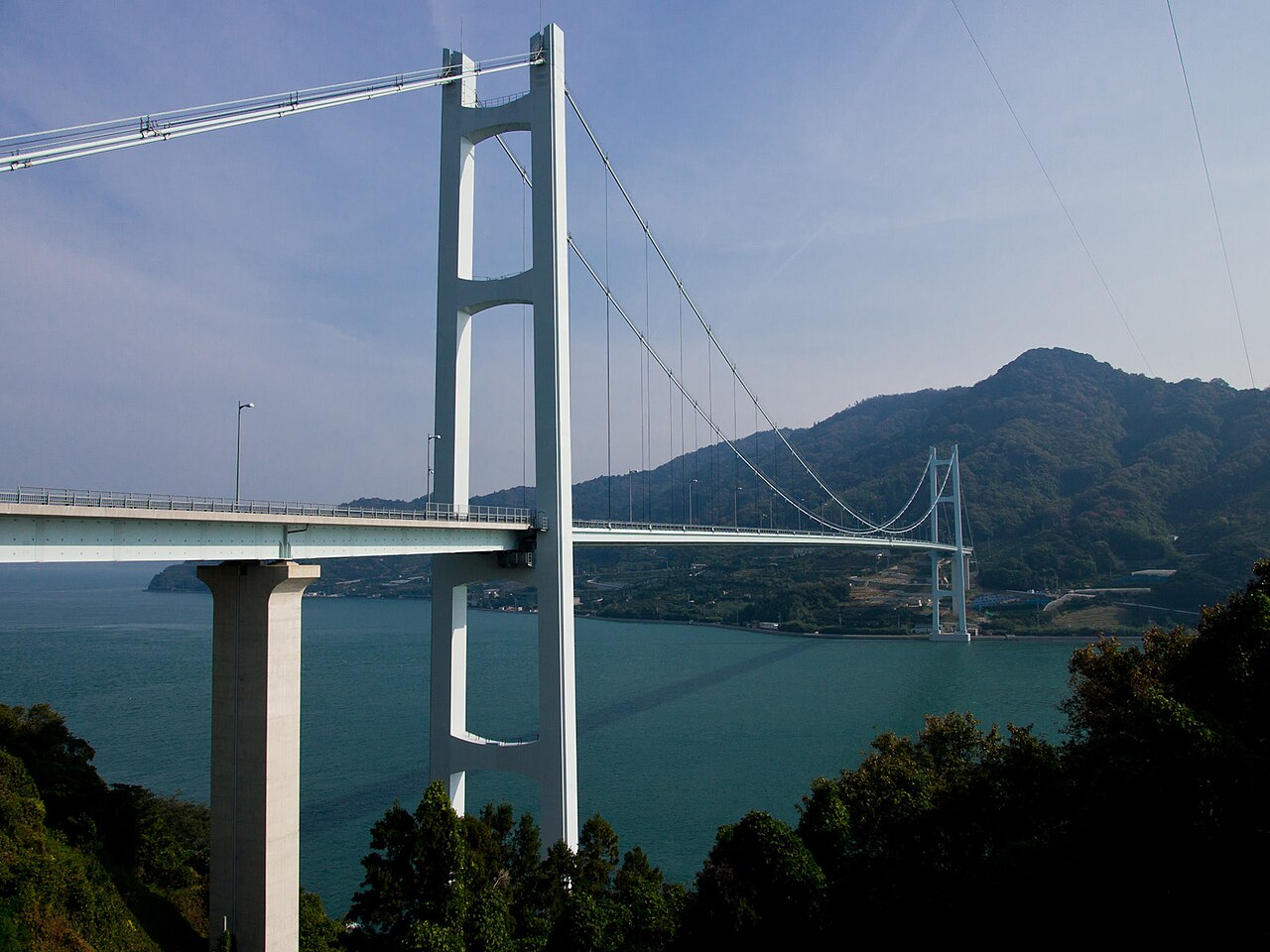
Key facts
| Location | Strait between Kami-Kamagari Island (Oura, Kamagari-cho) and Toyoshima (Toyohama-cho), Kure, Hiroshima Prefecture; Akinada islands route (Akinada Tobishima Kaido), Seto Inland Sea |
|---|---|
| Type | Single-span suspension bridge with a steel stiffening girder; earth-anchored on rock |
| Spans | Suspended span 540 m between towers (533 m girder); 3-span plate girder approach (41.0 + 41.6 + 41.2 m) and 4-span twin box girder approach (3 × 59.5 + 58.5 m); 903.2 m in total |
| Main span | 540 m |
| Towers | Steel, 109.5 m, each erected in a few large blocks |
| Deck | Steel stiffening girder with an orthotropic deck, 13.0 m wide: two lanes of 7.25 m and a 2.0 m footway |
| Main cable | Spun from 7.02 mm high-strength wire (7 mm class) |
| Cable erection | Air spinning |
| Navigation clearance | 50 m over a 540 m wide channel |
| Built | Project from 1999; opened 18 November 2008 |
| Owner | Hiroshima Prefecture and Hiroshima Prefectural Road Corporation |
| Design | CHODAI, Wesco and FUKKEN (design consultants) |
| Construction | Joint ventures including Mitsubishi Heavy Industries with Miyaji Iron Works (suspension bridge), Nippon Steel Engineering with Shinko Wire, and Yokogawa Bridge (approach girder) |
| Cost | About ¥24 billion |
Design
The span was set by the channel: the towers stand 540 m apart and give ships a channel 540 m wide with 50 m clearance. Only the main span is suspended; the approaches on both sides are continuous girder bridges.
Cost drove the design. The anchorages were founded directly on rock instead of on deep foundations. The cables were air spun from 7 mm-class wire, larger than the usual 5 mm class, which means fewer wires to spin for the same steel area. The towers were designed to go up in a few large blocks rather than many small segments, and the girder joints were designed to be welded all round, a detail chosen for durability. Dehumidification systems were built into the main cables, the girder and the towers from the start.
How it was built
Anchorages
Both anchorages bear directly on rock, a cheaper solution than the caisson or pile foundations of larger bridges.
Towers
The 109.5 m steel towers were erected in large blocks, each lifted in a single operation by a floating crane, instead of the usual many small segments placed by a climbing crane.
Cables
The main cables were spun on site by air spinning from 7.02 mm wire.
Deck
The suspended girder was erected with lifting beams and by lifting blocks straight up from below. The field joints between erection blocks were welded right round the cross-section. On the A1 to P2 side the approach girders were launched without a launching nose. The 903 m bridge contains 2,767 t of structural steel.
Key dates
| 1999 | Hiroshima Prefecture starts the project |
| 18 November 2008 | Opened to traffic |
| Fiscal 2008 | JSCE Tanaka Prize (works) and Zenken Award (roads) |
What engineers remember it for
- Japan's first large suspension bridge of the 21st century, and a catalogue of cost-cutting methods for medium spans.
- Cables spun from 7 mm-class wire rather than the usual 5 mm class.
- Dehumidification of cables, girder and towers from the start.
Construction records
The construction records below can be read in the browser or downloaded. Large scanned volumes may take a moment to open.
← All suspension bridge records
Related on TheBridgeEng
Questions engineers ask
- How were the Toyoshima Bridge towers erected?
- In large blocks, each lifted in a single operation by a floating crane, which was one of the measures used to cut the construction cost.
- Why were the Toyoshima Bridge cables spun from 7 mm wire?
- A larger wire means fewer wires to spin for the same steel area, which shortens the cable work; it was one of several cost-cutting measures on the bridge.
- How long is the Toyoshima Bridge?
- The suspended span is 540 m between the towers and the whole bridge, with its girder approaches, is 903.2 m long.
Sources
- JSCE Tanaka Prize 2008 (works): Toyoshima Bridge
- Hiroshima Prefecture: Akinada islands bridges, Route 3 Toyoshima Bridge
- MLIT: Toyoshima Bridge opening effects (road project effect sheet)
- MLIT road materials council: long-span bridge and high-strength cable tables
- Nagami Y., Fukaya S.: Aesthetic Design of TOYOSHIMA Bridge (Annual Design Review of JSSD 15(1), 2010)
- Structurae: structure 20086957 (Toyoshima Bridge)
- Bridgemeister: Toyoshima
- Monash bridge database: Toyoshima Bridge
- Wikipedia (ja): 豊島大橋
Updated 2026-11-13 · written by a practising bridge engineer