Suspension Bridge Records · Japan
Shimotsui-Seto Bridge: How It Was Built
A 940 m single-span suspension bridge carrying road and railway on the Seto-Ohashi route between Honshu and Shikoku, opened in 1988.
The Shimotsui-Seto Bridge is the northernmost of the six long-span bridges of the Seto-Ohashi route, which links Kojima in Okayama with Sakaide in Kagawa. It spans from Mount Washu on Honshu to the island of Hitsuishijima, carrying the Seto-Chuo Expressway on its upper deck and the JR Seto-Ohashi Line on its lower deck.
Only its 940 m main span is suspended. The stiffening truss is cantilevered out into the 230 m side spans instead, which made it the first single-span suspension bridge in the world with overhanging spans, and its main cables were spun on site, while the other suspension bridges of the route used prefabricated strands.
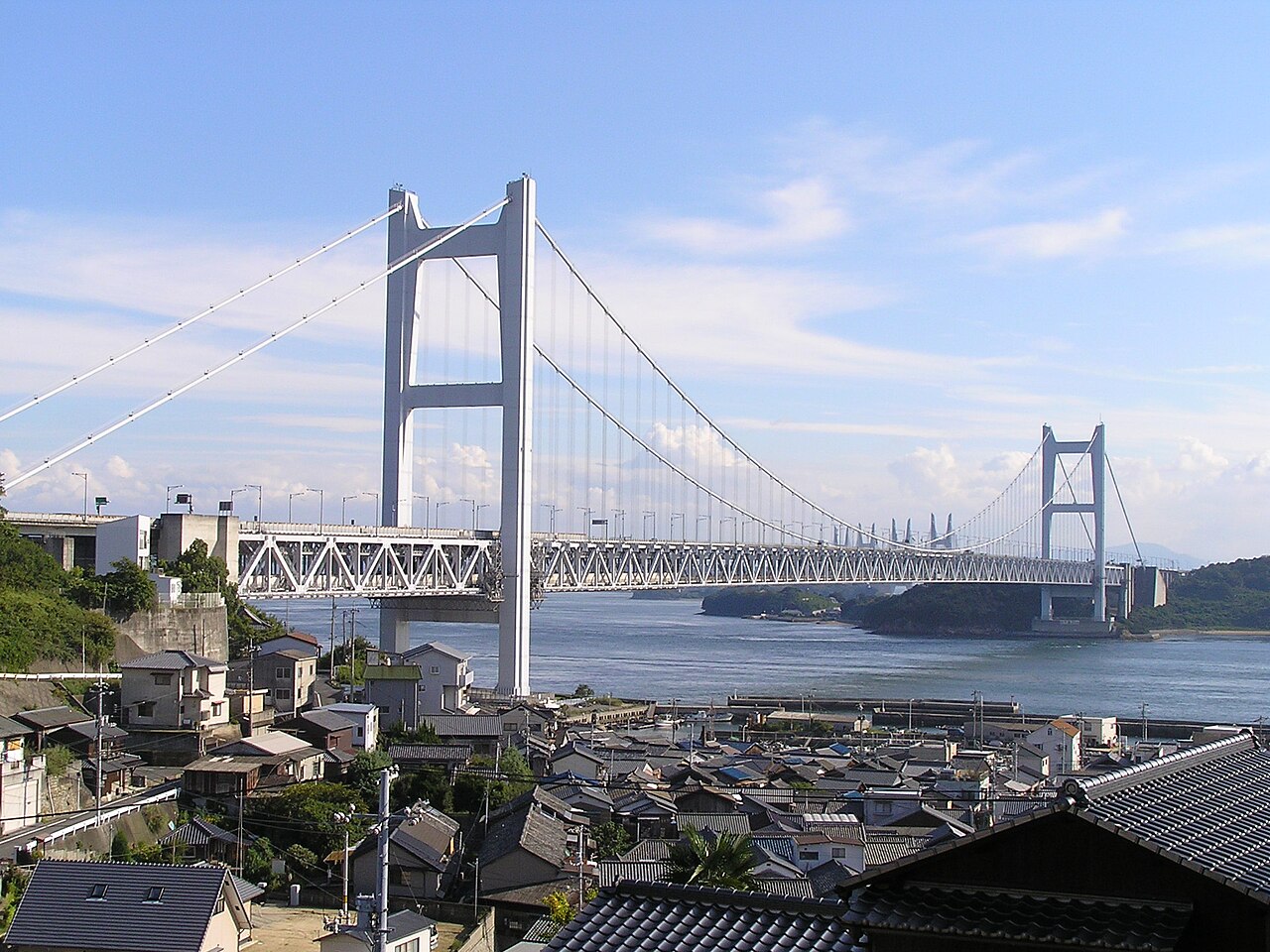
Key facts
| Location | Shimotsui Strait, between Mt Washu (Washuzan), Kojima, Okayama (Honshu) and Hitsuishijima Island, Kagawa; northernmost bridge of the Seto-Ohashi (Kojima-Sakaide) route |
|---|---|
| Type | Single-span suspension bridge with a double-deck steel stiffening truss cantilevered into the side spans; earth-anchored |
| Spans | 230 + 940 + 230 m (only the 940 m main span is suspended) |
| Main span | 940 m |
| Towers | Steel, tower top 149 m above datum |
| Deck | Double-deck steel stiffening truss: expressway above, railway below |
| Main cable | Two cables, 936 mm in diameter, spun on site from 5.37 mm wire |
| Cable erection | Air spinning |
| Navigation clearance | 31 m |
| Built | On-site work from 12 July 1981; opened 10 April 1988 |
| Owner | Honshu-Shikoku Bridge Authority (now Honshu-Shikoku Bridge Expressway) |
| Design | Honshu-Shikoku Bridge Authority |
Design
The ground set the form. On the Honshu side the bridge comes out of Mount Washu, part of the Seto Inland Sea National Park, so the anchorage there is a tunnel anchorage driven into the hillside to spare the landscape. The topography also left no room for suspended side spans. Instead the stiffening truss was cantilevered into the side spans, which reduces the angle break in the deck at the ends of the suspended span, important for a railway.
Air spinning was chosen for the main cables because it allowed a smaller cable cross-section at the tunnel anchorage than prefabricated strands would have needed. A 1990 ASCE paper describes the advanced air spinning method developed for the bridge through wind-resistance testing. At the northern end the Washuzan Tunnel was built as a four-bore structure, the two upper bores for the expressway and the two lower for the railway, which the owner describes as the first such structure in the world.
How it was built
Foundations and anchorages
Site work started with excavation for the 4A anchorage, which sits on a direct foundation. Tower pier SB2P stands on a pneumatic caisson and SB3P on a direct foundation. The substructure used about 204,000 m³ of concrete and 21,400 t of steel; the superstructure about 66,000 t of steel.
Pilot rope
Closing the shipping lane was difficult, so the pilot rope was carried across the strait while a crane barge held it high above the water, clear of passing ships.
Main cables
The two cables were spun on site from wire of 5.37 mm, pulled across the strait by spinning wheels and finished at 936 mm in diameter.
Railway
Before the route opened, test trains of up to about 1,000 t were run over the bridges. Along the route, buffer girders were developed and installed at the girder ends to ease the stretching, contraction and bending of the deck that could otherwise endanger trains.
Key dates
| 10 October 1978 | Ground-breaking for the Seto-Ohashi route |
| 12 July 1981 | On-site construction of the bridge begins |
| 10 April 1988 | Route opens to road and rail traffic |
What engineers remember it for
- The first single-span suspension bridge in the world with cantilevered side spans.
- The only one of the route's suspension bridges with air-spun cables, chosen to suit the tunnel anchorage.
- The four-bore Washuzan Tunnel stacks the expressway over the railway at the bridge's northern end.
Construction records
The construction records below can be read in the browser or downloaded. Large scanned volumes may take a moment to open.
← All suspension bridge records
Related on TheBridgeEng
Questions engineers ask
- Why are the side spans of the Shimotsui-Seto Bridge not suspended?
- The topography left no room for suspended side spans, so the stiffening truss was cantilevered into them, which also reduces the angle break in the deck at the ends of the main span.
- Why were the Shimotsui-Seto Bridge cables air spun?
- Air spinning gave a smaller cable cross-section at the tunnel anchorage in Mount Washu than prefabricated strands would have needed.
Sources
- HSBE Seto-Ohashi: 下津井瀬戸大橋 (data and features)
- HSBE: Shimotsui-Seto Bridge (English introduction)
- HSBE route guide: E30 Seto-Chuo Expressway (Seto-Ohashi Bridges)
- HSBE Seto-Ohashi: ケーブルの架設 (cable erection)
- HSBE Seto-Ohashi: 仕上げ (finishing and opening)
- TRID record: Matsuzaki, Uchikawa, Mitamura, Advanced fabrication and erection techniques for long suspension bridge cables, ASCE J. Constr. Eng. Manage. 116(1), 1990
- Bridgemeister: Shimotsui-Seto
- Wikipedia: Great Seto Bridge
Updated 2026-11-13 · written by a practising bridge engineer