Suspension Bridge Records · China
Runyang Yangtze River Bridge: How It Was Built
A 1,490 m single-span suspension bridge over the south channel of the Yangtze between Zhenjiang and Yangzhou, opened in 2005: the longest span in China at the time.
The Runyang crossing links Zhenjiang and Yangzhou in Jiangsu with two main bridges, separated by Shiyezhou island: the South Bridge, a suspension bridge with a 1,490 m span, and the North Bridge, a cable-stayed bridge of 176 + 406 + 176 m. This page is about the South Bridge. Work on the crossing began in October 2000 and it opened on 30 April 2005, ahead of schedule.
At completion its span was the longest in China and the third longest suspension span in the world, after Akashi Kaikyo and Great Belt East. Only the main span is suspended; the 470 m side spans carry the cables to the anchorages, and the approaches are not hung from them.
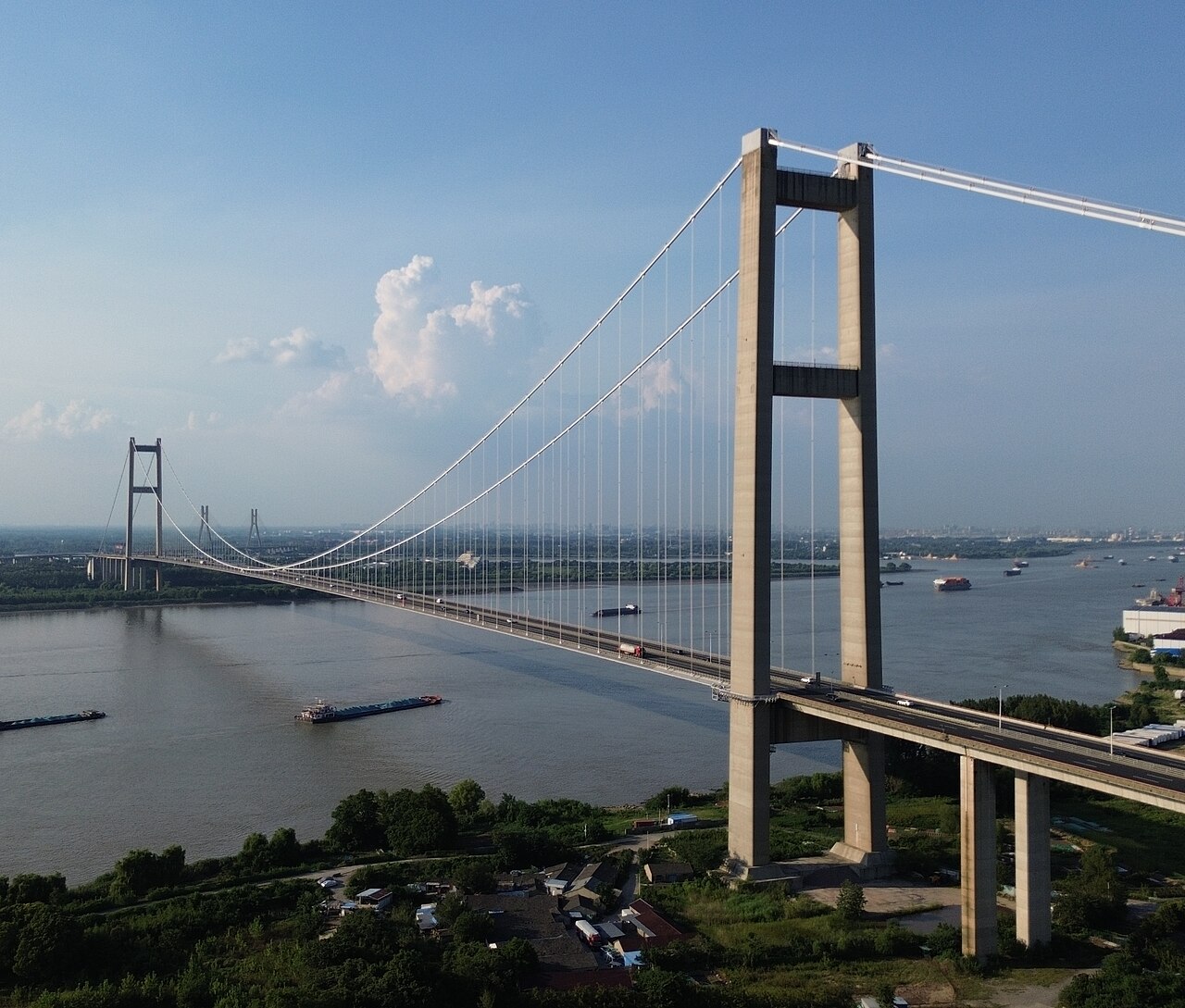
Key facts
| Location | South branch of the Yangtze River, between Zhenjiang (south bank) and Shiyezhou island, on the Zhenjiang to Yangzhou crossing, Jiangsu |
|---|---|
| Type | Single-span suspension bridge with a flat streamlined steel box girder; earth-anchored with gravity anchorages |
| Spans | 470 + 1,490 + 470 m (only the main span is suspended) |
| Main span | 1,490 m |
| Sag ratio | 1/10 |
| Towers | Reinforced concrete portal towers with three cross beams, about 215 m, on 2.8 m bored piles |
| Deck | Fully welded streamlined steel box, 38.7 m wide and 3.0 m deep, in 16.1 m segments |
| Main cable | 2 cables 34.3 m apart, each 184 strands × 127 galvanised wires of 5.30 mm, 1,670 MPa; about 906 mm in diameter (895 mm at the clamps) |
| Cable erection | Prefabricated parallel wire strands (PPWS), hauled by a double-line reciprocating traction system |
| Hangers | PE-sheathed parallel wire strands of 5.0 mm wire, pinned at both ends |
| Navigation clearance | 50 m over a 390 m wide channel |
| Built | Crossing built from October 2000; deck closed 17 April 2004; opened 30 April 2005 |
| Owner | Jiangsu Provincial Yangtze River Highway Bridge Construction Commanding Department |
| Design | Highway Planning and Design Institute of the Ministry of Communications |
| Construction | China Road and Bridge Group and the Second Highway Engineering Bureau; Dorman Long Technology (deck erection gantries); T.Y. Lin International (special consultant) |
| Cost | CNY 5.8 billion for the whole crossing, both bridges |
Design
Sea-going ships need a channel 390 m wide with 50 m clearance in the south channel, and barge fleets 700 m with 24 m clearance. A single 1,490 m suspended span clears the river completely. The sag ratio of 1/10 was chosen from options between 1/9 and 1/10.5, and the basic design wind speed is 29.1 m/s.
The deck is a fully welded, flat streamlined steel box 38.7 m wide and 3.0 m deep, with a depth-to-span ratio of 1/497. The standard segment is 16.1 m long and weighs about 470 t. The 14 mm deck plate is stiffened by U-ribs, with diaphragms at about 3 m. The expansion joints at the deck ends, supplied by mageba, were designed for 2,160 mm of movement.
The two anchorages are gravity blocks with a prestressed anchor system, but their foundations differ. The south anchorage was excavated inside a rectangular retaining wall of bored piles, sealed against groundwater by an artificially frozen curtain of soil and braced inside by reinforced concrete, to a base level of minus 26 m. The north anchorage was excavated in stages inside a rectangular diaphragm wall, to minus 45 m, and founded on weathered rock.
How it was built
Anchorages against the flood season
The anchorage foundations had to be installed before the May to August flood season, and the underground work took two years, as planned. The north anchorage pit combined the diaphragm wall with inner linings and was then filled with reinforced concrete.
Towers
The concrete towers, about 215 m high, have box-section legs that taper from 6 × 12.5 m at the base to 6 × 9.5 m at the top, joined by three cross beams. They stand on bored piles 2.8 m in diameter.
Cables
Each main cable was built from 184 prefabricated parallel wire strands of 127 galvanised wires of 5.30 mm. The strands were hauled across by a double-line reciprocating traction system, the method used on the Akashi Kaikyo Bridge, which improved the speed of cable erection. The cables were compacted to about 906 mm, with 20 percent voids, and 895 mm at the cable clamps.
Deck
The steel main span was divided into 47 deck units of up to 470 t, made off site, floated into position beneath the cables and lifted by cable-mounted gantries of 130 t each, designed and supplied by Dorman Long Technology. A pair of gantries could erect one unit a day, and all 47 units went up in 12.5 weeks; the closure unit was placed on 17 April 2004. The gantries could set the deck level to within 0.5 mm. The deck was surfaced with 50 mm of two-layer epoxy asphalt, which had needed only local repairs, with no overhaul, by 2020.
Key dates
| October 2000 | Construction of the Runyang crossing begins |
| 17 April 2004 | Closure unit of the suspension bridge deck placed |
| 30 April 2005 | Crossing opened to traffic, ahead of schedule |
What engineers remember it for
- The longest span in China and the third longest suspension span in the world on completion.
- A frozen-soil curtain sealed the south anchorage excavation against groundwater beside the Yangtze.
- All 47 deck units were erected in 12.5 weeks.
Construction records
The construction records below can be read in the browser or downloaded. Large scanned volumes may take a moment to open.
← All suspension bridge records
Related on TheBridgeEng
Questions engineers ask
- How was the Runyang Bridge deck erected?
- In 47 steel units of up to 470 t, floated under the cables and lifted by pairs of 130 t cable-mounted gantries at up to one unit a day. All 47 were erected in 12.5 weeks and the closure unit was placed on 17 April 2004.
- Is the Runyang Bridge a suspension bridge or a cable-stayed bridge?
- Both: the Runyang crossing has a 1,490 m suspension bridge over the south channel of the Yangtze and a cable-stayed bridge with a 406 m main span over the north channel.
- How were the Runyang Bridge anchorages built?
- As gravity anchorages in deep rectangular pits: the south one inside bored-pile walls sealed by ground freezing, to minus 26 m, and the north one inside a diaphragm wall, to minus 45 m on weathered rock.
Sources
- Wikipedia: Runyang Bridge (Runyang Yangtze River Bridge)
- DLT Engineering: Runyang Bridge deck erection gantries
- Design and construction of super-long span bridges in China: review and future perspectives (Frontiers of Structural and Civil Engineering, 2020)
- Dabrowiecki, Two-hundred-year history of modern suspension bridges, part 3 (Nowoczesne Budownictwo Inzynieryjne, 2020)
- Prestress Technology 2017: traction system for main cable erection of Liangqing Bridge (mentions Runyang double-line reciprocating traction)
- Structurae: Runyang Yangtze River North Bridge
- Monash bridge database: Runyang Yangtze River South Bridge
- Construction Digital: Runyang Bridge
Updated 2026-11-13 · written by a practising bridge engineer