Suspension Bridge Records · Japan
Rainbow Bridge, Tokyo: How It Was Built
A 570 m double-deck suspension span over the entrance to Tokyo Port, opened in 1993, carrying an expressway, a port road, the Yurikamome transit line and two walkways.
The Rainbow Bridge, officially the Tokyo Port Connector Bridge, links Shibaura with the Daiba waterfront across the Tokyo Port No. 1 Channel. The idea came from the Tokyo Metropolitan Government's waterfront sub-centre plan of 1979, and its popular name was chosen by public contest. The 798 m suspension bridge is only the centre of a structure more than 3 km long: on the Shibaura side the approach climbs in a 1,026 m loop over the water to reach deck level.
The upper deck carries the Shuto Expressway Daiba Route; the lower deck carries a port road, the Yurikamome automated transit line and two walkways, about 1.7 km from end to end. At night it is lit white or in rainbow colours, depending on the season and on events.
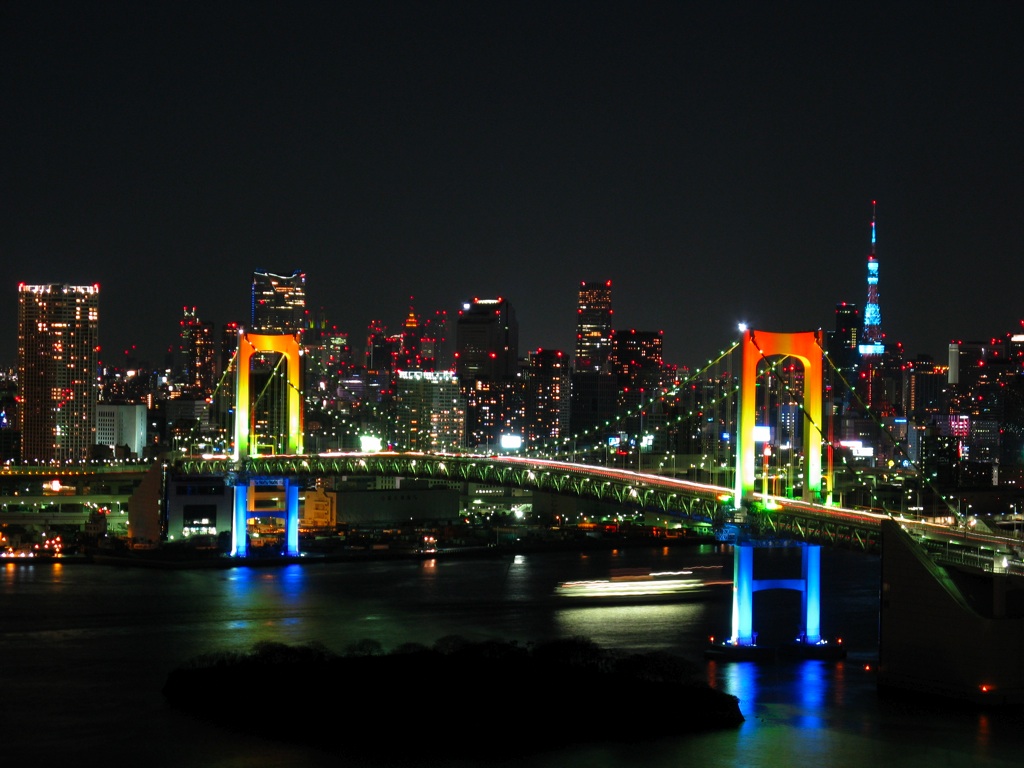
Key facts
| Location | Northern Tokyo Bay over the Tokyo Port No. 1 Channel, between Shibaura and Daiba (Odaiba), Minato, Tokyo |
|---|---|
| Type | Three-span, two-hinged suspension bridge with a double-deck stiffening truss; earth-anchored |
| Spans | 114 + 570 + 114 m (798 m; 918 m including the anchorages) |
| Main span | 570 m |
| Towers | Steel box-section rigid frames, 126 m, with an arched top cross beam |
| Deck | Double-deck steel Warren truss, 8.9 m deep and about 29 m wide |
| Main cable | Two cables of 762 mm, each of 127 prefabricated strands × 127 wires of 5.37 mm; about 5,500 t of cable |
| Cable erection | Prefabricated parallel wire strands (PPWS) |
| Navigation clearance | 50 m over a 500 m wide channel |
| Built | Construction from January 1987; opened 26 August 1993 |
| Owner | Tokyo Metropolitan Government (Port and Harbour Bureau) and Metropolitan Expressway Public Corporation |
| Construction | An Obayashi, Kajima and Shimizu joint venture under the Tokyo port construction bureau; Kawasaki Heavy Industries is also named as builder |
Design
The site set two hard limits. Ships needed a channel 500 m wide with 50 m clearance, while the approach to Haneda Airport capped the height of anything built there at 155 m. A cable-stayed scheme would have needed pylons about 200 m high, so a suspension bridge with towers of about 126 m was chosen.
An aesthetics committee shaped details such as the rounded tower edges and the form of the anchorages, whose roofs follow the line of the main cables. The Shibaura anchorage is a building with a sloping top that also holds a lift up to the walkway. The concrete anchor blocks measure about 70 × 49 × 41 m and take main cable forces of up to 230 MN.
How it was built
Foundations on soft ground
In about 12 m of water, soft sediments lie over the bearing stratum, which is reached at a depth of 30 to 38 m. The tower foundations and the anchor blocks were sunk as pneumatic caissons about 70 × 40 m in plan, working at an air pressure of 3.5 bar. Remote-controlled excavators fitted with video cameras dug inside the working chamber, and the spoil was carried out by conveyor belt. Few suspension bridges in the world stand on such soft rock, and the settlement of the layers below was assessed over a 100-year period.
Towers
The steel towers are box-section rigid frames about 126 m high. While they stood free during erection, wind-induced vibration was observed; after wind tunnel tests, active damping devices were installed at the tower tops.
Cables
Each main cable was built up from 127 prefabricated parallel wire strands of 127 wires of 5.37 mm and finished at 762 mm in diameter, about 5,500 t of cable in all.
Deck
The double-deck Warren truss, 8.9 m deep and about 29 m wide, was hung from the cables to carry the expressway above and the port road, the transit line and the walkways below.
Key dates
| 1979 | Waterfront sub-centre plan proposes the link |
| January 1987 | Construction begins |
| 26 August 1993 | Opened to traffic |
What engineers remember it for
- The bridge lighting won an IES Paul Waterbury award.
- Active dampers at the tower tops were added after wind-induced vibration of the free-standing towers.
- The suspension section with its anchorages is 918 m long; the Shibaura approach is 1,465 m including the loop, and the Daiba approach 1,367 m.
Construction records
The construction records below can be read in the browser or downloaded. Large scanned volumes may take a moment to open.
← All suspension bridge records
Related on TheBridgeEng
Questions engineers ask
- Why is the Rainbow Bridge a suspension bridge and not cable-stayed?
- Aircraft approaching Haneda Airport limited structures at the site to 155 m. A cable-stayed bridge across the 500 m channel would have needed pylons about 200 m high, so a suspension bridge with towers of about 126 m was chosen.
- What does the Rainbow Bridge carry?
- The Shuto Expressway on the upper deck, and a port road, the Yurikamome automated transit line and two walkways on the lower deck.
- How were the Rainbow Bridge foundations built?
- As pneumatic caissons about 70 × 40 m in plan, excavated under 3.5 bar of air pressure by remote-controlled excavators with video cameras, down to a bearing stratum 30 to 38 m deep.
Sources
- Yamazaki, Izumi, Ogihara: The Rainbow Bridge, Japan (Structural Engineering International 4(4), 1994), Structurae record
- Dabrowiecki K.: Mosty Japonii, part 2 (Nowoczesne Budownictwo Inzynieryjne, 2010)
- Structurae: Rainbow Bridge (1993)
- Structurae: Rainbow Bridge (structure 20004664)
- Tokyo Rope: bridge cable catalogue (reference list)
- MLIT road materials council: long-span bridge and high-strength cable tables
- Highlighting Japan, March 2024 (Government of Japan)
- Doboku Hakubutsukan (civil engineering museum): Rainbow Bridge
- Mynavi: infrastructure series no. 25, Rainbow Bridge
- Miyamoto International: Tokyo Bay (Rainbow) Bridge
Updated 2026-11-13 · written by a practising bridge engineer