Suspension Bridge Records · Japan
Kurushima Kaikyo Bridges: How They Were Built
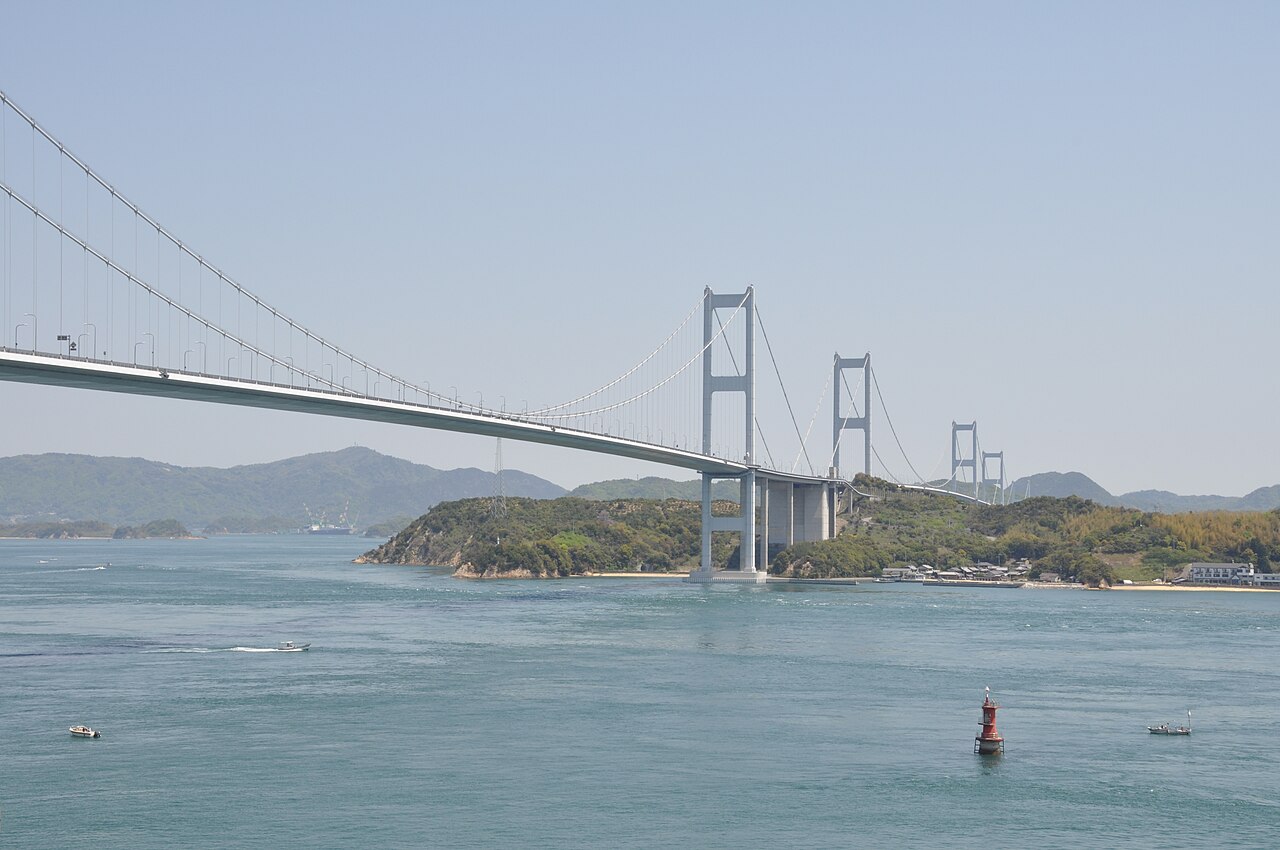
Three suspension bridges in a row across the Kurushima Strait, opened together in 1999: the first series of three continuous suspension bridges in the world.
The Kurushima Kaikyo Bridges carry the Nishi-Seto Expressway (Shimanami Kaido) from Ōshima to Imabari on Shikoku. The strait is about 4 km wide, its tidal currents reach 10 knots and about 10,000 ships a day pass through it. Instead of one huge span, the crossing uses three suspension bridges joined end to end by two shared anchorages: six towers and four anchorages, about 4.1 km in all.
The three bridges are different structures. The First bridge is a three-span suspension bridge with a 600 m main span, the Second a two-span bridge with a 1,020 m main span and a suspended 250 m side span, and the Third a single-span bridge with a 1,030 m main span and unsuspended side spans. They opened together on 1 May 1999.
Key facts
| Location | Kurushima Strait, Ehime, between Ōshima Island and Imabari (Shikoku), via the islets of Mushijima and Umashima |
|---|---|
| Type | Three suspension bridges in series with flat steel box girders; earth-anchored, with two shared anchorages |
| Spans | First 140 + 600 + 170 m; Second 250 + 1,020 + 245 m (two spans suspended); Third 260 + 1,030 + 280 m (side spans not suspended); about 4,105 m in all |
| Main span | 1,030 m |
| Towers | Six steel towers of cruciform section tapering towards the top; tower tops 149 m (First) and 184 m (Second and Third) |
| Deck | Flat hexagonal steel box girder, 27 m wide; 2.5 m deep (First) to 4.3 m (Third) |
| Main cable | Diameter 431 mm (First), 653 mm (Second), 636 mm (Third); Third bridge 102 strands × 127 wires per cable; about 8,400 t (Second) and 8,200 t (Third) of cable |
| Cable erection | Prefabricated parallel wire strands (PPWS) |
| Navigation clearance | 65 m |
| Built | Ground-breaking May 1988; opened 1 May 1999 |
| Owner | Honshu-Shikoku Bridge Authority (now Honshu-Shikoku Bridge Expressway) |
| Design | Honshu-Shikoku Bridge Authority |
Design
A single span across the whole strait was never needed. Spreading the crossing over three suspension bridges, linked by two anchorages that each serve two bridges, kept the spans to 600 to 1,030 m while leaving the main shipping channels clear. The anchorages between the bridges hold cables pulling in opposite directions, which balances much of the load on them.
All three bridges use a flat hexagonal steel box girder 27 m wide, a streamlined section with good wind stability. The towers have a cruciform section that tapers towards the top, and their shafts use tension-type bolted joints with the splice bolts hidden inside. On the Imabari side, the 10A anchorage at Itoyama is a tunnel anchorage, chosen to keep changes to the scenic hillside to a minimum.
How it was built
Foundations in a tidal race
The undersea foundations are cylindrical caissons, mostly placed by the laying-down caisson method developed on the earlier Seto-Ohashi and Akashi Kaikyo bridges. The seabed was excavated with large grab dredgers after the rock had been broken with rock-breaking rods. The three bridges together used about 474,000 m³ of substructure concrete.
Towers
Vibration damping devices were fitted to the towers during erection to control wind-induced oscillation while they stood free.
Cables
The main cables were built from prefabricated parallel wire strands of 127 wires; the Third bridge has 102 strands per cable. They were wrapped with watertight S-shaped wire and fitted from the outset with a system that blows dry air through the cable. The air plant sits inside the tower's intermediate cross beam, and humidity is monitored remotely, with alarm e-mails when it rises above the 40 percent target. In summer the First and Second bridges exceeded the target because the intake air was warm; the Third bridge, which has a dehumidifier at its intake, mostly stayed within it. When the cables were opened for a wire survey, there was no moisture and only slight white rust on the outer wires.
Deck
The box girder was erected by lifting prefabricated blocks straight up from a self-propelled barge. An automatic position control system developed for the project held the barge on station in the strong currents without mooring ropes. The three superstructures used about 27,000 t (First), 49,000 t (Second) and 46,000 t (Third) of steel.
Key dates
| May 1988 | Ground-breaking |
| 1 May 1999 | The three bridges open together with the Nishi-Seto Expressway |
What engineers remember it for
- The first series of three continuous suspension bridges in the world.
- Barge-lifted deck blocks placed without mooring ropes, using an automatic position control system, in currents of up to 10 knots.
- Dry-air cable protection from the start, with remote humidity monitoring.
Construction records
The construction records below can be read in the browser or downloaded. Large scanned volumes may take a moment to open.
← All suspension bridge records
Related on TheBridgeEng
Questions engineers ask
- Why are there three Kurushima Kaikyo Bridges instead of one?
- The 4 km strait was crossed with three suspension bridges joined by two shared anchorages, which kept the spans to between 600 m and 1,030 m while leaving the shipping channels clear.
- How was the Kurushima Kaikyo Bridge deck erected?
- Prefabricated box girder blocks were lifted straight up from a self-propelled barge that held its position in the strong tidal current with an automatic position control system, without mooring ropes.
- How are the Kurushima Kaikyo Bridge cables protected?
- They are wrapped with watertight S-shaped wire, and dry air is blown through them, with the humidity monitored remotely against a 40 percent target.
Sources
- HSBE Shimanami Kaido: 来島海峡大橋 (data table and features)
- HSBE: Kurushima-Kaikyo Bridges (English introduction)
- HSBE route guide: E76 Nishi-Seto Expressway
- HSBE letter: lecture 'World's first triple suspension bridge: Kurushima Kaikyo Bridge technology'
- JSCE Civil Engineering in Japan 1997: Nishiseto Expressway's Kurushima Bridge
- MLIT infrastructure tourism: 来島海峡大橋
- JSCE Tanaka Award candidate: suspension bridge cable dry-air injection system (2019)
- Structurae: Kurushima Kaikyo Bridge
- Structurae: First Kurushima-Kaikyo Bridge
- Structurae: Third Kurushima-Kaikyo Bridge
Updated 2026-11-13 · written by a practising bridge engineer