Suspension Bridge Records · Kazakhstan
Irtysh River Bridge, Semey: How It Was Built
A 750 m suspension span over the Irtysh River in Semey (formerly Semipalatinsk), Kazakhstan, opened in 2000: the first suspension bridge in a CIS country.
The Irtysh River Bridge, locally the "New Bridge", crosses the Irtysh in Semey, the former Semipalatinsk, about 800 m downstream of an older reinforced concrete bridge on which only two of four lanes could be used. It was built by Ishikawajima-Harima Heavy Industries (IHI) with Katahira & Engineers as consultant, financed largely by a Japanese ODA loan.
It was the first suspension bridge in a CIS country. Traffic across the river more than doubled after it opened, and in 2006 the new bridge carried more than 44,000 vehicles a day.
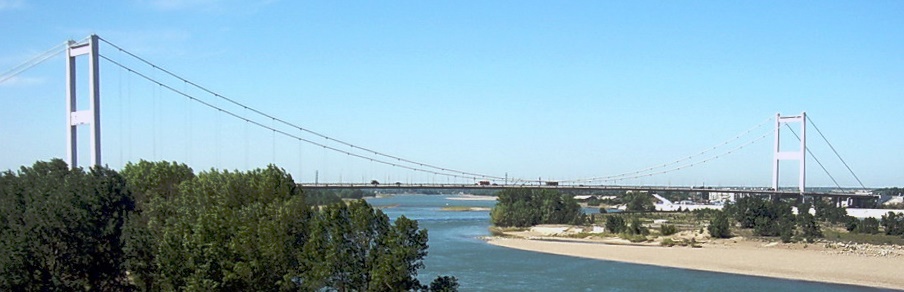
Key facts
| Location | Across the Irtysh River in Semey (formerly Semipalatinsk), Abai Region (formerly East Kazakhstan Region) |
|---|---|
| Type | Single-span suspension bridge with a steel stiffening girder; earth-anchored |
| Spans | 168 + 750 + 168 m (the 168 m side spans are approach viaducts); 1,086 m in all |
| Main span | 750 m |
| Towers | Steel, 90.5 m |
| Deck | Steel stiffening girder, 35 m wide, six lanes |
| Navigation clearance | 24 m |
| Built | April 1998 to November 2001; opened to traffic November 2000 |
| Owner | Akimat of the Semipalatinsk Region (now East Kazakhstan); handed to Semey City in 2008 |
| Design | Katahira & Engineers (consultant) with IHI |
| Construction | Ishikawajima-Harima Heavy Industries (IHI) |
| Cost | ¥29,964 million for the whole project, of which ¥21,236 million from a Japanese ODA loan |
Design
Concrete, steel box girder, cable-stayed and suspension schemes were compared. The suspension bridge was chosen because it needs no piers or towers in the river, which allowed work to continue all year, including in winter when the Irtysh freezes. As built, the bridge grew from the planned 880 m length, 670 m main span and 34.27 m width to 1,086 m, 750 m and 35 m.
The climate is extreme, with an annual temperature range of about plus or minus 50 °C. The bearings, supplied by mageba, were made from materials tested at -50 °C: pendulum bearings up to 6.70 m long and 8,000 kg at both ends of the deck to resist uplift, wind shoes at each abutment and 20 spherical bearings rated up to 10,500 kN. The whole bearing package was designed, made and delivered in 14 weeks. The deck waterproofing was also chosen for the harsh climate.
How it was built
Contract
A Japanese ODA yen loan of ¥21,530 million was signed in March 1997, and ¥21,236 million had been disbursed by June 2004. IHI was main contractor and Katahira & Engineers main consultant. The main supports, steel girders and cables were ordered as one package, which the evaluation credits with shortening construction. More than 500 local staff were hired and trained to international construction standards.
Bridge and roads
The wider contract included 1,564 m of approach road, 6,837 m of access roads on the two banks, five railway and highway underpasses and 20,500 m² of mastic asphalt surfacing. A tunnel for a sewage pipe was paid for entirely by Kazakhstan.
Opening
The bridge opened to traffic in November 2000, about a year ahead of the planned October 2001 opening, and the project works were completed in November 2001. The total cost was ¥29,964 million, about 6 percent over the ¥28,321 million plan.
Key dates
| March 1997 | Japanese ODA loan agreement signed |
| April 1998 | Construction begins |
| November 2000 | Opened to traffic, about a year early |
| November 2001 | Construction works complete |
| 2001 | Tolls on the new bridge abolished |
| September 2006 | Traffic counts: 44,402 vehicles a day on the new bridge |
| April 2008 | Bridge handed over to Semey City |
After opening
A JICA ex-post evaluation found that traffic over the river had risen to 79,289 vehicles a day by September 2006, 2.4 times the level before the project and 1.9 times the forecast, with 56 percent on the new bridge. The city's industrial output grew by 21 percent in 2004 and 15 percent in 2005.
The same evaluation warned about maintenance. In 2007 no maintenance agency or budget had yet been set up, the maintenance equipment supplied with the project was in storage, and repairs to the cables would need engineers from outside Kazakhstan. The structure and surfacing were still in good condition, which the evaluators put down to strict quality standards for the extreme climate and the absence of salt. The bridge was handed over to Semey City in 2008.
Construction records
The construction records below can be read in the browser or downloaded. Large scanned volumes may take a moment to open.
← All suspension bridge records
Related on TheBridgeEng
Questions engineers ask
- Why was the Irtysh River Bridge built as a suspension bridge?
- It needs no piers or towers in the river, which allowed work to go on all year, including in winter when the river is frozen.
- Who built the Irtysh River Bridge in Semey?
- Ishikawajima-Harima Heavy Industries (IHI) of Japan, with Katahira & Engineers as consultant, financed largely by a Japanese ODA loan.
Sources
- JICA ex-post monitoring report (2012): Irtysh River Bridge Construction Project
- JICA ex-post evaluation 2007, project 39 (English)
- JICA ex-post evaluation 2007, project 39 (Japanese)
- JICA project page: Irtysh River Bridge Construction Project (KAZ-P2)
- Structurae: Semipalatinsk Irtysh River Bridge
- Structurae: literature list (Ewert, Stahlbau 70(2) 2001; Bridge Design & Engineering 6(21) 2000)
- Bridgemeister: Semey (Semipatalinsk Irtysh River)
- mageba reference sheet: Irtysh River Bridge
- mageba reference detail: Irtysh River Bridge
- Alarko: Irtish River Bridge and Approach Roads Project
Updated 2026-11-13 · written by a practising bridge engineer