Suspension Bridge Records · South Korea
Gwangan Bridge, Busan: How It Was Built
A double-deck suspension bridge of 200 + 500 + 200 m across the bay off Gwangalli Beach in Busan, opened in 2003: the centre of the 7.42 km Gwangan Expressway and Korea's longest suspension span until 2012.
Gwangan Bridge (Gwangandaegyo, also written Kwangan) crosses the bay in front of Gwangalli Beach and links Suyeong-gu with Haeundae-gu in Busan. Its 900 m suspension bridge is the centre of the 7.42 km Gwangan Expressway, which also has truss bridges with 120 m spans and steel box girder approaches. The two decks, each about 18 m wide, carry four lanes of traffic in one direction each.
When it opened it was the longest suspension bridge in Korea, and it kept that title until Yi Sun-sin Bridge opened in 2012. It was built against a fixed date: the Busan Asian Games and the FIFA World Cup in 2002. The bridge opened temporarily for the Asian Games and fully in January 2003.
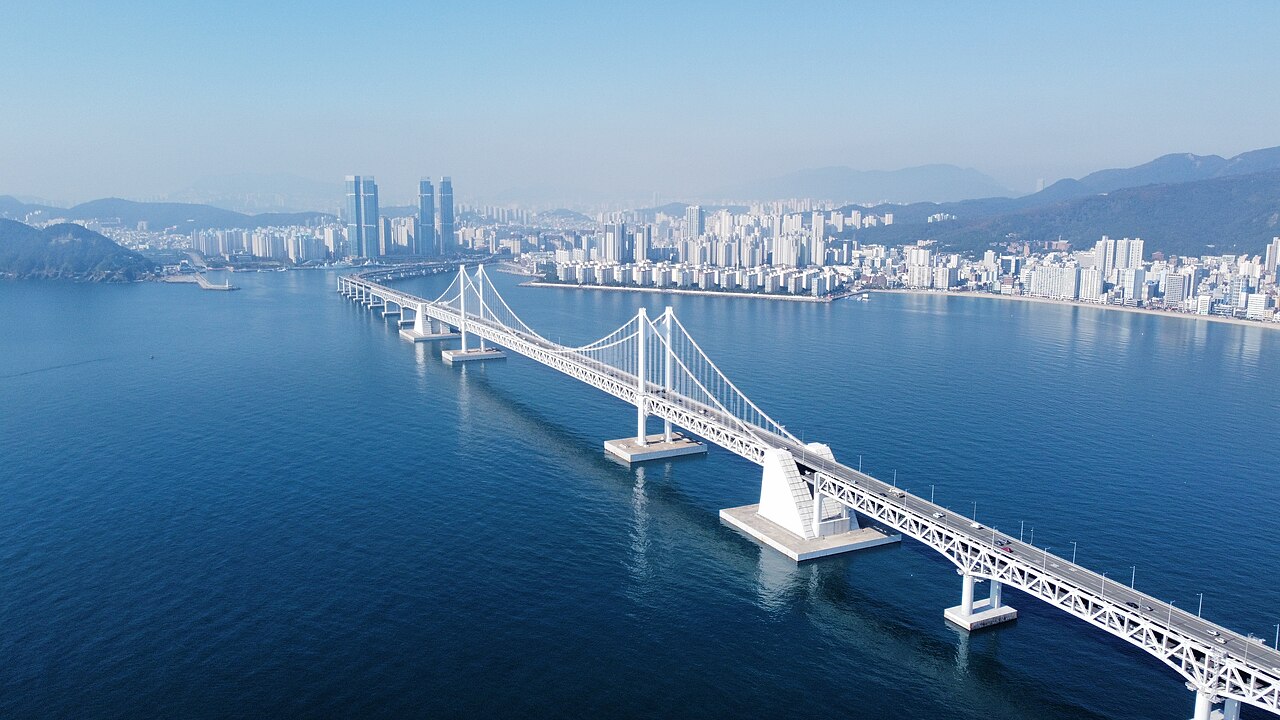
Key facts
| Location | Across the bay off Gwangalli Beach, Busan, linking Suyeong-gu and Haeundae-gu |
|---|---|
| Type | Three-span suspension bridge with a double-deck steel stiffening truss; earth-anchored |
| Spans | 200 + 500 + 200 m (900 m suspension bridge in the 7.42 km Gwangan Expressway) |
| Main span | 500 m |
| Towers | Steel portal towers, each erected in three large pieces by floating crane |
| Deck | Double-deck steel stiffening truss; two decks about 18 m wide, four lanes each, one direction per deck |
| Cable erection | Air spinning |
| Built | December 1994 to December 2002; temporary opening for the Asian Games in 2002; full opening January 2003 |
| Owner | Busan Metropolitan City |
| Design | Design and build by the contractor; detailed design of the main girder and towers by Miyamoto International; independent peer review by Burgess & Niple with Steinman; independent analysis check by TDV with BT Consultants |
| Construction | Dong Ah Construction Industrial; construction engineering for tower and truss erection by T.Y. Lin International |
| Cost | KRW 789.9 billion for the whole Gwangan Expressway (KRW 280.2 billion national and KRW 509.7 billion city funding) |
Design
The bridge stands in water about 12 m deep in an open bay. The design criteria included a maximum wave height of 10.8 m, a maximum tidal current of 0.4 m/s, a tidal range of under 1 m and a wind speed of 45 m/s. The double-deck truss puts the two directions of traffic one above the other, which keeps an eight-lane bridge narrow. According to its construction engineer, the lower deck was also designed to take a future railway.
The project was let as design and build. A Korean law introduced after several structural collapses had made contractors responsible for their designs, so the design was reviewed independently. Burgess & Niple with Steinman peer reviewed the main cables, suspenders, towers, deck, stiffening truss, anchorages, foundations, fatigue, seismic and wind tunnel analyses, and TDV with BT Consultants checked the structural analysis, including the geometry, the construction-stage simulation and the final traffic and seismic analyses. Miyamoto International carried out the detailed design of the main girder and the towers.
How it was built
Towers
Both towers are steel. Each was fabricated in three large pieces, which floating cranes lifted onto the tower piers, so that each tower went up in three lifts instead of many small segments placed by a climbing crane. Dong Ah Construction had both towers complete by September 2000.
Main cables
The main cables were built on site by air spinning. Spinning wheels carried the wire across the spans between the anchorages, the wires were gathered into strands and adjusted to their sag, and the strands were then compacted into the round cable before the cable bands and suspenders were fitted. The Korean construction record in the documents below covers this work in detail.
Stiffening truss
The double-deck truss was prefabricated in about 47 large blocks, which were brought under the bridge on barges and lifted vertically by gantries running on the main cables. T.Y. Lin International, which provided construction engineering for the tower and truss erection, describes this as the first time the vertical lift method, normally used for box girder decks, was applied to a stiffening-truss suspension bridge. Lifting whole blocks kept the work in the bay short and avoided assembling the truss member by member over the water.
Programme
Work on the expressway ran from December 1994 to December 2002. In 2000 the target was completion in April 2002, ahead of the Asian Games and the World Cup. The bridge opened temporarily in September and October 2002 for the Busan Asian Games and fully in January 2003.
Key dates
| December 1994 | Construction of the Gwangan Expressway begins |
| September 2000 | Both steel towers complete |
| September to October 2002 | Temporary opening for the Busan Asian Games |
| January 2003 | Full opening to traffic |
What engineers remember it for
- Korea's longest suspension span from 2003 until Yi Sun-sin Bridge opened in 2012.
- Its truss blocks were lifted vertically from barges by cable-mounted gantries, a box girder technique applied to a stiffening truss.
- The bridge has served as a test site: Pusan National University measured its hanger frequencies from video using image processing (2010), and its cable band bolt forces were measured with a hydraulic jack, a case cited in a 2018 study of band bolt force loss in Korean suspension bridges.
Construction records
The Korean construction record covers the cable work and erection details that are not in published English sources. Both records can be read in the browser or downloaded.
← All suspension bridge records
Related on TheBridgeEng
Questions engineers ask
- How were the main cables of Gwangan Bridge built?
- By air spinning: the wires were spun across the spans on site, gathered into strands, adjusted and compacted into the finished cables.
- How was the deck of Gwangan Bridge erected?
- As about 47 prefabricated double-deck truss blocks lifted vertically from barges by gantries running on the main cables.
- How long is Gwangan Bridge?
- The suspension bridge is 900 m long (200 + 500 + 200 m). The whole Gwangan Expressway crossing, including the truss bridges and approaches, is 7.42 km.
Sources
- Wikipedia: Gwangan Bridge
- TDV reference list: Kwang Ahn Bridge, Korea (client City of Pusan)
- T.Y. Lin International: Kwang An Grand Bridge
- Bridge Design & Engineering: Kwang-An Grand Bridge takes shape in Pusan (28 Sept 2000)
- Burgess & Niple: Kwang An Grand Bridge peer review
- Miyamoto International: Kwang-Ahn Grand Bridge
- Structurae: The Kwang Ahn Bridges, Pusan (SEI 11(1), 2001)
- KIBSE event sheet: Gwangan Bridge (광안대로) data
- mageba: Gwangan Bridge reference
- Park, Shin, Kim (2018), KSCE Journal 38(2): traffic-dependent displacement model for Gwangan Bridge
Updated 2026-11-13 · written by a practising bridge engineer