Suspension Bridge Records · Denmark
Great Belt East Bridge: How It Was Built
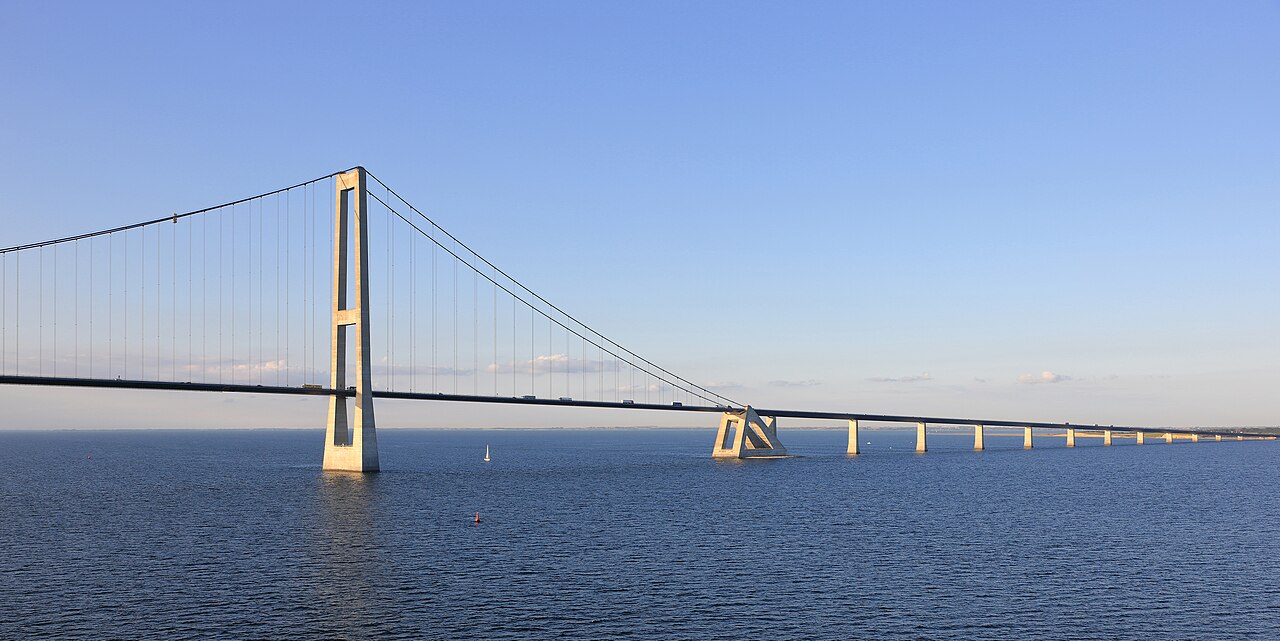
A 1,624 m main span across the eastern channel of the Great Belt in Denmark, opened in 1998: at its opening the second longest suspension span in the world.
The East Bridge carries the motorway of the Great Belt Fixed Link from Halsskov on Zealand to the island of Sprogø. With the East Tunnel for the railway and the West Bridge it completes the fixed link across the Great Belt. It opened to road traffic on 14 June 1998, two months after the Akashi Kaikyo Bridge, and became the second longest suspension span in the world.
Its 254 m concrete pylons are the tallest structures in Denmark, and its cables were spun in just three months. The deck is one continuous steel box 2,694 m long, with no vertical support at the pylons.
Key facts
| Location | Eastern Channel of the Great Belt (Storebælt), between Halsskov (Zealand) and Sprogø |
|---|---|
| Type | Three-span suspension bridge with a continuous closed steel box girder; earth-anchored, with anchor blocks in the sea |
| Spans | 535 + 1,624 + 535 m |
| Main span | 1,624 m |
| Sag ratio | 1/9 |
| Towers | Reinforced concrete portal pylons, 254 m, with two cross beams, on caissons founded on stone beds |
| Deck | Closed steel box girder, 31.0 m wide and 4.0 m deep, continuous over 2,694 m with no vertical support at the pylons |
| Main cable | 2 cables 27.0 m apart, each 37 strands × 504 wires = 18,648 galvanised wires of 5.38 mm; 827 mm in diameter |
| Cable erection | Aerial spinning (controlled-tension method) |
| Hangers | Vertical, at 24 m centres; 56 m between the hangers on either side of each pylon |
| Navigation clearance | 65 m |
| Built | Main contracts from October 1991; opened 14 June 1998 |
| Owner | A/S Storebælt (Sund & Bælt) |
| Design | COWI and Rambøll joint venture; architects Dissing+Weitling |
| Construction | Great Belt Contractors (substructure; a Danish, German and Dutch consortium); Coinfra (steel superstructure including the main cables) |
| Cost | Main contracts DKK 2.5 billion (substructure) and DKK 2.9 billion (superstructure), 1990 prices |
Design
The span was set by ships. Collision simulations begun in 1989 showed that the main span had to be at least 1,600 m, and the pylons were designed for impact from 250,000 DWT tankers. The 65 m clearance led Finland to bring a case against Denmark at the International Court of Justice in 1991, settled in 1992 with a payment of DKK 90 million.
The deck is a closed steel box 31 m wide and 4 m deep, continuous from one anchor block to the other. It has no vertical bearings at the pylons, and the nearest hangers on either side of each pylon are 56 m apart. Hydraulic buffers at the anchor blocks limit the deck's longitudinal movement to 1.0 m. The cable sag ratio is 1/9.
How it was built
Contracts
Great Belt Contractors won the concrete substructure in October 1991 for DKK 2.5 billion at 1990 prices, and the Italian contractor Coinfra the steel superstructure, including the main cables, for DKK 2.9 billion.
Pylons and piers
The pylon caissons were cast in Kalundborg and shipped 70 km to site; each weighs 32,000 t and rests on a stone bed. The rest of each pylon was cast in place in 4 m lifts with climbing formwork, up to 254 m. The lower cross beam, 12 m high, was precast as reinforced boxes, set between the legs at their base and jacked up in 30 cm steps to about 130 m above sea level, with only 30 mm clearance to the legs, then filled with pumped concrete. The approach piers were precast in Kalundborg in three parts, four or five elements at a time, and towed to site on a barge in about five hours.
Anchor blocks
The two anchor blocks stand in the sea. Each is about 63 m high and weighs 325,000 t including its ballast of sand and iron ore. At the base of the block each main cable splits into its 37 strands.
Cables
The cables were aerially spun by a further development of the controlled-tension method, with spinning and erection equipment developed under William Brown. About 20,000 t of galvanised wire was spun in three months by two alternating shifts of 25 men, which the designer of the equipment describes as a record by a wide margin. Each cable has 37 strands of 504 wires of 5.38 mm and is 827 mm in diameter.
Deck
Deck panels were made in Livorno, Italy, and the 48 m erection sections were trial assembled at yards in Taranto and in Sines, Portugal. The suspended deck went up as 57 sections, typically 48 m long, 31 m wide and about 500 t, brought two at a time by barge from Aalborg and hoisted by 200 t lifting cranes travelling on the main cables. The first and heaviest section, about 1,000 t, was placed at midspan in spring 1997 and erection proceeded outwards to the pylons.
Key dates
| 1989 | Ship collision simulations set the main span at 1,600 m or more |
| October 1991 | Main contracts awarded |
| 1992 | Settlement with Finland over the 65 m clearance |
| Spring 1997 | First deck section placed at midspan |
| 14 June 1998 | Opened to road traffic |
| 2014 to September 2015 | Main cable dehumidification installed |
What engineers remember it for
- The second longest suspension span in the world when it opened, two months after Akashi Kaikyo.
- About 20,000 t of cable wire spun in three months.
- The 254 m pylons are the tallest structures in Denmark.
- A dehumidification system for the main cables was added between 2014 and September 2015.
Construction records
The construction records below can be read in the browser or downloaded. Large scanned volumes may take a moment to open.
← All suspension bridge records
Related on TheBridgeEng
Questions engineers ask
- Why is the Great Belt East Bridge main span 1,624 m?
- Ship collision simulations showed that the main span had to be at least 1,600 m so that the pylons could stand clear of the shipping channel, and the pylons were designed for impact from 250,000 DWT tankers.
- How were the Great Belt East Bridge cables built?
- By aerial spinning with a controlled-tension method: about 20,000 t of galvanised 5.38 mm wire in 37 strands of 504 wires per cable, spun in three months.
- Is the Great Belt East Bridge deck supported at the pylons?
- No. The steel box deck is continuous over 2,694 m with no vertical support at the pylons; hydraulic buffers at the anchor blocks limit its longitudinal movement to 1.0 m.
Sources
- Sund & Bælt: Storebælt road and rail links (facts)
- Storebælt: Facts and history
- Structurae: Storebæltsbroerne / Great Belt East Bridge
- Ingeniøren (23 May 1997): Stoltheden (East Bridge deck erection, contracts)
- Ingeniøren (21 Oct 1994): Tværbjælken er næste skridt på Østbroen (pylon construction)
- Ingeniøren (22 May 1998): Hængebroer slår nye rekorder
- Ingeniøren (11 May 2016): Main cable replacement Q&A (18,648 galvanised wires)
- L. Hauge (COWI): The Danish Bridge Heritage (PDF)
- Brown Beech: Storebælt Bridge 1998 (aerial spinning)
- HOCHTIEF history: East Bridge over the Great Belt
Updated 2026-11-13 · written by a practising bridge engineer