Suspension Bridge Records · Türkiye
Fatih Sultan Mehmet Bridge: How It Was Built
The second bridge across the Bosphorus in Istanbul, opened in 1988: a 1,090 m main span between Europe and Asia, finished 192 days inside its contract period.
The Fatih Sultan Mehmet Bridge crosses the Bosphorus between Hisarüstü on the European side and Kavacık on the Asian side, about 5 km north of the first Bosphorus Bridge. It was designed by Freeman Fox & Partners, with the design led by Bill Brown, and built by a Japanese, Italian and Turkish consortium of IHI, Mitsubishi Heavy Industries, Nippon Kokan, Impregilo and STFA. By 2019 it carried about 200,000 vehicles a day.
Two choices set it apart from the first bridge. Its towers stand on land on both shores, so the 210 m side spans carry no deck and act only as backstays. And its hangers are vertical, a deliberate return to a more conventional design after the inclined hangers of the first bridge.
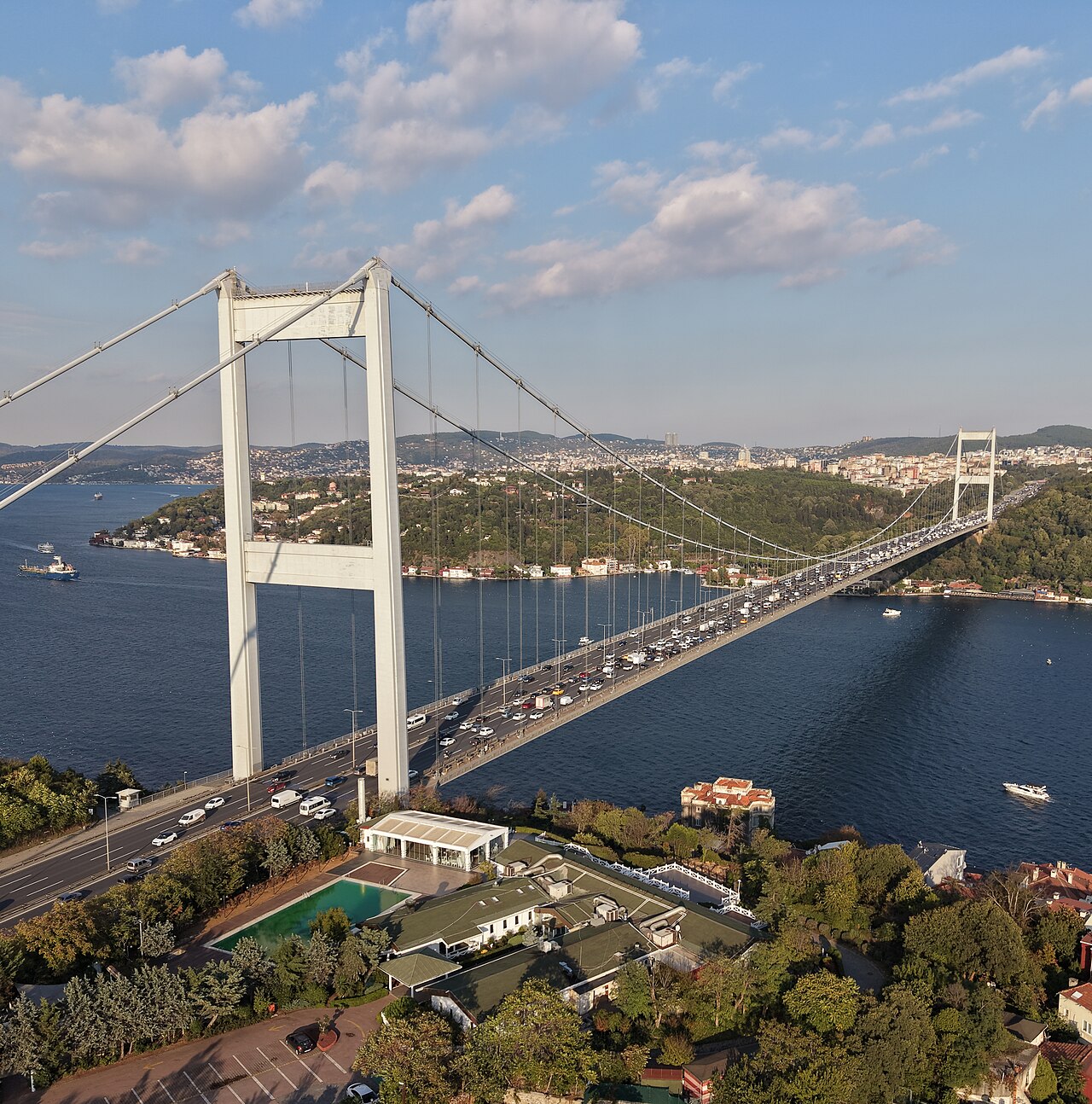
Key facts
| Location | Bosphorus strait, Istanbul, between Hisarüstü (Europe) and Kavacık (Asia), about 5 km north of the first Bosphorus Bridge |
|---|---|
| Type | Single suspended span with unsuspended backstays and a steel box girder; earth-anchored |
| Spans | 210 + 1,090 + 210 m between the anchorages; only the 1,090 m main span carries deck |
| Main span | 1,090 m |
| Towers | Steel portal towers of bolted stiffened panels, about 110 m (sources give 107.1 to 111.1 m), about 7,000 t |
| Deck | Orthotropic steel box, 33.8 m wide and 3.0 m deep; 39.4 m overall with 2.8 m walkways; four lanes each way |
| Main cable | 2 cables, each 32 strands × 504 wires of 5.38 mm (16,128 wires) in the main span, 0.77 m in diameter; 4 extra strands in the backstays (17,232 wires, 0.80 m) |
| Cable erection | Aerial spinning |
| Hangers | Twin vertical ropes of 76 mm, 60 per cable at 17.92 m, breaking load 370 t, hinged at both ends |
| Built | Work from 4 December 1985; completed 29 May 1988; opened 3 July 1988 |
| Owner | General Directorate of Highways of Türkiye (KGM) |
| Design | Freeman Fox & Partners, with the design led by Bill Brown |
| Construction | IHI, Mitsubishi Heavy Industries, Nippon Kokan, Impregilo and STFA |
| Cost | About US$144 million |
Design
The towers stand on limestone on the hillsides of both shores, so the main span reaches across the whole strait and the side spans are free backstays. Under dead load each main cable carries about 187 MN at the tower top, rising to about 232 MN with live load, according to the original record book. The design live load was about 8,000 t, the design wind a 45 m/s gust at deck level, and the seismic coefficients 0.10 g horizontally and 0.05 g vertically.
The hangers are pairs of vertical 76 mm ropes at 17.92 m, hinged at both deck and cable. The Institution of Civil Engineers records that vertical hangers were chosen as a more conventional design than the inclined hangers of the first Bosphorus Bridge.
How it was built
Foundations and anchorages
The tower footings, 14 × 18 m in plan, sit on limestone. Each anchorage is a reinforced concrete block 50 × 60 m in plan and about 35 m deep, with 110,000 m³ of concrete and 12,000 t of reinforcement. Inside it, each main cable splays into its 36 strands.
Towers
The steel towers, about 7,000 t in total, were made in Japan from high-strength stiffened panels, bolted together on site and erected in eight tiers with 450 t and 650 t cranes.
Cables
The main cables were aerially spun between 27 March and 30 July 1987. The spinning wheel carried four wires on each pass and ran at about 4 m/s, laying 51,486 km of 5.38 mm galvanised wire in all. To save time, spinning went ahead while work on the substructure was still in progress.
Deck
The deck is an orthotropic steel box 33.8 m wide and 3.0 m deep, 39.4 m wide overall with its walkways. It was erected from 62 units of 115 to 230 t, 13,600 t in total, brought to site by barge and hoisted by lifting tackle on the cables controlled from the shore. The 36 units over the water were lifted first, then the 26 units over land were brought in and moved into place. The first unit went up on 17 September 1987 and the last on 18 October 1987. The joints were welded between October 1987 and February 1988 and surfacing began in March 1988.
The bridge was finished on 29 May 1988, after 908 working days against a contract period of 1,100, and opened on 3 July 1988.
Key dates
| 29 May 1985 | Foundation ceremony |
| 4 December 1985 | Work starts |
| 27 March to 30 July 1987 | Main cables spun |
| 17 September to 18 October 1987 | All 62 deck units lifted |
| 29 May 1988 | Completed, 192 days inside the contract period |
| 3 July 1988 | Opened to traffic |
| 2008 | 44-channel vibration monitoring system installed |
| August 2021 | Replacement of all hangers begins |
Later work
In 2008 the bridge was instrumented with 44 channels of accelerometers, sampled at 100 per second with GPS time synchronisation, which have since been used to estimate the forces in its cables, hangers and towers from ambient vibration.
After damaged hangers were found during strengthening works in 2013, the highway authority KGM decided to replace all of them. The contract went to a joint venture of IHI Infrastructure and Makyol, and the replacement began in August 2021.
Construction records
The construction records below can be read in the browser or downloaded. Large scanned volumes may take a moment to open.
← All suspension bridge records
Related on TheBridgeEng
Questions engineers ask
- Why does the Fatih Sultan Mehmet Bridge have no suspended side spans?
- Its towers stand on land on the hillsides of both shores, so the 210 m side spans are used only as backstays to the anchorages. Only the 1,090 m main span carries deck.
- How long did it take to build the Fatih Sultan Mehmet Bridge?
- Work started on 4 December 1985 and finished on 29 May 1988, in 908 days against a contract period of 1,100 days. The cables were spun in about four months and the 62 deck units were lifted in about a month.
- What hangers does the Fatih Sultan Mehmet Bridge have?
- Pairs of vertical 76 mm ropes, 60 per cable at 17.92 m, unlike the inclined hangers of the first Bosphorus Bridge. All of them are being replaced, in work that began in 2021.
Sources
- KGM (General Directorate of Highways): Fatih Sultan Mehmet Köprüsü tarihçe (PDF)
- Y. Kavak, Estimation of Member Forces in FSM Suspension Bridge from Ambient Vibration Records, MSc thesis, Boğaziçi University, 2019
- S. A. Kilic et al., FE Model of the Fatih Sultan Mehmet Suspension Bridge Using Thin Shell Finite Elements, Arab J Sci Eng 42 (2017)
- Brown Beech: Bosphorus Bridge II 1988
- H. I. Alpaslan and J. Laçinyurt, Üçüncü Boğaz Köprüsü'nün Finansal Analizi, Istanbul Journal of Social Sciences 10 (2015)
- K. Kaptan, Fatih Sultan Mehmet Köprüsü Yapısal Davranışının Belirlenmesi, S.Ü. Müh. Bilim ve Tekn. Derg. 1(2), 2013
- A. Mubuli and B. Sevim, Assessment of Structural Response of FSM Bridge under Vehicle Loads, DEÜ Müh. Fak. Fen ve Müh. Derg. 18(54), 2016
- Webuild Group: Kınalı-Sakarya motorway and second bridge over the Bosphorus
- ICE: Bosphorus bridges
- Bridgemeister: Fatih Sultan Mehmet (Bosporus II)
Updated 2026-11-13 · written by a practising bridge engineer