Suspension Bridge Records · United States
Carquinez Bridge (Al Zampa): How It Was Built
A 728 m main span over the Carquinez Strait in California, opened in 2003: the first suspension bridge in the United States with an orthotropic steel box deck.
The Alfred Zampa Memorial Bridge carries westbound Interstate 80 over the Carquinez Strait between Vallejo and Crockett, beside the 1958 cantilever bridge that carries the eastbound traffic. It replaced the 1927 cantilever bridge, which was demolished by 2007, and it is named after Al Zampa, an ironworker who worked on many Bay Area bridges.
It was the first major suspension bridge built in the United States since 1973, the first new suspension bridge in the Bay Area since the Golden Gate, and the first suspension bridge in the country with an orthotropic steel box deck. The deck carries three traffic lanes, a carpool lane, two shoulders and a path for cyclists and walkers on the side facing San Pablo Bay.
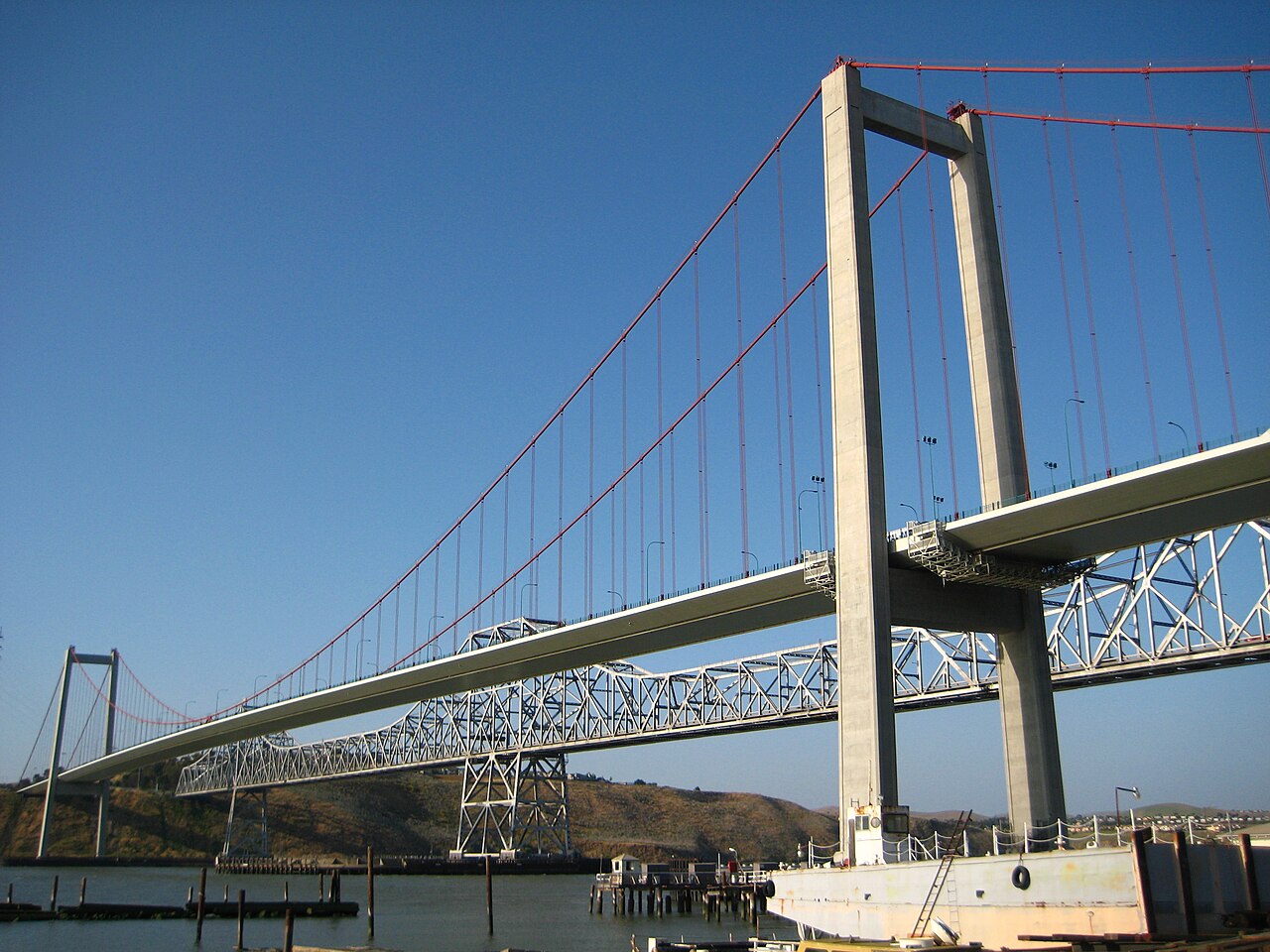
Key facts
| Location | Carquinez Strait on Interstate 80, between Crockett (Contra Costa County) and Vallejo (Solano County), California |
|---|---|
| Type | Suspension bridge with a closed orthotropic steel box girder; earth-anchored |
| Spans | 147 + 728 + 181 m |
| Main span | 728 m |
| Towers | Reinforced concrete portal frames, 128 m (north) and 123 m (south), hollow legs, jump-formed |
| Deck | Closed orthotropic steel box girder, 29 m wide and 3 m deep, continuous between the north anchorage and the south transition pier |
| Main cable | 2 cables, each 8,584 galvanised wires of 1,570 MPa minimum in 37 strands, compacted to 512 mm |
| Cable erection | Aerial spinning (controlled tension) |
| Hangers | Pairs of galvanised wire ropes with resin sockets at each panel point, 12.4 m apart |
| Built | 2000 to 2003; dedicated 8 November 2003; opened 11 November 2003 |
| Owner | California Department of Transportation (Caltrans) |
| Design | De Leuw, OPAC and Steinman joint venture, with Caltrans |
| Construction | FCI Constructors and Cleveland Bridge California joint venture; deck by IHI (Japan); erection engineering by DLT Engineering; cable spinning managed by Dorman Long Hordaland; wire by Bridon |
| Cost | About US$240 million |
Design
The design was finalised by the De Leuw, OPAC and Steinman joint venture with Caltrans, and drew on the seismic lessons of recent earthquakes in California and elsewhere. The two reinforced concrete towers have hollow legs and two post-tensioned struts designed to stay elastic in an earthquake.
The deck is a single orthotropic steel box, a relatively light, stiff and aerodynamic section in which most welded and bolted connections are enclosed and protected, with room inside for maintenance access and utilities. It is continuous over its whole length, with only two expansion joints, one at each end of the bridge. The steel deck is paved with a thin two-layer Trinidad Lake Asphalt over a waterproof membrane.
How it was built
Foundations
Each tower leg stands on six drilled shafts 3 m in diameter, 12 per tower. Steel casings were driven to bedrock, about 155 ft (47 m) on the south side and 127 ft (39 m) on the north, with rock sockets of about 141 ft and 79 ft beyond. The fractured rock on the south side was drilled in 25 ft stages, filled with lean concrete and re-cored. The pile caps were cast inside precast concrete shells, which were floated into position at high tide and lowered onto the shafts as the tide fell, while traffic stayed on the 1927 bridge alongside. The south anchorage sits on fill over soft clay and loose sand and is founded on 380 steel-cased piles 30 in. in diameter; the north anchorage bears directly on rock.
Towers
The towers rise about 410 ft above the water and were built by jump forming.
Cables
The main cables were aerially spun under controlled tension, a method chosen by the contractor. Each holds 8,584 zinc-coated wires of 228 ksi (1,570 MPa) minimum strength, splays into 37 strands at the gravity anchorages and was compacted to 20.2 in. (512 mm). Once the cable carried the whole weight of the bridge, it was coated with zinc paste, wrapped tightly with 3.5 mm galvanised wire and given three coats of paint.
Deck from Japan
The deck was fabricated by IHI in Nagoya and test fitted in Japan before shipping. It was erected in 24 units instead of the 48 specified, saving about US$1 million in site welding; typical units were 50 m long, 29 m wide and about 600 t. Three ships, each carrying eight units, made the three-week crossing of the Pacific; the first left Nagoya on 4 January 2003 and arrived on 24 January.
The large units and the nearby 1927 bridge ruled out the usual lifting gantry. Instead, four strand jacks were mounted on each deck unit and their strands were hung from the main cables by large temporary cast steel cable bands, so each unit lifted itself; a lift, including transfer to the permanent suspenders, took about four hours. About half the units were lifted straight up from the ships. In mid-strait, piers of the existing bridges blocked the water below, so units were raised as close as possible and swung into place with extra strand jacks and cable bands, one by more than 50 m. On the Vallejo side the water was too shallow, so units were lowered onto barges, taken between the bluffs and the north tower, raised and moved into position on walking hydraulic jacks; on the Crockett side a temporary trestle blocked access, so units were swung through the tower legs with inches to spare and landed on the trestle. The deck erection alone cost about US$17.2 million. The units were then bolted and welded into one continuous girder.
Key dates
| 2000 | Construction begins |
| 4 January 2003 | First ship with eight deck units leaves Nagoya |
| 24 January 2003 | First deck units arrive in the Bay Area |
| 8 November 2003 | Bridge dedicated |
| 11 November 2003 | Opened to traffic |
| 4 September 2007 | Demolition of the 1927 bridge complete |
What engineers remember it for
- The first suspension bridge in the United States with an orthotropic steel box deck.
- Deck units lifted by strand jacks mounted on the units themselves, hung from temporary cable bands, instead of a gantry.
- The first major US suspension bridge since 1973.
Construction records
The construction records below can be read in the browser or downloaded. Large scanned volumes may take a moment to open.
← All suspension bridge records
Related on TheBridgeEng
Questions engineers ask
- How was the Carquinez Bridge deck erected?
- In 24 steel box units of about 600 t, shipped from Japan. Four strand jacks on each unit, hung from the main cables by temporary cable bands, lifted it into place in about four hours; units that ships could not reach were swung or skidded into position.
- How were the Carquinez Bridge cables built?
- By aerial spinning under controlled tension: 8,584 wires of 1,570 MPa per cable in 37 strands, compacted to 512 mm and wrapped with galvanised wire over zinc paste.
Sources
- Caltrans: The Alfred Zampa Memorial Bridge
- Caltrans District 4: Carquinez Bridge
- MTC: Carquinez Bridge
- Mark Ketchum's Carquinez Strait Bridge page
- OPAC Consulting Engineers: Third Carquinez Strait Bridge
- Parsons: The New Carquinez Bridge (Alfred Zampa Memorial Bridge)
- Mathur, Orsolini, Ketchum and Spoth, Making Earthquakes Tremble, Roads & Bridges, May 2002
- ENR, Team Sets Deck For First U.S. Suspension Bridge In 30 Years, 12 May 2003
- ENR article copy (FIU ABC database PDF)
- FIU ABC project database: 2003 Carquinez Strait Bridge (Al Zampa Bridge)
Updated 2026-11-13 · written by a practising bridge engineer