Suspension Bridge Records · Japan
Kita and Minami Bisan-Seto Bridges: How They Were Built
Two road and rail suspension bridges in tandem on the Seto-Ohashi route, sharing one anchorage in the middle; the Minami bridge spans 1,100 m. Opened in 1988.
The Kita (North) and Minami (South) Bisan-Seto Bridges form the southern end of the Seto-Ohashi route between Honshu and Shikoku. They stand end to end and share a central anchorage on the island of Mitsugo-jima. The Kita bridge has spans of 274 + 990 + 274 m and the Minami bridge 274 + 1,100 + 274 m; both carry the expressway on the upper deck and the railway on the lower deck.
When the route opened in 1988, the Minami bridge had the longest span of any road and rail bridge in the world. In 2015 Guinness certified the Seto-Ohashi as the largest road and rail combined bridge in the world. The route was planned for four tracks, the conventional line and the Shinkansen; today only conventional trains cross.
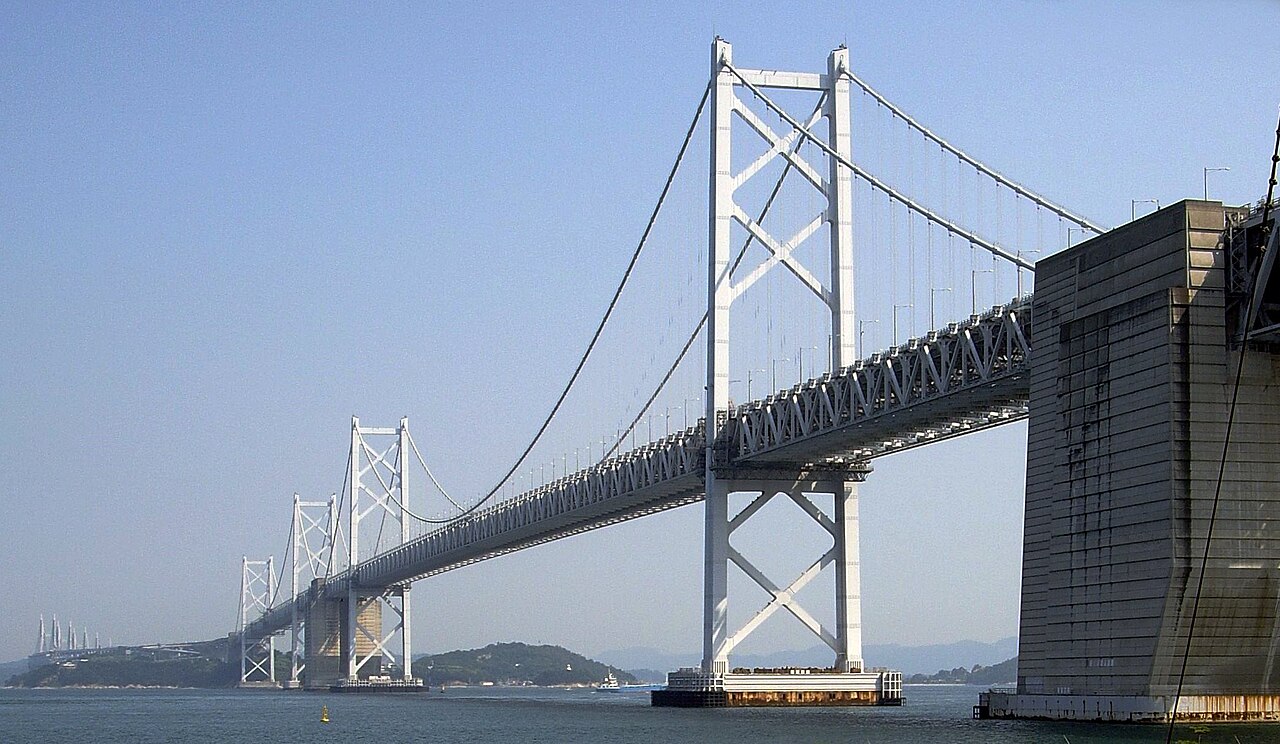
Key facts
| Location | Bisan-Seto Strait, Seto Inland Sea, Sakaide, Kagawa: Kita between Yoshima and Mitsugo-jima, Minami between Mitsugo-jima and Bannosu (Sakaide); part of the Seto-Ohashi bridges (Kojima-Sakaide route) |
|---|---|
| Type | Two three-span suspension bridges in tandem with double-deck steel stiffening trusses; earth-anchored, with a shared central anchorage |
| Spans | Kita 274 + 990 + 274 m; Minami 274 + 1,100 + 274 m |
| Main span | 1,100 m |
| Sag ratio | Kita: sag 90.0 m (about 1/11) |
| Towers | Steel; Minami towers 194 m |
| Deck | Double-deck steel stiffening truss, continuous over three spans: expressway above, railway below |
| Main cable | Minami: 271 strands × 127 wires of 5.23 mm per cable, 1,070 mm in diameter (the largest in the world at the time), about 20,000 t of cable |
| Cable erection | Prefabricated parallel wire strands (PPWS) |
| Navigation clearance | 65 m |
| Built | Route ground-breaking 10 October 1978; opened 10 April 1988 |
| Owner | Honshu-Shikoku Bridge Authority (now Honshu-Shikoku Bridge Expressway) |
| Design | Honshu-Shikoku Bridge Authority |
| Construction | Minami superstructure: Ishikawajima-Harima Heavy Industries, Kawasaki Heavy Industries, Mitsubishi Heavy Industries and Yokogawa Bridge |
| Cost | Over ¥1 trillion for the whole Seto-Ohashi route |
Design
Putting two suspension bridges end to end with a shared anchorage halved the number of anchorages needed in the middle of the strait. The central 4A anchorage on Mitsugo-jima holds about 80,000 t of cable pull from the Kita bridge and 90,000 t from the Minami bridge at the same time, in opposite directions. The Minami bridge's southern 7A anchorage resists 90,000 t of cable pull and weighs about 1 million t.
Each Minami main cable is 1,070 mm in diameter, the largest in the world when built. The route was designed for a life of more than 100 years, and its maintenance now aims at more than 200 years.
How it was built
The first laying-down caissons
The Minami 7A anchorage and the 5P and 6P tower piers stand in 32 to 50 m of water and were the first foundations in the world built by the laying-down caisson method. Steel caissons fabricated in a shipyard were towed to site, sunk onto the prepared seabed and filled with concrete. The foundations rest on bedrock 10 to 50 m below sea level; the seabed was blasted and then excavated with grabs of 13 m³ (125 t bucket) in hard rock and 25 m³ (60 t bucket) in sediment, and divers worked at 50 m depth from a bell lowered from the support vessel Seatopia.
After placement, the caissons were filled with coarse aggregate and grouted with mortar supplied continuously from the mortar plant ship Seiki. The 7A caisson was placed within a four-day weather window to a tolerance of plus or minus 50 cm.
Towers
The 194 m steel towers of the Minami bridge were erected with a special 130 t crane and finished within 19 mm of plumb against an allowance of 3 cm. The contact faces of the tower blocks were machined at night, when temperatures were stable, and checked with a 0.04 mm feeler gauge.
Cables
The cables were built from prefabricated parallel wire strands of 127 wires; the Minami cables have 271 strands each. Strands were pulled out during the day and their tension adjusted at night, when the temperature was stable, with the night lighting designed not to dazzle passing ships.
Stiffening truss
Factory-assembled truss blocks were lifted about 90 m above the sea by a large floating crane and erected outwards from the towers, with as many as 3,000 bolts securing a single block. Buffer girders were developed and fitted at the girder ends to ease the stretching, contraction and bending of the deck that could otherwise endanger trains.
Key dates
| 10 October 1978 | Ground-breaking for the Seto-Ohashi route at Bannosu, Sakaide |
| 10 April 1988 | Road and railway open together |
| 2015 | Guinness certifies the Seto-Ohashi as the largest road and rail combined bridge in the world |
What engineers remember it for
- The first laying-down caissons in the world, the method later used on the Akashi Kaikyo and Kurushima Kaikyo bridges.
- The Minami bridge had the longest span of any road and rail bridge in the world when it opened.
- A shared central anchorage serves two suspension bridges at once.
Construction records
The construction records below can be read in the browser or downloaded. Large scanned volumes may take a moment to open.
← All suspension bridge records
Related on TheBridgeEng
Questions engineers ask
- What is the laying-down caisson method?
- A steel caisson is fabricated in a shipyard, towed to site, sunk onto seabed that has been excavated to rock, and filled with aggregate and grout or concrete. It was first used for the Minami Bisan-Seto Bridge foundations in 32 to 50 m of water.
- Why do the Bisan-Seto bridges share an anchorage?
- The two bridges are in tandem, so their cables pull in opposite directions on the central anchorage on Mitsugo-jima, about 80,000 t from the Kita bridge and 90,000 t from the Minami bridge, saving an anchorage in the strait.
Sources
- Seto Ohashi Commemorative Hall, Model Descriptions (Kagawa Prefecture)
- Japan Atlas: Architecture, Seto-Ohashi Bridges (Web Japan)
- Structurae: Minami Bisan-Seto Bridge
- Structurae: Kita Bisan-Seto Bridge
- Bridgemeister: Minami Bisan-Seto
- Bridgemeister: Kita Bisan-Seto
- Tokyo Rope: bridge cable catalogue (reference list)
- Yoshida I., technical significance of the Seto Ohashi (ORSJ Bulletin Vol. 32, 1987)
- Matsuzaki, Uchikawa, Mitamura: Advanced Fabrication and Erection Techniques for Long Suspension Bridge Cables (ASCE JCEM 1990)
- JSCE bridge photo sheet: Seto Ohashi
Updated 2026-11-13 · written by a practising bridge engineer