Suspension Bridge Records · Norway
Askøy Bridge: How It Was Built
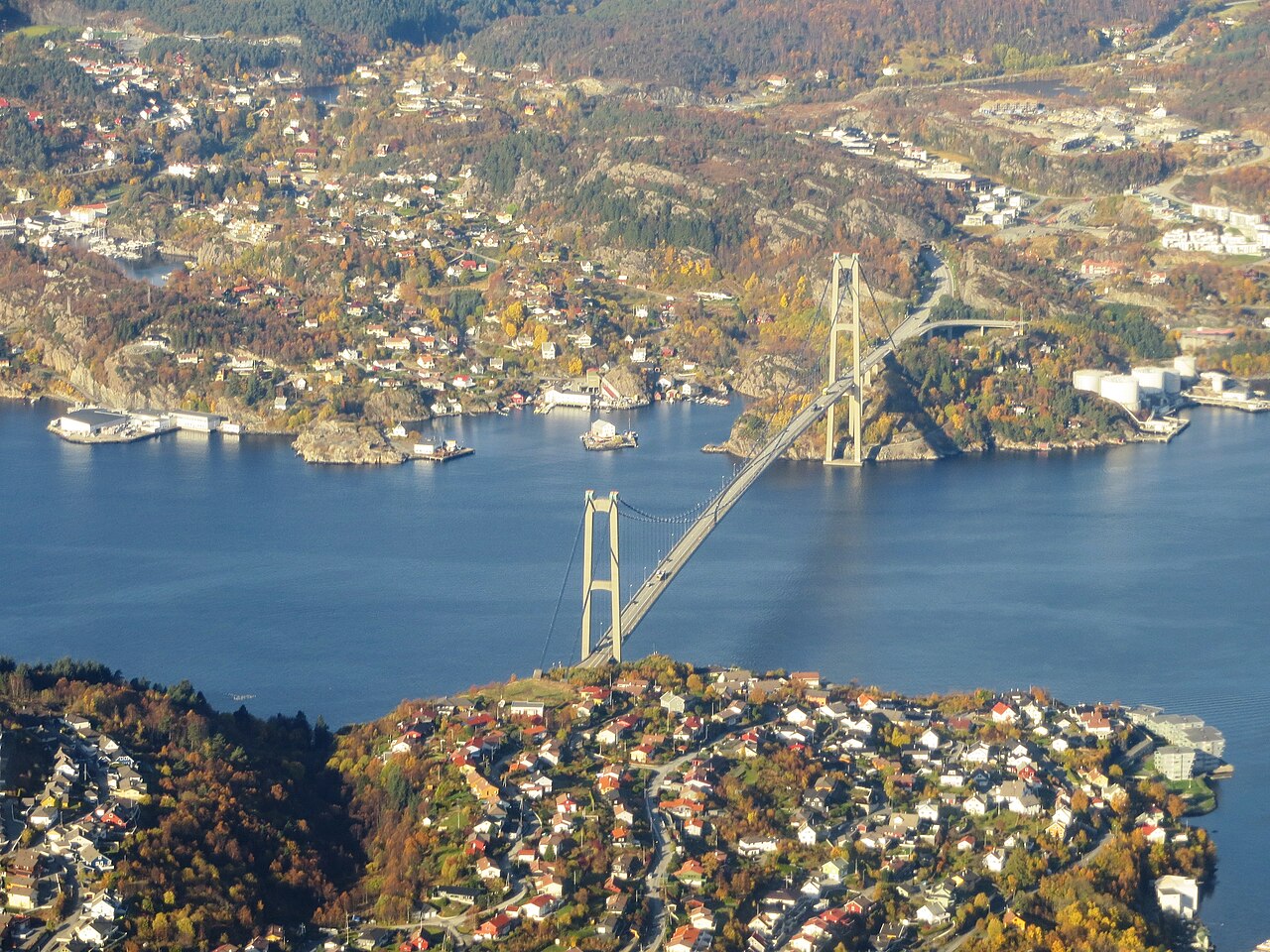
An 850 m single-span suspension bridge over the Byfjorden near Bergen, opened in 1992, whose main cables are prefabricated locked coil strands instead of spun wire.
The Askøy Bridge links the Bergen mainland at Brøstadneset with the island of Askøy at Storeklubben. When it opened on 12 December 1992 it was the longest suspension bridge in Scandinavia, and it kept the record for Norway's longest span until the Hardanger Bridge opened in 2013. It was financed by tolls through the company Askøybrua AS, and the tolls ended in November 2006.
Its most unusual feature is the main cable. Instead of being spun from thousands of single wires, each cable is an open bundle of 21 locked coil strands, each made in the factory to its full length of about 1,250 m.
Key facts
| Location | Byfjorden near Bergen, between Brøstadneset (Bergen, mainland) and Storeklubben (Askøy island), Vestland |
|---|---|
| Type | Single-span suspension bridge with a closed steel box girder; earth-anchored in rock |
| Spans | Main span 850 m; concrete approach viaducts of 173.0 m and 33.7 m with free backstays; 1,056.7 m in all |
| Main span | 850 m |
| Sag ratio | 1/10 |
| Towers | Reinforced concrete portal towers, 152 m, legs slipformed |
| Deck | Closed aerodynamic steel box girder, 15.5 m wide and 3.0 m deep, about 6.9 t/m including surfacing |
| Main cable | 2 cables, each an open bundle of 21 fully galvanised locked coil strands (7 wide × 3 layers); strand 99 mm, wire 1,570 MPa; each strand about 1,250 m long and 71 t |
| Cable erection | Prefabricated locked coil strands, pulled across one by one |
| Hangers | Vertical, at 12 m centres, in the main span only |
| Navigation clearance | 62 m |
| Built | Work from 1989; opened 12 December 1992 |
| Owner | Norwegian Public Roads Administration; financed by the toll company Askøybrua AS |
| Design | Bridge Department of the Norwegian Directorate of Public Roads; Aas-Jakobsen (box girder, hangers and clamps); architect Selberg Arkitektkontor |
| Construction | Monberg & Thorsen and KB Spennteknikk; strands by Thyssen; hangers by Bridon; deck boxes by Kværner Eureka |
| Cost | About NOK 400 million |
Design
The bridge spans the Byfjorden in one 850 m span between towers on the two shores, leaving 62 m of clearance for shipping. The backstays run free over concrete approach viaducts to anchorages in the rock, so only the main span carries hangers.
Locked coil strands, made to full length in the factory, replaced cable spinning. A locked coil strand has an outer layer of interlocking Z-shaped wires that seals the inside, and pulling 42 finished strands across the fjord needed far less site work than spinning thousands of wires. The design group was led by the Bridge Department of the Norwegian Directorate of Public Roads, with Aas-Jakobsen designing the steel box girder, the hangers and the hanger clamps.
How it was built
Towers
The two legs of each concrete tower were slipformed at the same time, in three stages, between December 1989 and May 1991, to a top level of +149.5 m; with the cable saddles the towers are 152 m high.
Anchorages
The cables are anchored in rock. Steel bars are coupled to prestressed tendons placed in predrilled holes 25 m long and 165 mm in diameter, inside PEH tubes grouted with cement mortar. The splay chambers are dehumidified.
Cables
Catwalks made of smaller ropes were installed first. The locked coil strands, made by Thyssen, were then pulled one by one off their steel drums by a winch at the southern rock anchorage. Catwalk and cable installation together took about six months.
Deck
The box girder, 15.5 m wide and 3.0 m deep, was made at two former shipyards 30 km apart, in Moss and Fredrikstad. Units 12 m long were welded into segments normally 36 m long, which were shipped to Bergen in two transports on barges, stacked three high, each voyage taking about 65 hours. A six-stage erection technique was developed for the girder, and lifting and temporarily connecting all the segments took only 11 days, one of them lost to weather. The last deck section was lifted on 4 April 1992, and because the work was ahead of schedule the opening was brought forward from May 1993 to December 1992.
Key dates
| December 1989 | Tower slipforming begins |
| May 1991 | Towers complete |
| 1 July 1991 | Cable work between the towers begins |
| 4 April 1992 | Last deck section lifted |
| 12 December 1992 | Opened, five months earlier than planned |
| November 2006 | Tolls end |
What engineers remember it for
- Main cables of prefabricated locked coil strands, rare on a span of this length.
- The whole steel deck was lifted and temporarily connected in 11 days.
- The longest suspension bridge in Scandinavia when it opened, and Norway's longest span until 2013.
- In 2024 it was reported that 140 upper hanger fittings would have to be replaced.
Construction records
The construction records below can be read in the browser or downloaded. Large scanned volumes may take a moment to open.
← All suspension bridge records
Related on TheBridgeEng
Questions engineers ask
- What are the main cables of the Askøy Bridge made of?
- Each cable is an open bundle of 21 fully galvanised locked coil strands of 99 mm, arranged 7 wide and 3 deep. Each strand was made in the factory to its full length of about 1,250 m and pulled across one at a time.
- How long did it take to erect the Askøy Bridge deck?
- Lifting and temporarily connecting all the steel box segments took 11 days, including one day lost to weather.
Sources
- Wikipedia: Askøy Bridge
- B. K. Kaptan, Strait Crossings, MSc thesis, Bogazici University, 1994 (ch. 12, Case study: Askøy Suspension Bridge)
- Aas-Jakobsen: Askøy Bridge reference sheet (archived PDF)
- Norsk vegmuseum / DigitaltMuseum: Brudel (Thyssen locked coil cable sample)
- Norsk vegmuseum / DigitaltMuseum: Askøybrua aerial photo record
- Teknisk Ukeblad (22 Mar 2024): Skader gjør at 140 stangfester på Askøybrua må byttes ut
- Brown Beech: Askøy Bridge 1992
- Norconsult: Askøy bridge (barrier retrofit and bearings, 2014 to 2017)
- bridgeinfo.net: Askøy Bridge
- Structurae: Erection of the steel structure for the Askøy suspension bridge (IABSE-FIP Deauville 1994)
Updated 2026-11-13 · written by a practising bridge engineer