Suspension Bridge Records · Japan
Akashi Kaikyo Bridge: How It Was Built
Three spans of 960 + 1,991 + 960 m across the Akashi Strait, opened in 1998: for 24 years the longest suspension span in the world.
The Akashi Kaikyo Bridge links Kobe on Honshu with Awaji Island across the Akashi Strait, about 4 km wide and up to about 110 m deep, with tidal currents of up to 4.5 m/s and more than 1,400 ships passing each day. Its 1,991 m main span, about twice the previous Japanese record, held the world record from 1998 until 2022.
Almost every part of it pushed a limit of its time: the depth of the tower foundations, the height of the steel towers, the strength of the cable wire, and an earthquake whose fault ran between the towers while the bridge was being built. It carries the Kobe-Awaji-Naruto Expressway and had carried 150 million vehicles by September 2013.
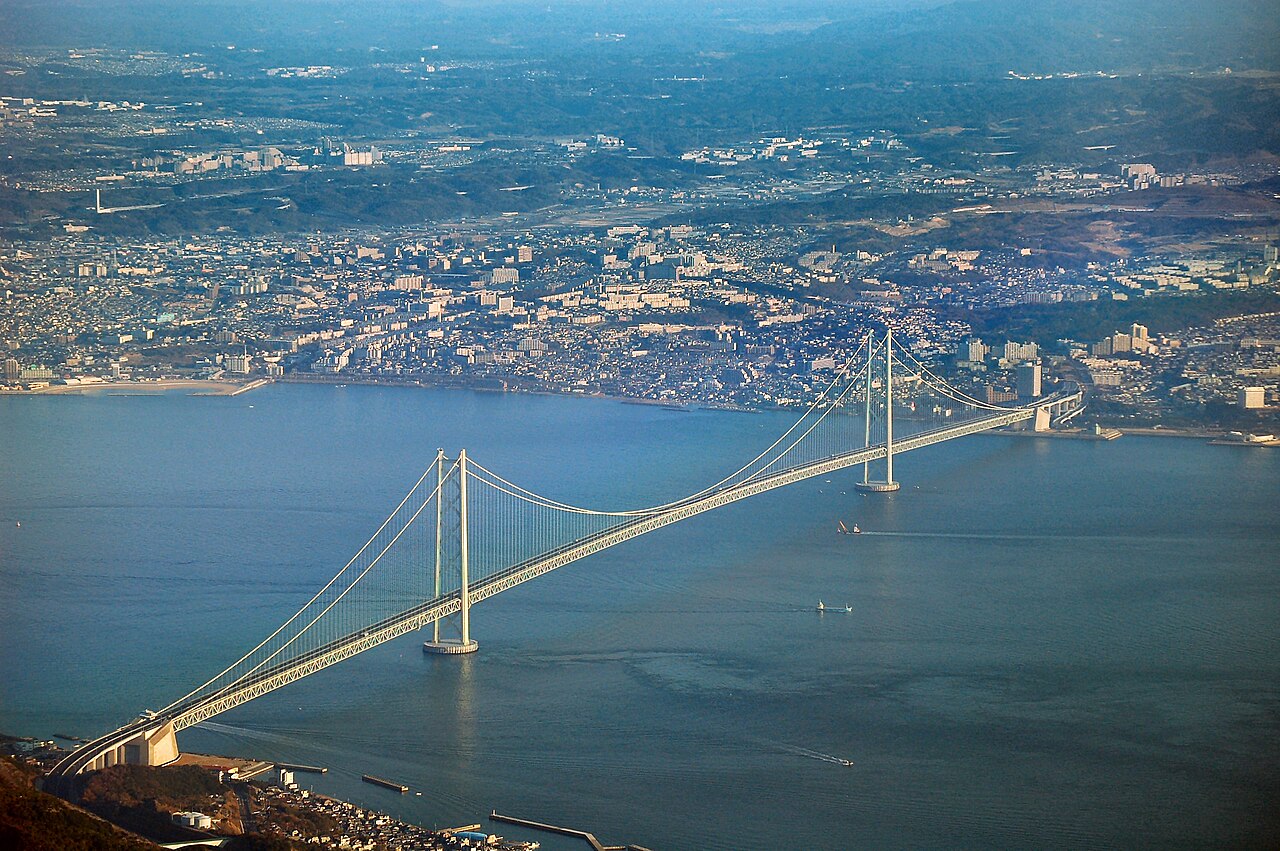
Key facts
| Location | Akashi Strait, between Maiko, Tarumi-ku, Kobe (Honshu) and Matsuho, Awaji City (Awaji Island) |
|---|---|
| Type | Three-span, two-hinged suspension bridge with a steel stiffening truss; earth-anchored |
| Spans | 960 + 1,991 + 960 m (3,911 m, all three spans suspended) |
| Main span | 1,991 m |
| Sag ratio | 1/10 |
| Towers | Steel, 282.8 m above sea level (297.3 m including the saddle), about 30 segments each |
| Deck | Steel stiffening truss, 35.5 m wide and 14 m deep, about 90,000 t |
| Main cable | One cable per side of 290 strands × 127 wires of 5.23 mm, 1,760 N/mm² (180 kgf/mm²); 1,122 mm in diameter; about 50,500 t of cable |
| Cable erection | Prefabricated parallel wire strands (PPWS), each strand about 4,085 m long |
| Hangers | Parallel wire strands of 7 mm wire, two hanger ropes per truss panel point |
| Navigation clearance | 65 m |
| Built | On-site work from May 1988; truss closed September 1996; opened 5 April 1998 |
| Owner | Honshu-Shikoku Bridge Authority (now Honshu-Shikoku Bridge Expressway) |
| Design | Honshu-Shikoku Bridge Authority |
| Construction | More than 100 contractors, including Kawada Industries, Kawasaki Heavy Industries, Taisei, Obayashi (Kobe-side anchorage joint venture) and Solétanche Bachy (anchorage foundations) |
| Cost | About ¥500 billion |
Design
The bridge was designed for winds of up to 80 m/s at deck level; the strongest wind recorded at the site had been 49.4 m/s, in 1965. Its aerodynamics were checked on a 1/100 scale full-bridge model in a large wind tunnel, and vertical plates added along the bottom centre of the truss raised its flutter speed. It was designed for earthquakes of magnitude 8.5.
The cables set the scale of everything else. With the 160 kgf/mm² wire then in use, two cables of about 1,000 mm on each side would have been needed. A new 180 kgf/mm² (1,760 N/mm²) wire, about 200 MPa stronger than the wire of the Seto-Ohashi bridges, allowed a single cable of about 1.1 m on each side. All three spans are suspended, so the whole 3,911 m is one suspension structure.
How it was built
Foundations
The two tower piers were built by the laying-down caisson method. Steel caissons 80 m in diameter and 70 m high were fabricated in a shipyard, towed to site and sunk onto seabed that had been excavated about 60 m below the water surface, then filled with concrete.
Anchorages
Each anchorage weighs about 350,000 t. The Kobe-side 1A anchorage was built inside an excavated circular shaft 85 m in diameter and 63.5 m deep; the anchorage body is 63 m wide, 84.5 m long and 47.5 m high and took 140,000 m³ of concrete.
Towers
Each steel tower was stacked from about 30 prefabricated segments roughly 10 m high, lifted by a self-climbing tower crane rated at 145 t and aligned by laser. Pendulum-type tuned mass dampers held down wind-induced motion while the towers stood free.
Pilot rope and cables
The first pilot rope was carried over the tower tops by helicopter, the first time this was done, so that the shipping lane stayed open. Catwalks were then hung from the ropes, and the main cables were built from factory-made strands of 127 wires, each about 4,085 m long, pulled from one anchorage over both tower saddles to the other: 290 strands per cable, about 300,000 km of wire in all.
The earthquake
The Hyogo-ken Nanbu (Kobe) earthquake struck on 17 January 1995, during construction. Movement on the Nojima fault, which runs between the towers, shifted the Awaji tower by 1.3 m and the Awaji anchorage by 1.4 m. The centre span grew by about 0.8 m and the southern side span by about 0.3 m. The two central truss panels were redesigned 0.4 m longer to absorb the change.
Stiffening truss
Truss members were fabricated off site, barged to the tower piers, lifted to deck level and carried out along the deck by travelling cranes, so the busy strait never had to close for deck erection. The truss was closed in September 1996.
Key dates
| 26 April 1986 | Ground-breaking ceremony |
| 1 May 1988 | On-site construction begins |
| 17 January 1995 | Hyogo-ken Nanbu earthquake; the Awaji tower moves 1.3 m |
| September 1996 | Stiffening truss closed |
| 5 April 1998 | Opened to traffic |
| 2008 and 2018 | Main cables opened for inspection: no water, sound wire |
What engineers remember it for
- Dry air has been blown into the main cables since construction. Cable openings in 2008 and 2018 found no water and sound wire, and the system has since been used on many other suspension bridges.
- The 1,760 N/mm² wire developed for it halved the number of main cables needed.
- Its pilot rope was the first to be laid by helicopter.
Construction records
The construction records below can be read in the browser or downloaded. Large scanned volumes may take a moment to open.
← All suspension bridge records
Related on TheBridgeEng
Questions engineers ask
- How were the Akashi Kaikyo Bridge cables built?
- From 290 prefabricated parallel wire strands per cable, each of 127 wires and about 4,085 m long, pulled from one anchorage to the other over both towers after the pilot rope had been laid by helicopter.
- What did the 1995 Kobe earthquake do to the Akashi Kaikyo Bridge?
- Fault movement between the towers shifted the Awaji tower by 1.3 m and its anchorage by 1.4 m during construction. The centre span grew by about 0.8 m, and the deck truss was redesigned to suit.
- How deep are the Akashi Kaikyo Bridge foundations?
- The tower caissons, 80 m in diameter and 70 m high, sit on seabed excavated about 60 m below the water surface.
Sources
- HSBE: Akashi-Kaikyo Bridge (English introduction)
- HSBE: 明石海峡大橋 (Japanese introduction)
- HSBE: Development of Materials
- HSBE: 施工技術 (construction technology)
- FHWA Public Roads, Jul/Aug 1998: World's longest suspension bridge opens in Japan (J. D. Cooper)
- Obayashi Corporation chronicle: Akashi Kaikyo Bridge 1A anchorage
- Nippon Steel quarterly 2014: high-strength bridge cable wire
- Nippon Steel Technical Report No. 116: bridge wire
- Nippon Steel quarterly 2014: Honshu-Shikoku bridges
- JSCE Tanaka Award candidate: suspension bridge cable dry-air injection system (2019)
Updated 2026-11-13 · written by a practising bridge engineer